The landscape of online retail is undergoing a profound transformation with the emergence of agentic ecommerce—a shift from static web browsing and rigid automation to autonomous AI agents capable of executing multi-step tasks independently. Unlike traditional artificial intelligence tools that simply provide single answers or execute pre-programmed rules, agentic ecommerce systems dynamically evaluate current store data, make complex decisions, and utilize authorized tools to manage everything from product discovery to backend inventory operations.
As retail platforms increasingly adopt technologies like the Universal Commerce Protocol and OpenAI and Stripe’s Agentic Commerce Protocol, industry analysts note that this capability represents a fundamental leap beyond conventional automation. Where older systems relied on rigid, linear workflows—such as sending an automated email twenty-four hours after a cart abandonment—modern AI agents operate with broader goals. Given an objective like recovering lost sales, an agent can autonomously verify stock levels, analyze cart values, and determine whether to draft a personalized discount or reach out to the customer, adapting on the fly when conditions change.

How Agentic Ecommerce Differs from Traditional AI and Automation
To understand the significance of agentic workflows, industry observers point to the limitations of earlier ecommerce technology. Traditional AI tools in the digital marketplace typically perform isolated functions. A fraud-detection algorithm evaluates the risk profile of a single payment transaction, while a recommendation engine suggests related items based on historical shopper data. While undeniably useful, neither capability possesses the autonomy to plan, reason, and execute across an entire commerce lifecycle.
An ecommerce agent, by contrast, integrates these disparate functions into a cohesive workflow. For instance, if a payment is flagged by a fraud system, an agent can utilize that specific output to pause fulfillment and route the order for manual review, rather than blindly continuing down a fixed operational pipeline.
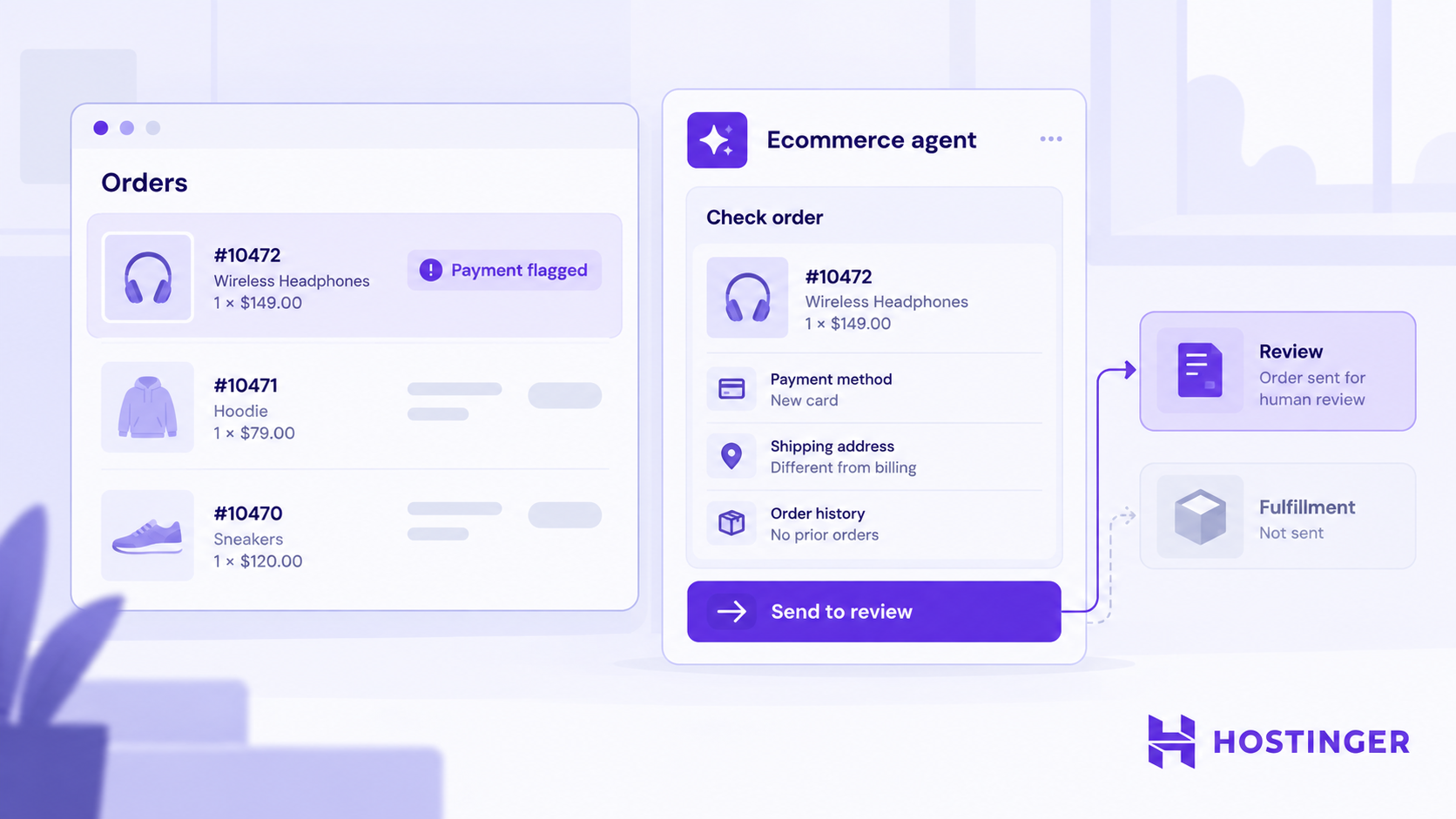
This operational flexibility highlights the stark contrast between traditional automation and agentic systems. Traditional scripts execute predefined triggers with zero deviation. If a specific parameter is met, a predetermined action follows. Agentic ecommerce introduces situational awareness, allowing the software to reassess changing data environments in real time and select from a permitted suite of actions to achieve its overarching objective.
Buyer-Side Versus Merchant-Side Applications
The deployment of agentic ecommerce generally splits into two distinct categories based on who assigns the task and what access permissions are granted: buyer-side agents and merchant-side agents.
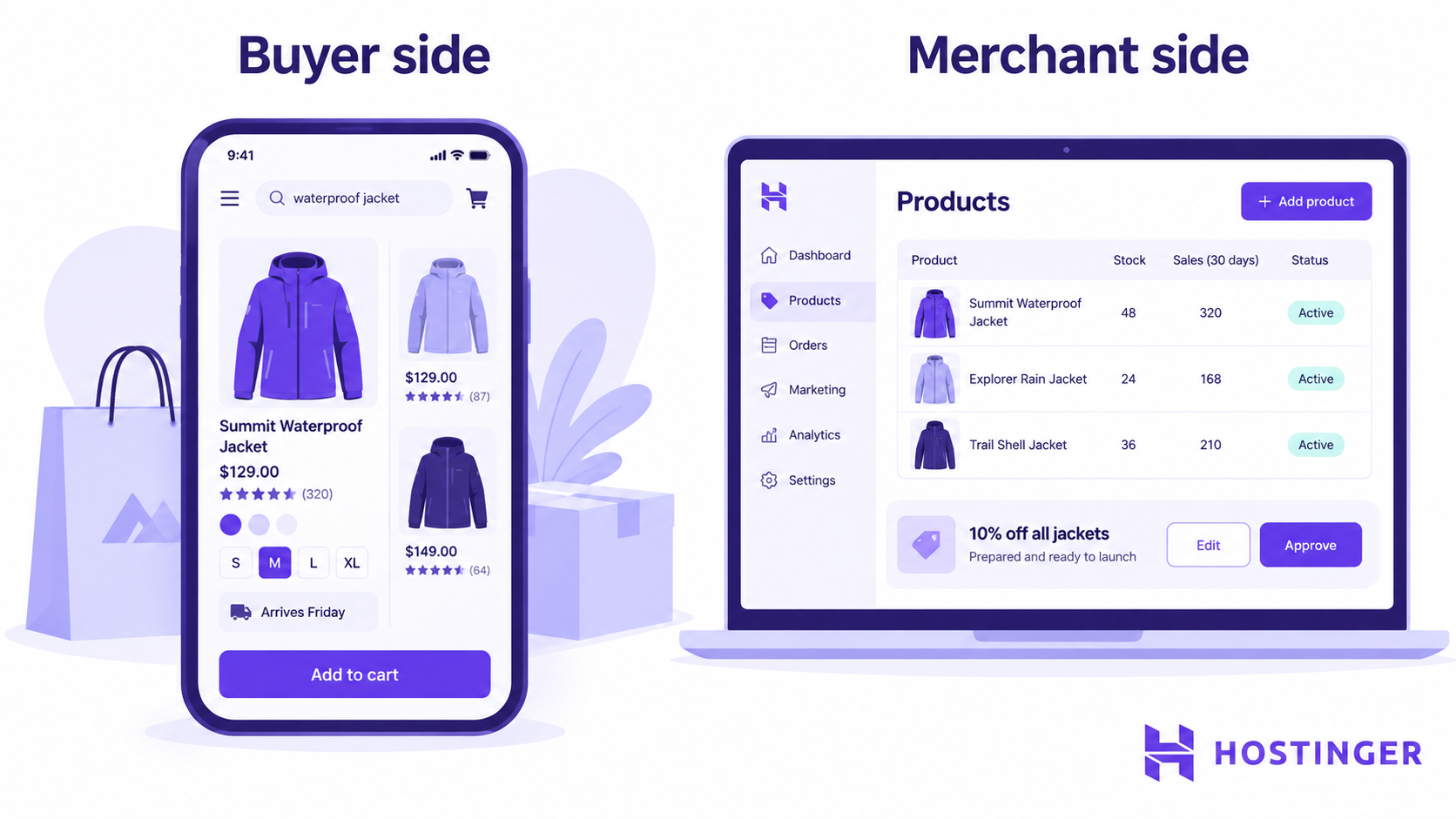
Buyer-side agents act on behalf of consumers, helping them navigate the overwhelming abundance of the modern digital marketplace. A shopper might task an assistant with finding a specific item, such as a waterproof jacket under a certain price point that arrives by a specific deadline. The agent searches available catalogs, filters for size and material specifications, compares pricing structures, and curates a shortlist. Where integrated with supported retail platforms and authorized by the user, these agents can even assemble carts and execute secure checkouts within strict financial and operational boundaries.
On the flip side, merchant-side agents assist business owners and operations teams with administrative and managerial duties directly inside the ecommerce dashboard. A merchant might instruct an agent to comb through the product catalog, identify slow-moving inventory with high profit margins, and draft targeted promotional campaigns for those specific items. The degree of autonomy remains tightly controlled; merchants retain the power to dictate whether an agent has direct publishing privileges or simply prepares drafts for human review.

Infrastructure Requirements and Emerging Protocols
Powering these autonomous workflows requires a robust underlying infrastructure. Experts emphasize that agentic ecommerce cannot function effectively without clean, structured product data. When details like color, size, material, and dimensions are explicitly categorized rather than buried in unstructured product descriptions, AI agents can accurately parse and compare items. Furthermore, real-time synchronization of pricing, inventory levels, and store policies is essential to prevent scenarios where an agent recommends unavailable products or calculates inaccurate checkout totals.
To facilitate seamless communication between disparate AI platforms and merchant stores, industry standards are beginning to take shape. Application programming interfaces provide the software connections necessary for agents to query store data and request permitted actions. Meanwhile, standardized commerce protocols—such as the Universal Commerce Protocol and the Agentic Commerce Protocol—aim to establish shared rules for these interactions, reducing the friction of custom integrations across multiple retail ecosystems.
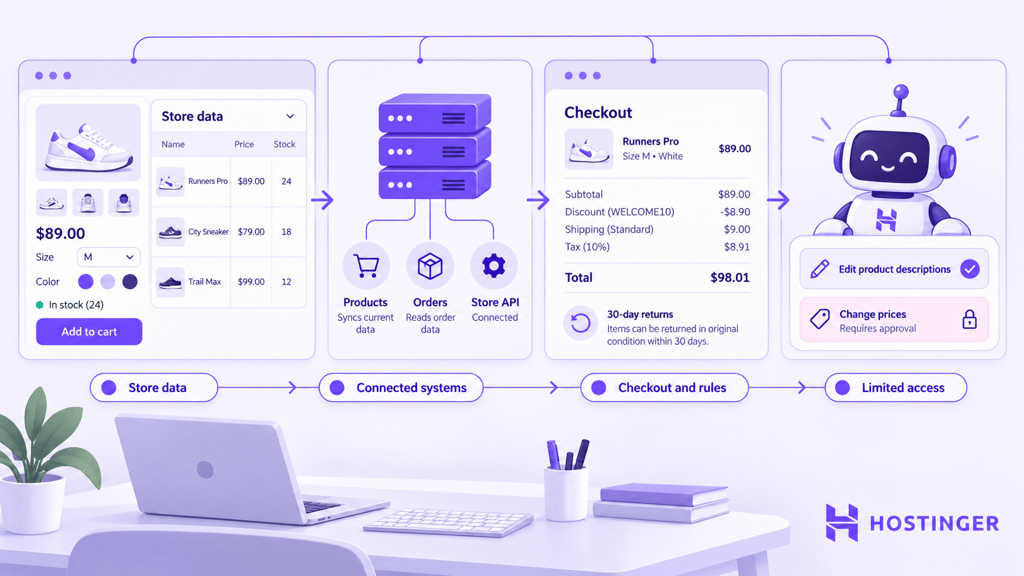
Platforms are actively building out these capabilities to support the transition. Hostinger Ecommerce, for instance, centralizes product data, inventory tracking, order management, and payment settlements within a unified Store Manager. Through tools like Hostinger Agent for internal dashboard tasks, Hostinger Connector for AI coding assistants, and the Public Sales Channel API for custom storefront development, merchants are given structured pathways to prepare their digital operations for agent-driven commerce.
Strategic Considerations for Modern Merchants
As agentic ecommerce matures, merchants are urged to evaluate their digital readiness carefully. Transitioning toward an agent-ready store begins with auditing product databases to ensure data integrity, testing API connections to verify that external software retrieves accurate information, and running sandbox tests on checkout and return policies.

While the benefits of agentic ecommerce—including enhanced customer reach, reduced operational overhead, and dynamic adaptability—are substantial, analysts caution against relinquishing total control prematurely. Experts recommend starting with small, reversible tasks, such as updating metadata or drafting promotional content, and gradually expanding permissions as the reliability of the agent-merchant relationship is proven. By establishing clear access limits and maintaining rigorous data hygiene, retailers can harness the efficiency of autonomous AI while safeguarding their operational integrity.