
Arriving roughly two months after the deployment of Linux 7.2, the latest major kernel release, Linux 7.3, has officially landed. True to expectations, the defining characteristic of this fresh release is raw performance. Headlining the update are notable filesystem speedups, scheduler optimizations tailored specifically for gaming workloads, and reduced latency for real-time operations. These core performance enhancements are rounded out by expanded hardware support and a series of targeted under-the-hood refinements contributed by developers across the global open-source community.
As has become tradition with every significant kernel milestone, Linus Torvalds offered his signature casual assessment of the release cycle via the Linux Kernel Mailing List. Marking the stable launch of version 7.3, Torvalds noted that the final week of development progressed without notable incident, allowing the release to go out smoothly and setting the stage for the opening of the merge window for version 7.4.
True to form, Torvalds humorously preempted any immediate administrative delays by explaining his personal schedule for the start of the next cycle. Rather than diving straight into code merges first thing in the morning, his annual family vacation meant he would spend the day on a boat and underwater. While the reference to being underwater points to his well-known passion for scuba diving—one of his rare pursuits outside the tech world—he confirmed he would return to reviewing and merging code by the afternoon, though with a temporarily unconventional schedule.
Linux 7.3: What’s New?
The breadth of hardware enablement in Linux 7.3 is vast, highlighted heavily by early preparations for upcoming architectures. Advanced Micro Devices has been particularly active in laying the foundational support for its upcoming hardware. The HSMP driver has been updated to support protocol v7, a critical component relied upon by Zen 6 Family 1Ah Model 80H processors. With AMD positioning these advanced processors for an official market launch in January 2027, the inclusion of this upstream driver support ensures that the Linux kernel will be ready to communicate effectively with the silicon right out of the gate.
Similarly, the Platform Management Framework driver has been updated to accommodate the same processor family while introducing a new ioctl interface designed to supply detailed device metrics. Beyond traditional desktop and server platforms, niche hardware enthusiasts also receive attention. Owners of Ryzen AI Halo mini PCs can now natively control the integrated LED lighting of their devices directly through the kernel via a newly introduced driver designated as amd_halo_led. Prior to this upstream inclusion, adjusting the lighting system on these specific devices required running a specialized Debian-based distribution provided by AMD known as the Ryzen AI Developer Platform, making standard Linux desktop integration cumbersome.
Power management and CPU behavior tuning have also received refined controls. The amd-pstate driver introduces a notable enhancement for users who enjoy granular optimization of their processor characteristics. The opt-in Dynamic Energy Performance Preference feature, which allows the kernel to dynamically adapt performance profiles on the fly, was previously restricted to a system-wide toggle. With Linux 7.3, administrators and power users can activate this capability on a per-core basis by simply selecting the dynamic preference option under the existing powersave governor.

Graphics and gaming improvements form another critical pillar of the Linux 7.3 release, driven significantly by engineering contributions from Valve. Older Radeon graphics cards benefit from a more graceful recovery mechanism when encountering GPU hangs. Engineer Timur Kristóf completely overhauled the GPU reset logic so that the recovery process isolates itself strictly to the graphics and compute block, leaving valuable graphics memory untouched during a reset cycle. This targeted approach prevents disruptive system-wide stalls and maintains a smoother operational state when hardware encounters transient rendering faults.
Additionally, Valve engineer Natalie Vock contributed the first phase of a broader initiative aimed at dramatically improving gaming performance on systems constrained by video RAM limitations. When a modern game exhausts available VRAM, the Linux kernel can now intelligently evict lower-priority data out to standard system RAM, freeing up high-speed memory precisely where the game demands it. Demonstrating the efficacy of these patches, demanding titles such as Indiana Jones and the Great Circle have been observed successfully running on hardware with restricted memory configurations, requesting up to 9GB of resource allocation on an 8GB graphics card while retaining playable frame rates. While the complete patch set is already integrated into specialized gaming distributions like SteamOS, the remaining upstream components are steadily making their way into the broader mainline kernel ecosystem.
System memory management has also been optimized to address critical performance bottlenecks under heavy operational loads. Engineers at ZTE discovered that a specific lookup operation utilized by Kernel Samepage Merging—the feature responsible for consolidating identical memory pages to save RAM—could hold an internal lock for hundreds of milliseconds. Under severe memory pressure, this locking behavior led to noticeable application freezes. Their implemented fix successfully reduced the worst-case duration of these lock holds during stress tests from over 705 milliseconds down to less than 2 milliseconds.
A parallel locking inefficiency was addressed in the zsmalloc memory allocator, which is heavily utilized by zRAM and Zswap for storing compressed memory pages. Wenchao Hao of Xiaomi targeted this bottleneck, yielding performance gains of up to 1.83x on a Raspberry Pi 4B and a 1.4x improvement on a 20-core Intel computing system. These optimizations collectively ensure that systems running low on physical memory can maintain responsiveness even during intensive multi-threaded tasks.
Can’t Wait to Get Started?
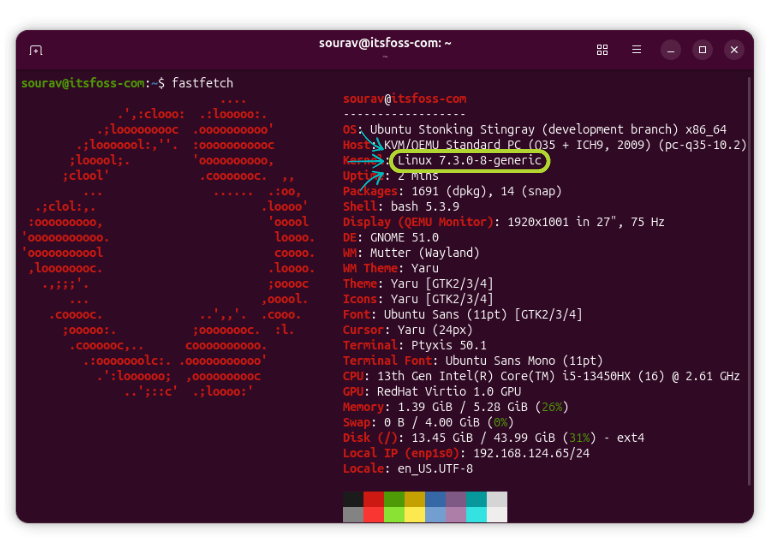
For users eager to deploy Linux 7.3 immediately, adopting an up-to-date operating system release is the most practical path forward. The interim Ubuntu release, Ubuntu 26.10, provides a straightforward out-of-the-box mechanism to experience the new kernel version. Alternatively, users favoring rolling-release distributions or fast-moving desktop environments can anticipate the update rolling out naturally through official repositories on platforms such as Fedora Workstation and Arch Linux.
For advanced users who prefer to bypass distribution release cycles entirely, mainline kernel packages can be installed directly on compatible systems, though such methods carry inherent stability risks. Production environments and mission-critical setups are generally advised to wait for official downstream distribution packages to ensure complete system stability and seamless driver integration.
Leave a Reply