
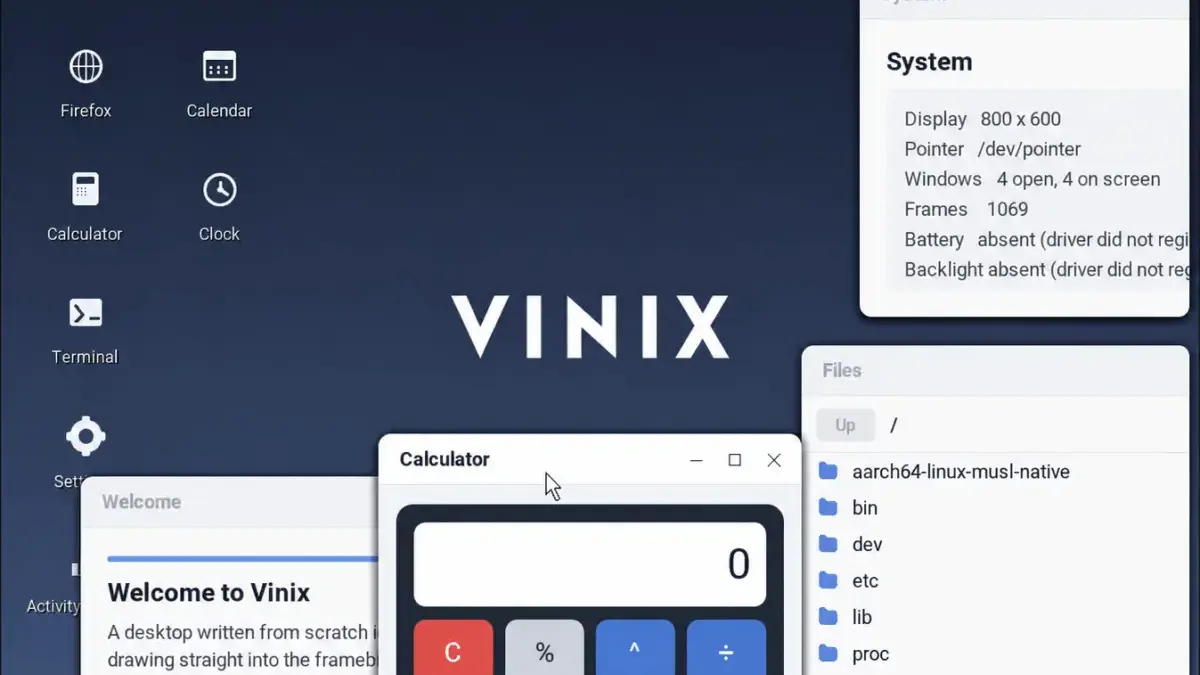
The computing landscape has long been dominated by a handful of proprietary tech giants, leaving users with fewer choices when they want performance untethered from corporate bloat. For owners of Apple MacBooks, a new project aims to carve out an alternative path. Vinix, an independent, open-source operating system written primarily in the V programming language, is positioning itself as a fast, minimal alternative designed to counter the growing resource weight of modern macOS releases.
While operating systems that are neither proprietary nor powered by the traditional Linux kernel face massive compatibility hurdles, Vinix has managed a remarkable engineering feat: it runs Docker containers on ARM64 hardware. How an operating system achieves this without a native Linux kernel comes down to implementing the necessary foundational features. Vinix developers built their own custom implementations of namespaces and cgroups, alongside overlayfs and seccomp. These additions allow a stock Alpine Linux Docker engine to function smoothly on ARM64 architectures.
Beyond containerization, Vinix boasts support for QEMU 9.1.2, which enables users to boot a secondary instance of Vinix directly inside a window of the first. For those looking at entertainment capabilities, the operating system can handle classic titles and modern demos alike, including DOOM, a DOOM 3 demo, Gothic II’s demo via OpenGothic, and Minecraft Java Edition.
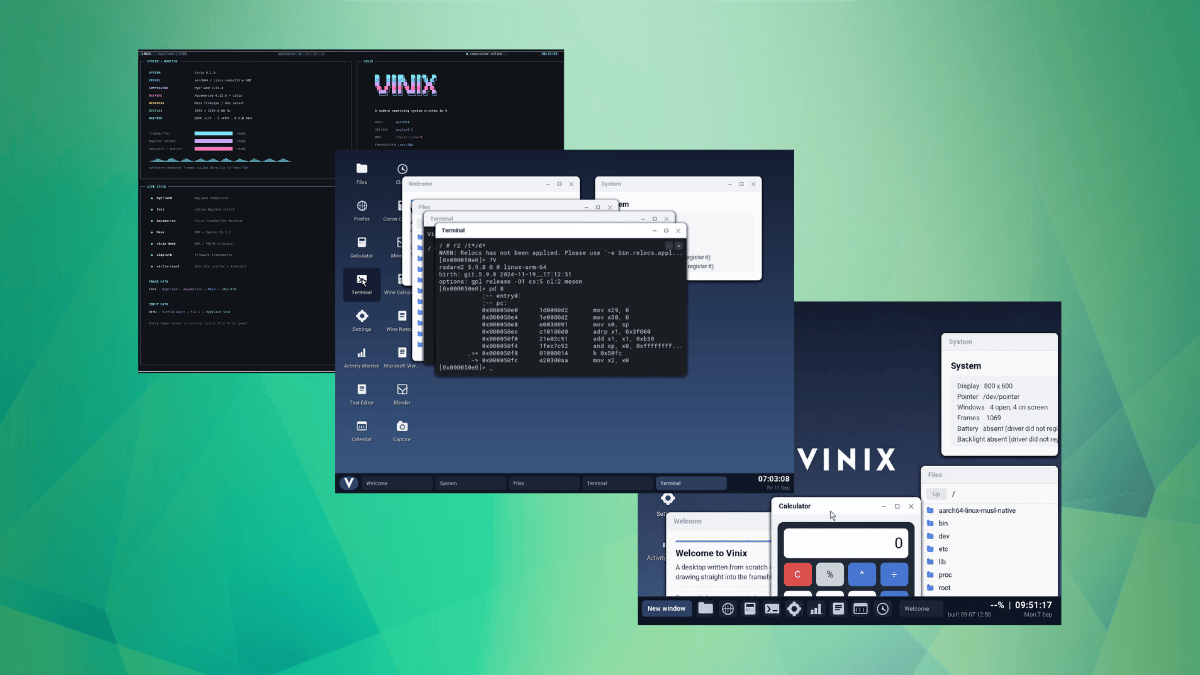
Despite these impressive capabilities, Vinix remains in its early stages of development and comes with notable limitations. The current Docker support lacks bridge networking and iptables rules. Meanwhile, QEMU relies entirely on software emulation for now, Minecraft runs in a resource-intensive interpreter mode on a single CPU core, and the DOOM 3 demo hovers around 13 frames per second under software rendering. Because of these constraints, developers emphasize that Vinix is early-stage software and is not yet intended for daily use or production environments.
Yet Another Operating System Built for Speed and Minimalism
Vinix was conceived with a clear purpose: to provide MacBooks with a fast, minimal, and completely open-source operating system. The project’s core motivation stems from perceptions that macOS has grown progressively slower and more bloated with each passing software release. Initially, the development team is targeting Apple Silicon devices with the ultimate goal of covering the entire M-series lineup, though hardware support is presently centered around the M1 chip.
For developers and enthusiasts who prefer a lean computing environment, Vinix offers a compelling philosophy. While traditional Linux users may find little incentive to switch, Vinix explicitly avoids systemd, maintaining a kernel compact enough for a single developer to read through entirely. The system is meticulously designed so that nothing runs in the background unless explicitly initiated by the user. It sticks to a single, cohesive init system, desktop environment, package manager, and binary format.

Memory management is handled manually by the kernel rather than relying on a traditional garbage collector, ensuring that cleanup passes never interrupt active system calls or the graphical compositor. At its technical foundation, Vinix is built upon the V programming language, selected specifically for its rapid compilation times and small, highly readable design. The project also serves as a practical testbed for bare-metal programming in V.
Security has also been a major design consideration, with the operating system adopting a model heavily inspired by OpenBSD. Features like pledge and unveil are available for applications that choose to opt in, and user memory is protected by preventing memory regions from being simultaneously writable and executable by default. However, secure boot verification mechanisms for the bootloader, kernel, and root filesystem are not yet supported.
Running Native Linux Applications on an Independent Kernel
At its architectural core, Vinix operates as a monolithic kernel booted via Limine, with essential device drivers built directly into the system image. While the vast majority of the codebase is written in V, it is complemented by strategic components in C and assembly.
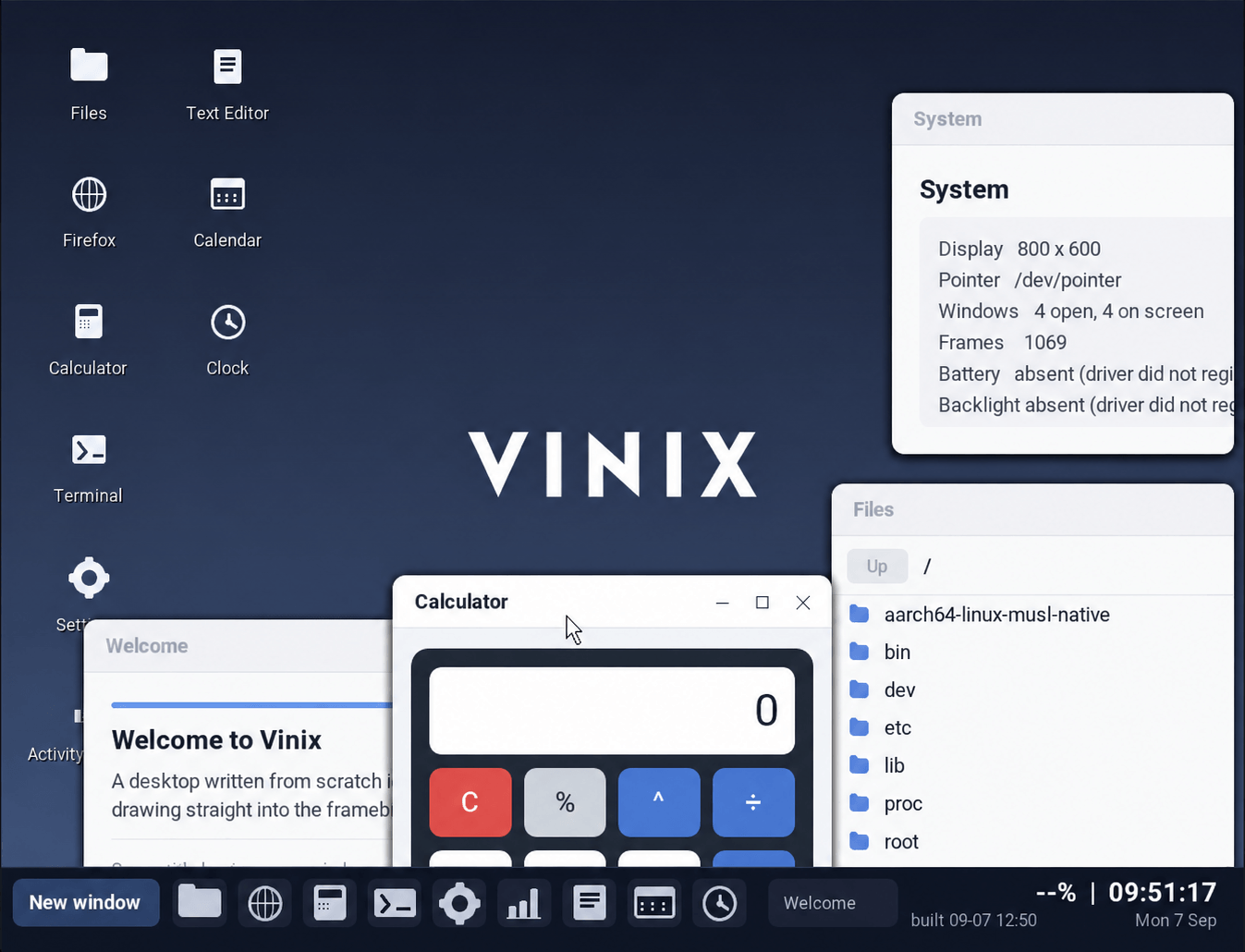
For the graphical user interface, Vinix features a native desktop built using V UI2, which renders directly through the framebuffer. Additionally, X.org and Hyprland sessions are available as operational choices on ARM64. According to project metrics, the operating system consumes a mere 50 megabytes of RAM immediately after boot and requires roughly one gigabyte of disk space once fully installed.
Vinix achieves its ability to run Linux applications by targeting Alpine Linux and its aarch64 packages. Because Alpine is exceptionally lightweight, security-focused, and built around musl and BusyBox, Vinix can natively interpret the system calls, ELF format requirements, and musl behaviors that Linux binaries rely on. This means applications run directly on the hardware without requiring a virtual machine or translation emulator.
Users can install new applications using pkg, a command-line utility that pulls software directly from Alpine’s aarch64 package repositories. Popular software such as Chromium, GIMP, Sublime Text, and Gnumeric have been verified to work, alongside Wine, the popular compatibility layer for running Windows software.
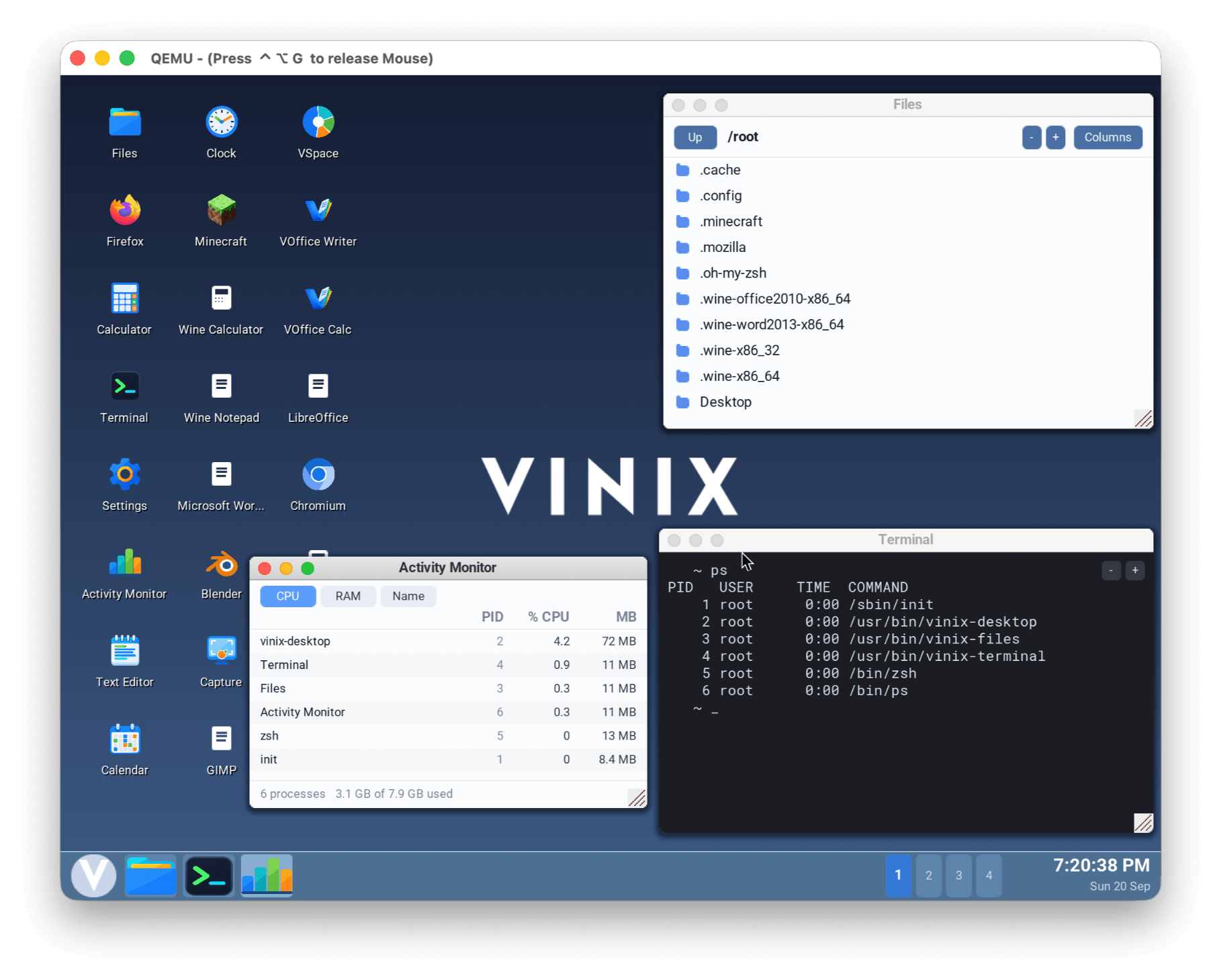
Naturally, this capability is currently restricted to ARM64 architecture and a curated selection of packages. Software that relies heavily on specific Linux kernel features that Vinix has not yet implemented may fail to execute correctly. Furthermore, support for newer Apple processors like the M3, M4, and M5 chips is currently in development, and native GPU acceleration drivers remain an ongoing work in progress.
The Origins and Future of the Project
The history of Vinix spans several years of iterative development. The earliest code commits on GitHub date back to March 2021, with the original kernel core constructed by Mintsuki, the creator of the Limine bootloader. Following an extended development pause of roughly two years, Alexander Medvednikov, the author of the V programming language, stepped in to take over as project maintainer.
While Mintsuki’s foundational work established the physical and virtual memory managers alongside the scheduler, the post-handover phase has seen Vinix expand rapidly. The operating system has since gained robust storage, networking, input, and graphics support, transforming into a functional Unix-style userspace capable of running complex Alpine-based compatibility layers.
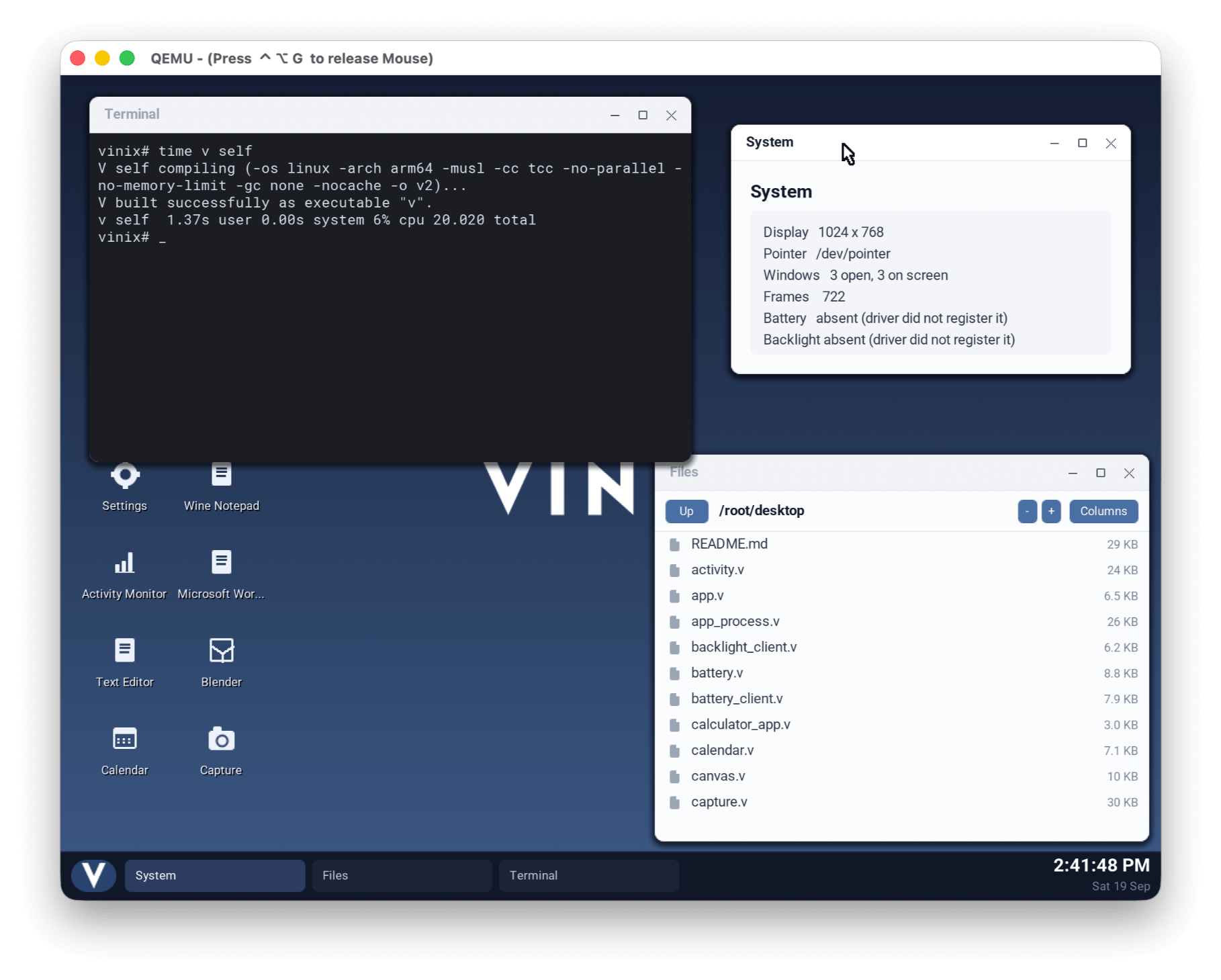
For those interested in experimenting with the platform, the official Vinix website offers a disk image installer file tailored for M1 Macs. Additionally, the project’s official software repository provides two distinct ISO files: an ARM64 version aimed at QEMU and VirtualBox environments on Apple Silicon, and an x86_64 version targeted at traditional Intel and AMD systems. Running the operating system within a virtual machine requires modest resources, needing at least four gigabytes of memory and four gigabytes of storage space, though adventurous developers can also compile the entire system directly from source code.


Leave a Reply