
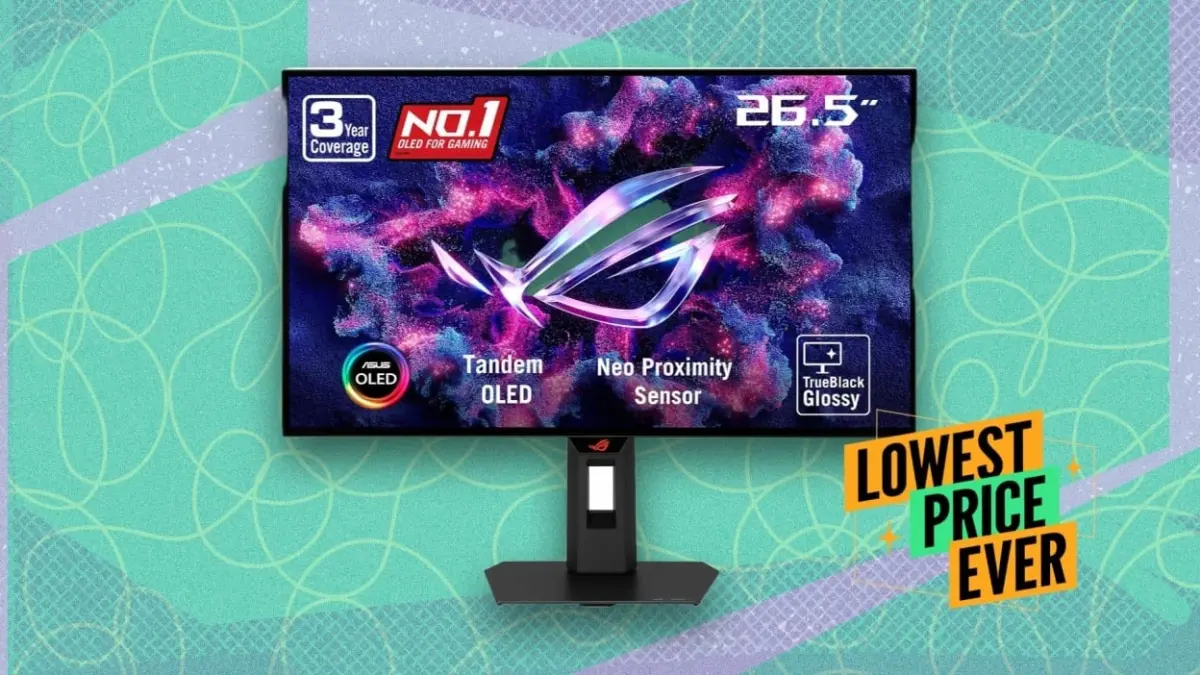
PC gaming enthusiasts looking to upgrade their display setups have a significant discount option available as the 27-inch ASUS ROG Strix OLED XG27AQWMG gaming monitor hits an all-time low price point. Originally retailing for $649, the high-performance display has received a $100 price reduction, bringing its cost down to $549. The price drop represents a notable entry threshold for a monitor equipped with high-end WOLED technology, dual-mode frame rate scaling, and near-instantaneous pixel response times.
The monitor has drawn widespread attention in the gaming hardware space due to its feature set, which caters to both graphical fidelity enthusiasts and high-framerate competitive esports players. By lowering the financial barrier to OLED technology, the current deal positions the ROG Strix XG27AQWMG as a high-value contender in the crowded 27-inch display segment.
At the core of the display’s visual performance is a 27-inch 4K UHD WOLED (White OLED) panel. Unlike traditional liquid crystal displays (LCDs) that rely on a dedicated LED backlight array passing light through liquid crystal matrices, OLED panels utilize self-emissive pixels. In a WOLED configuration, a white light source is combined with color filters to form individual subpixels. This structural design offers distinct operational advantages over standard RGB OLED layouts and traditional backlit display technologies such as IPS, VA, or TN panels.
Because WOLED pixels can turn off entirely when displaying black colors, the panel produces an infinite contrast ratio and deep, true dark levels without the light bleed, edge blooming, or halo effects commonly found on LED-backlit or Mini-LED monitors. The use of white subpixel assistance also aids in delivering high image uniformity across a broad range of room lighting conditions. This makes high-dynamic-range (HDR) content, including modern cinematic AAA games, movies, and high-definition television broadcasts, appear vastly more vivid, punchy, and lifelike.
Display optics are further enhanced by the inclusion of a TrueBlack Glossy screen coating. The choice of panel coating remains a key point of discussion among display enthusiasts, as traditional matte anti-glare treatments physically diffuse light across a textured outer film. While matte coatings prevent sharp reflections, they often introduce a subtle grainy haze over the picture, reducing perceived sharpness and softening black levels. The TrueBlack Glossy coating on the XG27AQWMG avoids this visual degradation, maintaining clear optical clarity, rich contrast, and vibrant subpixel sharpness.
However, the optical properties of the TrueBlack Glossy finish come with practical room-lighting considerations. While the coating is designed to mitigate general glare better than conventional glossy glass surfaces, real-world evaluations note that it cannot completely eliminate reflections when subjected to direct, intense light sources. Bright lamps or unshaded windows positioned directly opposite or adjacent to the screen can still overpower the reflective coating, making light management within the viewing environment an important setup factor.
Beyond display optics, the ROG Strix OLED XG27AQWMG is distinguished by its operational flexibility in resolution and refresh rates. Operating at its native performance ceiling, the display runs at a high-density 4K UHD resolution paired with a 280 Hz refresh rate. Rendered at 4K, fine textures, text, and intricate environmental details are displayed with crisp visual fidelity, accommodating single-player adventure titles, media consumption, and high-resolution desktop productivity.

Recognizing that running modern games at 4K resolution at 280 frames per second places immense demands on graphics hardware, ASUS integrated a dedicated Frame Rate Boost mode into the monitor. This dual-mode functionality allows users to shift the display’s operating profile from native 4K at 280 Hz down to Full HD (FHD / 1080p) resolution at an elevated 330 Hz refresh rate.
This hardware flexibility targets two distinct gaming use cases within a single screen. When playing fast-paced competitive multiplayer games—such as first-person shooters, battle royales, and fighting games where maximum frame rates and input lag reduction are prioritize over fine resolution details—switching to the 330 Hz FHD profile provides a fluid, low-latency competitive advantage. When transitioning back to immersive single-player games or high-definition video playback, users can return to the native 4K 280 Hz profile to maximize panel sharp clarity.
Complementing its high refresh rates is an ultra-fast 0.03 ms response time rating. Traditional high-end LCD gaming displays typically record pixel response times between 1 ms and 4 ms, which can cause subtle motion blur, ghosting artifacts, or inverse trailing behind rapidly moving objects. Because self-emissive OLED pixels switch states almost instantaneously, the 0.03 ms response speed eliminates motion artifacts at a hardware level. Fast-moving targets, swift camera pans, and rapid motion remain sharp and distinct across all supported refresh rates.
To ensure that high frame rates translate into smooth visual performance without tearing or micro-stuttering, the monitor includes robust adaptive synchronization support. The panel is natively compatible with NVIDIA G-SYNC technology and supports AMD FreeSync protocols. These adaptive sync standards dynamically synchronize the refresh rate of the monitor to the real-time frame generation output of the graphics processing unit (GPU), preventing horizontal screen tearing and minimizing stutter without adding the heavy input delay associated with traditional software-based vertical synchronization (V-Sync).
A primary historical concern associated with organic light-emitting diode displays is the risk of image retention and permanent panel burn-in, which occurs when static graphical elements—such as desktop taskbars, web browser headers, or video game heads-up displays (HUDs)—are left on screen at high brightness levels for extended periods. The ROG Strix OLED XG27AQWMG addresses panel longevity concerns through a multi-layered protection architecture driven by OLED Care Pro software controls and built-in physical sensors.
A key hardware feature in this maintenance suite is the integrated Neo Proximity Sensor. The sensor continuously monitors the area in front of the display to detect user presence. If the player steps away from their desk, the system automatically detects the absence and dims the screen or shifts into a low-power standby mode. When the user returns to the desk, the display instantly restores full operational brightness. By limiting the time static images remain illuminated while the display is unattended, the sensor actively mitigates cumulative heat buildup and organic layer degradation.
This physical sensor works alongside the suite of software safeguards within OLED Care Pro. These automated routines include background pixel-shifting algorithms, pixel refresher cycles executed during standby periods, and screen saver protocols designed to evenly distribute subpixel usage over time. Together, these systems reduce the long-term risk of burn-in, providing greater reliability for users who plan to use the screen for mixed daily workloads alongside gaming.
With low input lag, instantaneous pixel response times, dual-mode frame rate capability, and deep WOLED contrast performance, the monitor delivers a comprehensive feature set for PC gamers. The current $100 promotional discount lowering the ASUS ROG Strix OLED XG27AQWMG to its historical low of $549 makes high-end OLED display technology considerably more accessible to mainstream buyers and custom PC builders looking to upgrade their visual experience.



Leave a Reply