
The performance goals form is due on Friday, a familiar corporate ritual that millions of professionals face with a mixture of resignation and cynical compliance. The routine is well-established: a handful of generic bullet points that sound responsible, a manager who skims them once during a brief meeting, and a calendar quarter that completely buries the objectives by week three.
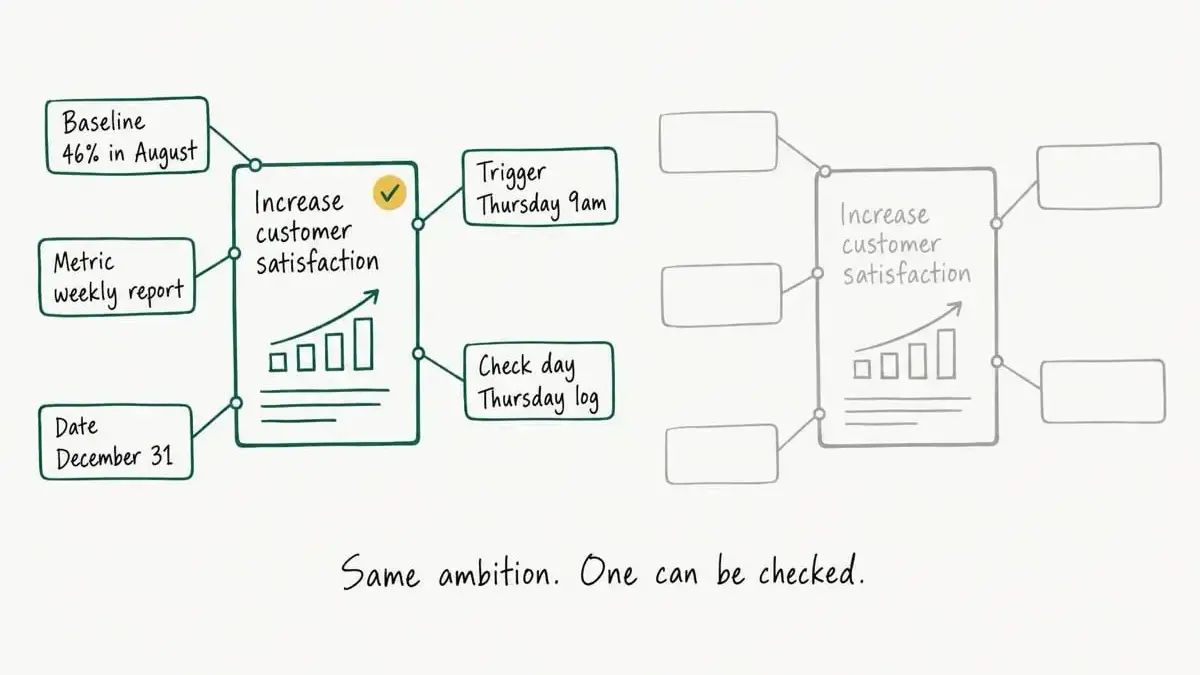
The underlying problem is rarely a lack of personal ambition or a deficiency in professional drive. Instead, those goals were simply never built to survive an ordinary Tuesday in a busy office environment—a day when a key customer suddenly escalates a critical issue, a valued colleague unexpectedly resigns, and a project initiative promised back in January abruptly turns out to require an unapproved budget. Most standard examples of SMART goals used in the modern workplace fail at the exact same juncture: they are grammatically correct sentences that remain operationally empty. They typically lack a starting baseline number, a designated owner, or any assigned day of the week for actual review.
To address this widespread disconnect between corporate paperwork and daily operational reality, management experts and workplace researchers have increasingly emphasized the necessity of embedding concrete parameters into professional objectives. A genuine SMART goal for the workplace requires a starting number you can look up, a verified metric, a realistic timeline, a specific execution trigger, and a dedicated check day.
What a SMART Goal for the Workplace Actually Is
A proper SMART goal for the workplace is an objective written with such precision that any colleague could independently verify its status without needing to ask for clarification. It clearly states a measurable change from a known starting point, establishes a target that remains realistic given actual available resources, articulates a valid reason the business enterprise should care, and sets a concrete completion date.
The historical acronym has drifted significantly from its origins, and that semantic drift matters for modern professionals. George Doran originally introduced the concept of SMART objectives in a November 1981 issue of Management Review, framing the terms as Specific, Measurable, Assignable, Realistic, and Time-related. Doran designed the framework primarily for managers setting operational objectives within a corporate structure. Over the decades, however, the terminology on typical corporate forms shifted to include Achievable and Relevant.
Practitioner histories often explain this shift as a fundamental change in who the goals are written for. While Doran was assigning work downward to other employees, contemporary knowledge workers frequently write their own performance objectives. This distinction highlights the importance of reclaiming the "Assignable" element that frequently gets dropped in modern translations. On a shared team objective, clear ownership is the entire argument; a vague statement like "we will improve onboarding" is merely a sentence that four different people can nod politely at while nobody actually takes responsibility.
The Structural Anatomy of Effective Workplace Objectives
Effective work goals consistently share a distinct structural shape: a starting baseline number you can point to, a verification metric that a third party could check, a specific target date, and a standing day of the week to review progress. Examining individual output, management responsibilities, team delivery, customer service, sales quotas, professional skill development, process refinements, and workload management reveals that successful objectives avoid vague verbs entirely.

Objectives that rely on terms like "increase," "improve," or "streamline" without anchoring data points often fail to drive actual behavior. A professional goal without a starting baseline cannot truly be missed, and a target that is impossible to miss functions more like a descriptive sentence than a binding commitment. When multiple professional objectives compete for the exact same operating hours, underlying prioritization challenges often manifest as overwhelming feelings of being underwater at work, effectively masquerading as a goal-setting failure when they are actually calendar management issues.
Analyzing the empirical foundation behind goal-setting reveals why specific structural components matter. Research originating from decades of goal-setting studies, notably led by figures such as Locke and Latham, consistently demonstrates that specific and difficult objectives produce significantly higher performance levels than vague instructions to simply do one’s best. However, these positive effects depend heavily on operating conditions such as continuous feedback, task complexity, and genuine goal commitment.
Furthermore, psychological research into implementation intentions indicates that forming specific if-then plans—defining precisely when, where, and how an action will take place—yields substantial improvements in goal attainment. When combined with regular progress monitoring, which randomized studies show significantly boosts completion rates especially when results are recorded and publicly reported, the mechanical components of a goal far outweigh the psychological inspiration of the acronym itself.
Navigating the Gap Between Corporate Forms and Daily Execution
A recurring challenge for professionals is the divergence between the review version of a goal and the running version used for actual execution. The review version belongs on the corporate HR form: it must be assignable, properly dated, tied to metrics the business already tracks, and written compactly for a reviewer who may spend less than two minutes reading it. The running version, by contrast, lives directly within the professional’s daily workflow, carrying the specific execution triggers, weekly check days, and detailed activity logs.
Treating both versions as identical documents often transforms goal-setting season into an exercise in corporate theater. Nonetheless, taking the formal review documentation seriously remains vital for career progression, as formal performance evaluations frequently inform organizational decisions regarding promotions and structural reorganizations. Maintaining a running version with visible historical tracking allows the formal summary to reflect genuine operational progress.
When unexpected disruptions inevitably shatter a business quarter, traditional workplace goals typically fail through quiet abandonment, heroic overextension leading to team burnout, or hurried renegotiations when the objectives are no longer relevant. To prevent these outcomes, resilient professionals establish a floor version for every goal—representing the absolute minimum acceptable result that still counts—alongside a clear recovery rule for resuming progress monitoring after an unavoidable missed week. Preserving the regular check-in habit, even when performance metrics temporarily flatline, ensures that projects can be systematically restarted rather than completely reinvented from scratch during the next planning cycle.



Leave a Reply