
You packed the running shoes. They came home clean.
That is the usual trajectory of travel workouts. The intention gets packed into the suitcase, the session never happens, and a four-night business trip quietly becomes the event that derails a fitness program you had successfully maintained for two consecutive months. This rarely happens because a hotel room is inherently a bad place to train. Rather, it happens because at 6:40 a.m. in an unfamiliar city, facing a client breakfast at eight and a biological clock that insists it is the middle of the night, nobody has the cognitive bandwidth to design a workout from scratch.
What actually survives a trip is a decision you made before you ever zipped your luggage. Fitness experts suggest packing two predetermined sessions—one lasting 20 minutes and another taking just eight—alongside a strict rule governing which one to run each morning. This eliminates the need for open-ended debate in a room with blackout curtains and a looming 9 a.m. start time.
Why the Plan to "Find a Gym There" Keeps Failing
The intention to find a local gym on the road almost always collapses on logistics rather than a lack of willpower. The typical hotel fitness room turns out to be a cramped space featuring two adjustable dumbbells, a treadmill with a dead digital display, and a single bench currently occupied by another guest. Meanwhile, the real gym down the street requires a day pass and an unexpected 15-minute walk you never budgeted for. By the time you navigate both options, your morning window has vanished, and your first meeting has started without you.
What you reliably possess instead is a floor, a wall, a chair, a door, and a suitcase. That baseline inventory remains identical whether you are traveling to Cleveland or Frankfurt, making it the only reliable foundation worth building a session around. For those seeking slightly more versatility, a basic resistance band weighs virtually nothing and folds easily into a shoe.
Sleep deprivation is the other major hurdle a trip introduces. A survey of 2,242 business-class travelers in Japan and the United States revealed worse self-reported jet lag among individuals with sleep disorders, while those who were more physically active reported milder symptoms. While this data offers a questionnaire-based observation rather than a physiological mechanism, it accurately describes the environment you will be training in: short sleep, a shifted internal clock, and a schedule dictated entirely by someone else’s agenda.
The Trip Is Not Where You Lose It. The Week After Is.
Four nights away costs you very little in physical terms. A short break is not long enough to undo months of consistent work, yet the fear that it might triggers two counterproductive responses: cramming an excessively difficult session into an already strained week, or writing the entire week off because a partial schedule feels pointless. Neither reaction addresses the real threat. What a trip actually risks is the thread—the simple continuity of having a session booked for the day you land.
In a small trial involving 20 resistance-trained men who trained for four weeks, stopped for two, and then resumed, leg-press strength did not drop across the break. While this single trial involving one specific lift is hardly a universal law, it provides a reassuring answer to the anxious questions travelers often ponder in airport terminals.
Instead of maintaining continuity, travelers frequently return home with nothing scheduled, a vague sense of falling behind, and the notion that they should start over properly on Monday. Unfortunately, Monday is where the actual damage occurs. The session you skipped on Wednesday in a hotel room cost you almost nothing; the complicated restart process it triggers, however, can cost you an entire month.
Consequently, the primary purpose of travel workouts is not to make dramatic physical progress. It is simply to land at your home airport still embedded in your ongoing program.
This inverts the standard fitness advice handed to travelers. The usual recommendation involves a denser, harder session designed to compensate for the gym you are missing, which unfairly demands more of you during the week you have the least energy to give. The wiser approach is the exact opposite: shrink the session until the trip cannot possibly defeat it, and let the full version resume when your morning routine normalizes.
The 20-Minute Session and the 8-Minute Floor
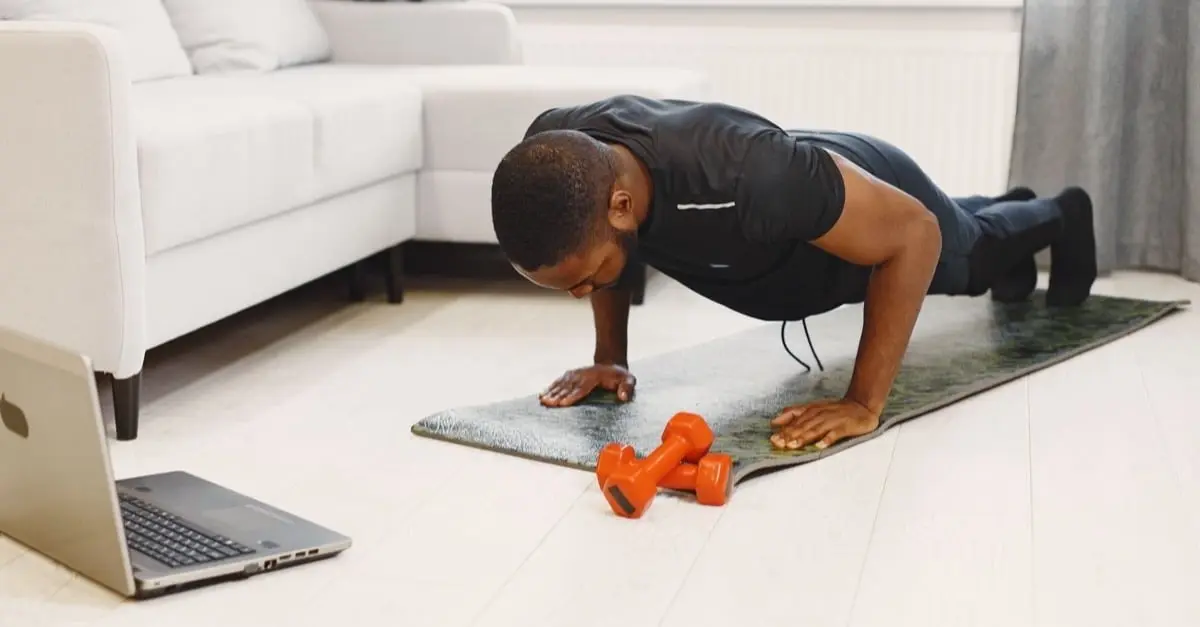
Travelers should pack two specific sessions and nothing else. The full session consists of five movements performed for three rounds, taking roughly 20 minutes. The floor session uses the exact same five movements for a single round, taking about eight minutes. On a trip, the floor routine serves as the default option, while the full session functions as a bonus—a complete reversal of how you would operate at home. Every movement utilizes a wall, a chair, a door, or your suitcase, ensuring zero dependence on hotel amenities.
The movements include a split squat, a single-leg hip hinge, a push-up, a door-anchored row, and a loaded suitcase carry. For the split squat, place your back foot on the floor a long stride behind you while resting your fingertips on a desk chair for balance. The hip hinge is executed as a single-leg deadlift, standing on one leg and reaching toward the floor with the back leg light behind you. Push-ups can be adapted using a desk, chair seat, bed frame, or the floor.
The rowing movement requires looping a towel securely around a sturdy door handle, leaning back, and pulling yourself forward, or alternatively performing a bent-over row while holding your packed suitcase. Finally, the carry involves holding the suitcase in one hand, walking down the hotel corridor and back, and then switching sides.
A critical safety note applies to the rowing movement, as it is the only exercise that trusts hotel furniture. You must select a door that latches securely and opens away from you so that pulling on it presses the door firmly into its frame rather than swinging it open. Loop the towel around the handle, then test it with a tentative lean before placing your full weight on it. Sliding doors, loose handles, or doors that open toward you must be avoided entirely; in those rooms, substitute the suitcase row and leave the towel in the bathroom.
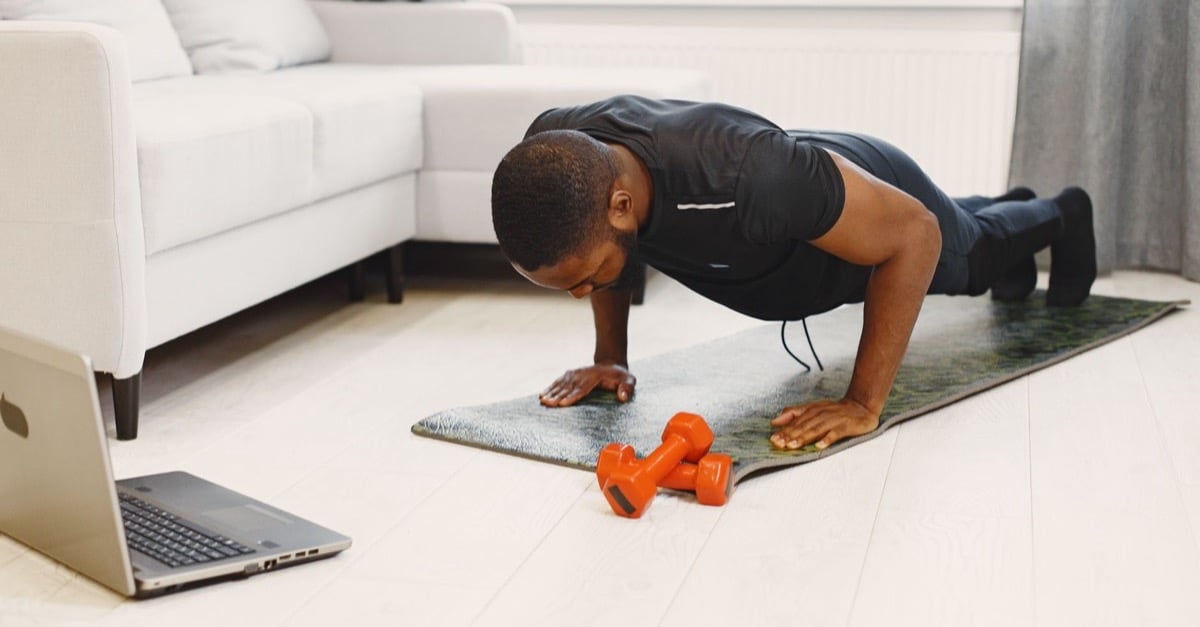
These five movements intentionally mirror the core exercises found in standard at-home weight training plans. You are not switching programs for a week; you are simply running a stripped-down version of the routine you already follow, which is why returning home does not feel like arriving at an intimidating starting line. If any specific movement does not suit your room layout or physical needs, substitute it with a bodyweight equivalent rather than abandoning the slot altogether.
Furthermore, a small dose of exercise is far from a consolation prize. A review of maintenance training literature indicates that younger adults can preserve their strength and muscle size for up to 32 weeks on just one session per week and a single set per exercise, provided the relative intensity of the effort remains high. Older adults, by contrast, may require two sessions and two to three sets to maintain muscle mass. This research highlights maintenance rather than growth, and its success hinges entirely on maintaining high effort.
Travelers often get this dynamic backward. The critical variable to protect on the road is not how many sets you manage to squeeze in, but rather how challenging the final set feels. Executing the three sets as a circuit—moving through all five exercises once before repeating the cycle—keeps the effort high and proves significantly faster than finishing three separate squat sets before touching anything else.
Trips lasting longer than a week require only one adjustment: retain at least one full session in every week you are away rather than relying entirely on abbreviated floor routines. This provides a necessary margin for safety, ensuring your body stays accustomed to standard training loads even during extended travel.
Making Hotel Room Sessions Challenging Without Weights
A bodyweight set succeeds when it feels genuinely difficult at the end, not when it takes a long time to complete. In a hotel room, you can manipulate difficulty by altering angles and pacing: lower your hands to increase leverage, slow down the descent, train one leg at a time, or introduce a deliberate pause at the bottom of the movement. When a set stops feeling challenging by the final two repetitions, you should make the movement mechanically harder rather than mindlessly chasing high repetition counts. Counting out 40 casual push-ups is an entirely different activity than targeted strength training.
Substantial evidence suggests that progressive calisthenics constitute legitimate training rather than a mere placeholder. In a four-week trial, moderately trained men who performed progressive push-up variations improved their bench press one-rep max comparably to a group performing traditional bench presses. While this does not prove that every unloaded movement perfectly matches its loaded counterpart, it confirms that a push-up scaled to become progressively harder functions as a valid training stimulus.
If an exercise causes discomfort, scale the movement down rather than pushing through pain through sheer stubbornness. A smaller range of motion, a folded towel placed under the knee, or a low-impact alternative for the day represents a far superior strategy to finishing a compromised set.
Anatomy of a Four-Night Business Trip
A realistic four-night business trip involves four mornings, one of which will inevitably be written off entirely due to an early flight. A successful travel week typically consists of one full session, two floor sessions, and one morning where the pre-dawn airport car wins out. Returning home with your ongoing program intact after training three times during an otherwise disruptive week represents a major success.
Monday involves landing late at night across multiple time zones, meaning nothing happens until morning. Tuesday begins early, prompting a quick eight-minute floor session before the shower and the first email. Wednesday allows for the full 20-minute session and a suitcase carry down the corridor while the rest of the hotel is still asleep. Thursday brings a grueling conference schedule and a late dinner, handled through a brief morning floor routine followed by high daily step counts accumulated simply by walking to and from the venue. Friday involves a pre-dawn departure where resting is the correct administrative call.
Two aspects of this schedule deserve attention. First, placing every session in the morning aligns with both practical scheduling constraints and the physiological reality of sleep deprivation. A meta-analysis of 69 studies covering 959 participants found acute sleep loss associated with a measurable drop in physical performance tests, with evening evaluations consistently showing worse results while morning tests remained largely unaffected.
Second, high daily step counts—such as walking 11,000 steps around a conference city—provide excellent general health benefits, but they do not replace structured resistance training. While walking improves certain physical metrics, resistance exercise remains superior for preserving functional strength and independence. Walking the city is valuable, provided you understand that its purpose is not muscle retention.
Packing the Decision Before the Shoes
Ultimately, the phrase "I’ll pick it back up when I’m home" is rarely wrong about the single week in question, but it is deeply flawed regarding the entire month. A trip ends, followed by a frantic catch-up week and a busy weekend, leaving a fitness program that was running smoothly in its second month stranded without the restart it needs. An eight-minute session on a Tuesday morning is not about the physical output of those eight minutes; it is about preventing the creation of a gap that demands a major psychological decision later.
Before your next trip, take three decisive actions. Write your two chosen sessions into the digital note that holds your flight confirmation. Decide beforehand which mechanical variation you will use for your push-ups and split squats so that Tuesday morning requires zero mental debate. Finally, establish your governing rule: run the full session when you have 25 minutes of breathing room, and execute the floor routine every other morning, including travel days.
The running shoes are optional, and the suitcase is your primary equipment. But the prepared note is what actually makes travel workouts happen.
Leave a Reply