
For millions of women navigating the menopausal transition, nighttime rest does not simply become lighter; it fundamentally changes character. Menopause sleep problems typically manifest at both ends of the night, creating a frustrating cycle where falling asleep is an arduous task and staying asleep feels nearly impossible. Data from the landmark Study of Women’s Health Across the Nation (SWAN), which enrolled 3,045 women aged 42 to 52, demonstrates that the odds of experiencing both types of sleep disruption rise steadily throughout the menopausal transition.
The repetitive nature of these disturbed nights often serves as the primary indicator that something physiological is shifting. A woman might fall asleep easily by eleven, only to jolt awake at 2:40 a.m. feeling damp, kicking off the covers before pulling them right back on. Another brief period of unconsciousness follows, interrupted by another awakening at 4:15 a.m., leading straight into a six o’clock alarm because daily professional and personal responsibilities demand it.
By Thursday, the accumulated sleep deficit takes a heavy toll. Women find themselves uncharacteristically short-tempered with loved ones or staring blankly at routine workplace correspondence, rereading the same email four times. Secondary analyses tracking that same SWAN cohort over a decade revealed that self-reported insomnia symptoms affected 31 percent of women in early perimenopause during their first year, climbing to 39 percent by the tenth year. Among women in late perimenopause, the prevalence started at 32 percent and rose to 48 percent over a decade. These figures represent self-reported symptoms occurring at least three times a week rather than clinically diagnosed insomnia, fluctuating across different stages and years. Yet, for the individual lying awake in the dark, the experience feels isolating, far removed from the fleeting nature of ordinary bad sleep. Over time, this dynamic breeds an entirely new psychological hurdle: a growing dread of the bed itself, a development that clinical experts note outweighs the utility of any over-the-counter supplement.
Why the Usual Natural Remedies Keep Failing You
The frustration experienced by midlife women is frequently compounded by the overwhelming array of unorganized and unverified natural remedies promoted for sleep disturbances. Traditional suggestions often arrive as an unsorted list of options lacking clear mechanisms, standardized dosing, or rigorous grading of evidence.
Melatonin serves as a primary example of this disconnect. When results from randomized trials focusing specifically on menopausal women are pooled, its impact on overall sleep quality fails to reach statistical significance. In scientific terms, this indicates uncertainty rather than definitive disproof, a nuanced reality rarely communicated on product labels. Herbal supplements like valerian root face similar scrutiny. An umbrella review published in 2024 synthesized eight systematic reviews examining valerian’s efficacy for sleep disturbances and concluded that the available evidence was weak or inconclusive, showing no reliable benefit for insomnia.
Faced with these mixed outcomes, individuals typically try one remedy, dedicate a fortnight to the regimen, notice no tangible change, and quietly conclude that personal failure is to blame. In reality, the issue stems from an oversimplified approach to a complex physiological problem. Menopause-related insomnia is not a singular condition; it involves at least three distinct underlying causes that require targeted strategies rather than generalized guesswork.
Menopause Sleep Problems Are a Wake-Up Pattern, Not One Problem
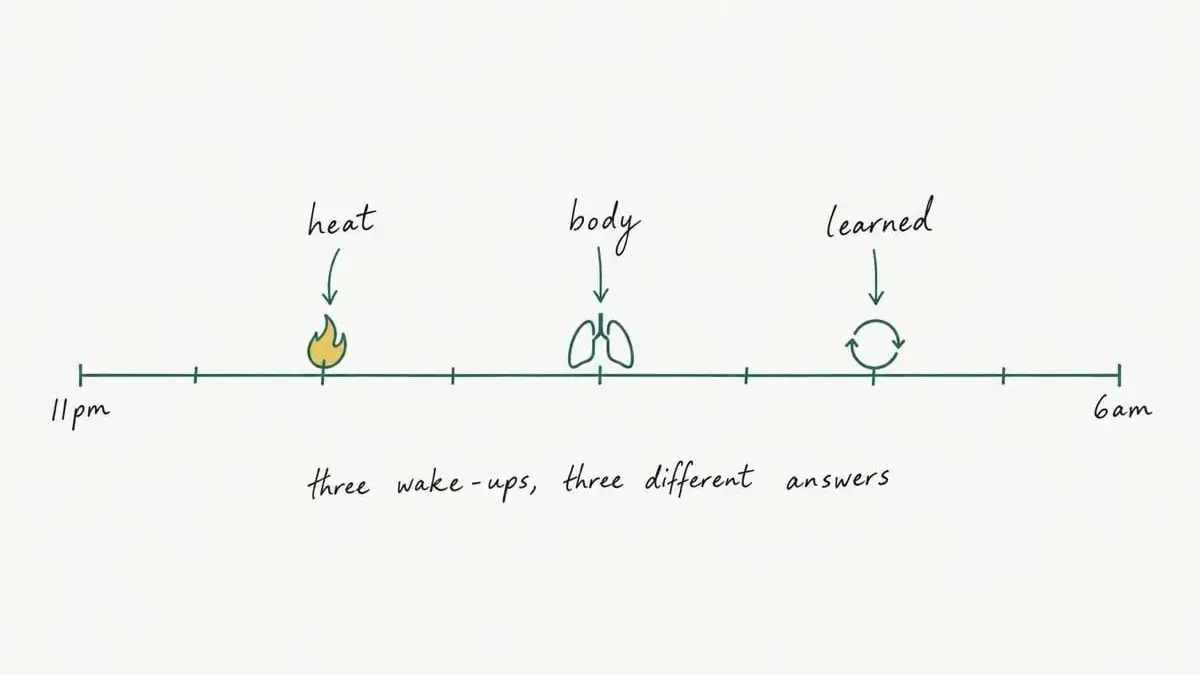
Clinical insights suggest that menopausal sleep disturbances are best understood not as a single uniform issue, but as at least three distinct wake-up patterns sharing overlapping symptoms. These include heat-driven awakenings, body-driven disruptions related to underlying physiological factors like breathing irregularities, and learned awakenings that persist long after vasomotor symptoms have subsided. Because each pattern originates from a different mechanism, a remedy effective for one will yield little to no result for the others. Identifying which pattern dominates a person’s nights transforms a random list of tips into a coherent medical strategy.
Heat-driven waking remains the most widely recognized manifestation, and its physiological foundation is well-documented. In an objective actigraphy study monitoring 168 midlife women, 78 percent of objectively recorded nocturnal hot flashes coincided with a waking episode. Participants demonstrated a significantly higher probability of being awake in the five minutes immediately following a hot flash compared to the minutes preceding it. While temporal concurrence does not definitively prove that every awakening is initiated by a flash, the correlation remains robust.
Body-driven waking, conversely, frequently escapes notice during routine evaluations. Data from the Sleep in Midlife Women Study indicated that the adjusted apnea-hypopnea index—a metric measuring breathing events during sleep—was approximately 31 percent higher post-menopause than during the premenopausal period. This metric tracks discrete respiratory disruptions rather than formal sleep apnea diagnoses. Crucially, obstructive sleep apnea in women often presents unconventionally in primary care settings, with patients reporting insomnia, persistent fatigue, and low mood rather than the characteristic loud snoring typically associated with the condition. This atypical presentation is a primary reason sleep-disordered breathing frequently goes undiagnosed in women.
Finally, learned waking explains why many women remain wide awake at 3 a.m. years after their hot flashes have ceased. Over time, the bedroom environment becomes mentally associated with wakefulness, worry, and nocturnal arithmetic regarding the following day’s schedule. This phenomenon is no longer driven by fluctuating hormones, making it the pattern most responsive to specific behavioral interventions. While these three categories serve as practical organizing tools rather than rigid clinical classifications—with real-world nights often featuring a blend of all three—recognizing these distinctions points directly toward appropriate next steps.
Natural Remedies, Ranked by the Evidence Behind Them
When evaluated strictly through the lens of scientific evidence, non-pharmacological interventions for menopausal sleep disturbances align in a distinct hierarchy: cognitive behavioral therapy for insomnia ranks first, regular exercise takes second place, and dietary supplements sit a distant third.

In a randomized controlled trial involving 106 midlife women suffering from frequent hot flashes and insomnia, telephone-delivered cognitive behavioral therapy for insomnia (CBT-I) reduced insomnia severity scores by an average of 5.2 points more than a menopause-education control group at eight weeks, with those therapeutic gains successfully maintained at the 24-week mark. No dietary supplement or herbal product possesses clinical trial data demonstrating comparable efficacy.
CBT-I functions as a structured therapeutic course, typically lasting four to eight sessions, administered by a trained clinician, specialized therapist, or validated digital platform. The intervention addresses the mechanical and psychological foundations of poor sleep by establishing a fixed wake-up time, restricting time spent in bed to match actual sleep duration, breaking the habit of lying awake ruminating, and dismantling the psychological associations tied to nighttime wakefulness. Professional medical organizations recognize this clinical value. The American College of Physicians recommends CBT-I as the initial, primary treatment for all adults suffering from chronic insomnia, backed by moderate-quality evidence, while positioning medication as a secondary option for consideration if behavioral therapy alone proves insufficient.
Physical activity occupies the second tier of evidence. Pooled individual-participant data across multiple clinical trials found that structured exercise reduced Insomnia Severity Index scores by a modest 2.1 points relative to control groups. While a two-point reduction represents a real and measurable improvement, it offers an honest reflection of its limitations: worthwhile as part of a broader routine, but insufficient to resolve severe sleep disruption on its own.
Dietary supplements occupy the third tier, with clinical data highlighting varying degrees of uncertainty and interaction risks. Because supplements can interact unpredictably with prescription medications and with each other, medical professionals universally advise discussing any herbal or over-the-counter product with a physician or pharmacist prior to use.
Meanwhile, popular lifestyle recommendations, such as cooling the bedroom environment, lack robust controlled clinical evidence specifically proving they treat menopausal insomnia, though research in broader populations suggests mild skin warming or cooling can marginally influence sleep-onset latency. Experts advise viewing cooler room temperatures and breathable bedding as matters of comfort rather than direct therapeutic cures for hormonal sleep disruptions, as a thermostat adjustment cannot dismantle a learned psychological thought loop at 3 a.m.
What One Week of This Actually Looks Like
Translating these clinical insights into daily life generally begins with observation rather than immediate intervention. Rather than purchasing multiple supplements or altering every nighttime habit simultaneously, experts suggest establishing a single, consistent wake-up time across all seven days of the week, including weekends. For one week, individuals maintain a simple daily log noting the time of any awakenings, whether hot flashes played a role, and any indicators related to breathing difficulties or daytime fatigue. By the fifth or sixth day, this log identifies which specific wake-up pattern is disrupting the night.
Clinical scenarios illustrate how this diagnostic approach functions in practice. A 49-year-old woman in early perimenopause might record four nocturnal awakenings in a week, three of which involve significant night sweats requiring bedding changes, with no reported breathing issues. Her pattern is clearly heat-driven. Rather than adopting eight simultaneous lifestyle changes, her strategy involves holding a fixed 6:15 a.m. wake time, incorporating regular walks, utilizing breathable bedding, and documenting the frequency of her vasomotor symptoms to share with her physician at her next appointment, entirely avoiding unnecessary supplement purchases.
In contrast, a 54-year-old woman two years past her final menstrual period might experience frequent 3:10 a.m. awakenings entirely devoid of hot flashes, coupled with a tendency to lie awake mentally drafting to-do lists. However, if her log or partner notes occasional snoring alongside daytime sleepiness, her profile points toward both a learned behavioral wake pattern and potential sleep-disordered breathing. Her appropriate response involves consulting a physician regarding CBT-I for the behavioral component while explicitly addressing the snoring and fatigue during the same medical visit, rather than dismissing them as ordinary tiredness. Maintaining this observation log for a single week prevents the common pitfall of introducing magnesium, blackout curtains, specialized pillows, and sleep tracking applications all at once, ensuring that any subsequent steps are based on clear data rather than guesswork.
When This Needs a Clinician, Not a Remedy
Certain nighttime symptoms clearly indicate that a patient requires formal medical evaluation rather than over-the-counter remedies. Loud, disruptive snoring, breathing that repeatedly pauses or stops during sleep, sudden gasping or choking sensations, and persistent daytime exhaustion are recognized by health authorities as primary indicators of obstructive sleep apnea. Medical guidelines advise scheduling a physician consultation for these symptoms rather than experimenting with supplement aisles. Similarly, sleep difficulties persisting at least three times a week for a duration of three months or more meet the clinical criteria for chronic insomnia established by professional sleep medicine organizations.
Healthcare providers frequently caution against dismissing persistent sleep disruptions with the assumption that it is "just menopause," as this mindset often delays proper diagnosis of underlying conditions like sleep-disordered breathing. Furthermore, for women whose sleep disturbances are directly tied to vasomotor symptoms, hormone therapy remains the most effective treatment for hot flashes and night sweats, subsequently improving sleep quality. Decisions regarding hormone therapy require an individualized benefit-risk assessment conducted in partnership with a qualified clinician, ensuring that treatment aligns with overall health history and personal medical needs.
Leave a Reply