
For millions of women navigating midlife, the disruption of rest does not arrive as an occasional bout of tiredness; it comes with a distinct and repetitive rhythm. Menopause sleep problems typically manifest at both ends of the night—making it harder to fall asleep and significantly harder to stay asleep. According to data from the Study of Women’s Health Across the Nation, a comprehensive longitudinal project that followed 3,045 women aged 42 to 52 at enrollment, the odds of experiencing both types of sleep trouble increase steadily across the menopausal transition.
The nights repeat themselves with uncanny precision. When nothing else in a person’s life has changed, yet waking up becomes a predictable nightly event, that combination serves as the primary tell. It is precisely why generic sleep advice frequently bounces off midlife patients without offering any real relief.
For a large percentage of women, the staying-asleep half of the equation is the loudest and most disruptive, often following a familiar template. Sleep arrives by eleven without much difficulty, only for the individual to jolt awake at 2:40 in the morning, feeling damp, kicking off the covers, and then pulling them back up shortly after. Another awakening occurs around 4:15, leading straight into a 6:00 a.m. alarm because professional obligations and daily responsibilities do not pause for fatigue.
By Thursday, the toll becomes evident: short tempers with loved ones and the frustrating experience of rereading the same work email four times. A secondary analysis tracking ten years of that same cohort revealed that insomnia symptoms were reported by 31 percent of women in early perimenopause during their first year, climbing to 39 percent by year ten. Among women in late perimenopause, the figures started at 32 percent and rose as high as 48 percent. These figures represent self-reported symptoms occurring at least three times a week rather than clinically diagnosed chronic insomnia, and they fluctuate depending on the specific stage and year. Nevertheless, they highlight a widespread reality, reassuring individuals that they are not isolated outliers during lonely 3 a.m. hours.
Over time, a psychological shift occurs alongside the physical disruption: the individual begins to actively dread the bed itself. That emerging aversion is a critical development, carrying far more weight and psychological impact than any supplement bottle sitting on a kitchen counter.
Why the Usual Natural Remedies Keep Failing You
Natural remedies aimed at fixing broken midlife sleep frequently fail because they are traditionally presented as an overwhelming menu of options lacking clear prioritization, underlying mechanisms, or any transparent grading of scientific evidence. Melatonin serves as a clear example of this phenomenon. When researchers pooled data across four randomized trials involving menopausal women, the overall effect on sleep quality did not reach statistical significance. In scientific terms, this indicates uncertainty rather than outright disproving, yet that nuance is rarely reflected on the labels of over-the-counter boxes.
Herbal alternatives like valerian root fare no better under scientific scrutiny. An umbrella review published in 2024 synthesized eight systematic reviews examining valerian for sleep disturbances and judged the existing evidence to be weak or inconclusive, finding no demonstrable evidence of efficacy specifically for insomnia.
Faced with these options, a common cycle ensues: a woman tries a remedy, gives it two weeks, feels no noticeable difference, and quietly concludes that the failure lies with her own body. In reality, the problem stems from being handed a crowded shelf of products and told to guess. Treating menopause-related insomnia as a singular issue is ineffective because the condition typically stems from at least three separate underlying causes.
Menopause Sleep Problems Are a Wake-Up Pattern, Not One Problem
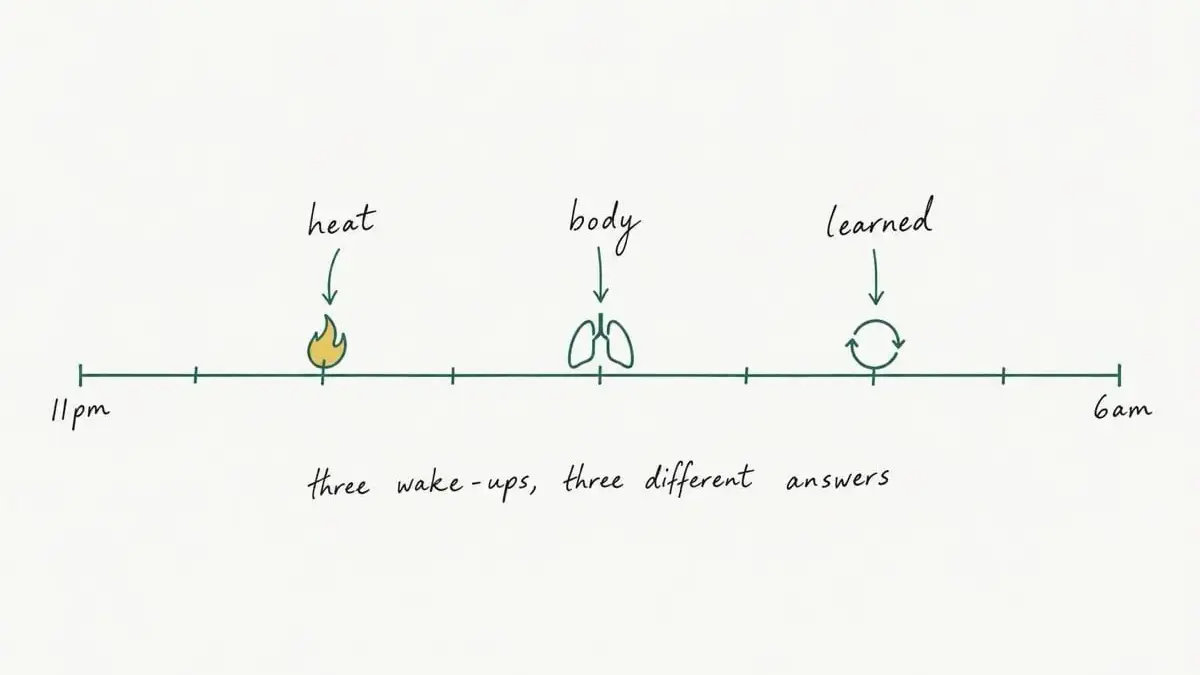
Clinical observations indicate that menopause-related sleep disturbances are not a monolithic issue. Instead, they represent at least three distinct wake-up patterns wearing the same outward symptom: heat-driven waking, body-driven waking caused by physiological factors such as disordered breathing, and learned waking that persists long after hot flashes have faded. A remedy targeted at one specific pattern does little to resolve the other two. Determining which pattern dominates a person’s nights is the key to transforming an arbitrary list of remedies into an effective decision-making strategy.
Heat-driven waking is the phenomenon most commonly associated with menopause, and its impact is well-documented. In a study of 168 midlife women monitored using actigraphy, 78 percent of objectively recorded nocturnal hot flashes coincided with an actual waking episode. Furthermore, women were far more likely to be awake in the five minutes immediately following a flash than in the minutes leading up to it. While mere concurrence does not prove that every single awakening is initiated by a flash, the connection remains difficult to dismiss.
Body-driven waking represents a pattern that is frequently overlooked by primary care providers and patients alike. Data from the Sleep in Midlife Women Study revealed that the adjusted apnea-hypopnea index was roughly 31 percent higher after menopause than it was before the transition. This metric measures breathing disruptions rather than counting new clinical apnea diagnoses. What makes this finding vital is its clinical presentation: women suffering from obstructive sleep apnea often visit primary care clinics reporting insomnia, persistent fatigue, and low mood rather than the classic symptom of loud snoring, which is a primary reason the condition frequently goes undiagnosed in female patients.
Learned waking explains why some women remain wide awake at 3 a.m. years after their hot flashes have completely subsided. Over time, the bed transforms from a place of rest into an environment associated with mental arithmetic, anxiety, and worrying about the coming day. This specific pattern is no longer driven by fluctuating hormones, yet it is paradoxically the category supported by the most robust non-pharmacological treatments available.
While these three categories serve as a practical organizing framework rather than a rigid clinical classification, real-world weeks frequently involve a mix of all three. Nevertheless, separating the nights into distinct groups remains valuable because each category points toward a different, more targeted next step.
Natural Remedies, Ranked by the Evidence Behind Them
When evaluated strictly by the strength of the supporting scientific evidence, natural and non-pharmacological interventions for menopause sleep problems fall into a clear hierarchy: cognitive behavioral therapy for insomnia ranks first, regular exercise takes second place, and dietary or herbal supplements trail as a distant third.
In a randomized trial involving 106 midlife women suffering from frequent hot flashes and insomnia, telephone-delivered cognitive behavioral therapy for insomnia improved insomnia severity scores by an average of 5.2 points more than a menopause-education control group at eight weeks, with those gains successfully maintained at the 24-week mark. Currently, no dietary supplement possesses clinical evidence matching that level of sustained efficacy.
Cognitive behavioral therapy for insomnia functions as a structured therapeutic course rather than a collection of casual lifestyle tips. Typically delivered over four to eight sessions by a clinician, a trained therapist, or a guided digital program, it focuses on core behavioral mechanics. These include maintaining a single, consistent wake time every day, restricting time spent in bed to match actual sleep duration, getting out of bed instead of lying awake in frustration, and dismantling the cognitive thought loops that paralyze sleep at 3 a.m.
Professional medical organizations consistently point to this modality as a primary intervention. The American College of Physicians recommends cognitive behavioral therapy for insomnia as the initial treatment for all adults suffering from chronic insomnia, issuing a strong recommendation based on moderate-quality evidence, with medication considered only through shared decision-making if behavioral therapy alone proves insufficient. While that particular guideline applies broadly to adults with chronic insomnia rather than exclusively to menopausal populations, clinical trials focusing specifically on midlife women yield supportive results.

However, a crucial clinical distinction exists regarding sleep hygiene. The American Academy of Sleep Medicine recommends utilizing the full, multicomponent version of cognitive behavioral therapy for insomnia while advising against relying on basic sleep hygiene tips as a stand-alone treatment. Consequently, the standard advice regarding dark rooms, avoiding screens, and cutting off late-afternoon caffeine is not a complete treatment in itself; it merely establishes a baseline foundation.
Exercise provides a secondary level of support, though with a more modest effect size. Pooled individual-participant data across four trials conducted by the Menopause Strategies: Finding Lasting Answers for Symptoms and Health network found that structured exercise reduced Insomnia Severity Index scores by an average of 2.1 points relative to control groups, compared to the 5.2-point reduction achieved by cognitive behavioral therapy. While a two-point drop represents a genuine and worthwhile clinical improvement, expectations must remain realistic regarding its ability to carry the entire therapeutic load.
Supplements occupy the third tier, requiring careful evaluation of their specific evidence bases. Because supplements can interact adversely with prescription medications and with each other, medical professionals consistently advise patients to review any planned regimen with a clinician or pharmacist before starting.
Regarding the ubiquitous advice to cool the bedroom environment, controlled clinical evidence demonstrating that lower room temperatures directly treat menopausal insomnia remains sparse. Controlled studies examining healthy adult subjects show that warming the skin of the trunk and upper legs by less than one degree Celsius can shorten sleep-onset latency by approximately three minutes. Because that research did not specifically investigate menopause or cooling interventions, it neither conclusively supports nor refutes traditional bedroom-cooling advice. Nonetheless, maintaining a cooler bedroom environment with breathable bedding and fans remains useful for comfort, ensuring that night sweats cause minimal disruption, even if a thermostat cannot dismantle a psychological thought loop at 3 a.m.
What One Week of This Actually Looks Like
In practical terms, approaching midlife sleep disruption methodically can initially feel uneventful. The process begins by selecting a single wake time and holding it firmly every day of the week, including weekends. Each morning involves recording three simple observations: the hour of waking, whether heat played a role, and whether any breathing-related symptoms or daytime fatigue surfaced. Ceasing the constant addition of new interventions allows the daily log, rather than a supplement label, to reveal which specific wake-up pattern is disrupting rest.
Consider two hypothetical midlife profiles illustrating contrasting pathways. Tricia, aged 49 and in early perimenopause, maintains a log showing four awakenings across seven nights, three of which involved damp sheets requiring a linen change and the activation of a bedside fan, with no disruptions noted in the breathing column. Her pattern is clearly heat-driven. Her management strategy avoids a sweeping overhaul of eight different habits; instead, she fixes her wake time at 6:15 a.m., incorporates daily walks, utilizes breathable bedding, and brings a concise note detailing her night-sweat frequency to her next clinical appointment.
For Tricia, the daily log serves a psychological function, translating the generalized feeling of never sleeping into precise clinical data: four nights out of seven, featuring three instances of night sweats, sustained over an eleven-week period.
Marlene, aged 54 and two years past her final menstrual period, experiences a different trajectory. Her hot flashes have largely subsided, yet she routinely wakes at 3:10 a.m. Her log records zero instances of heat, but reveals a consistent habit of lying awake in bed for 90 minutes mentally composing the next day’s to-do list. Furthermore, her breathing column is not entirely clear; her spouse has mentioned occasional snoring, and she frequently nods off in front of the television by 8:00 p.m.
Consequently, Marlene’s log points toward two distinct next steps: discussing cognitive behavioral therapy for insomnia with her physician to address the learned wake pattern, and simultaneously raising the issue of snoring and daytime sleepiness during the same medical appointment rather than dismissing them as ordinary fatigue. In the interim, she adopts the practice of getting out of bed whenever she remains awake for 20 minutes, preventing her brain from associating the bed with wakeful rumination.
Adhering to a logging routine for a single week before introducing new variables prevents the common pitfall of simultaneously adopting magnesium supplements, blackout curtains, specialized pillows, and sleep-tracking applications, which ultimately obscures which intervention, if any, provided relief.
Furthermore, midlife sleep disruption rarely occurs in an isolated vacuum; it typically intersects with shifting personal and professional responsibilities, underscoring the importance of viewing these challenges without self-blame.
When This Needs a Clinician, Not a Remedy
Certain nocturnal symptoms signal that sleep disruption has moved beyond what over-the-counter remedies can address. Loud snoring, breathing that repeatedly pauses and starts, audible gasping or choking noises, and persistent daytime exhaustion are highlighted by health authorities as primary indicators of underlying conditions such as sleep apnea. Medical guidance consistently recommends consulting a physician regarding these symptoms rather than continuing to experiment with products down a supplement aisle.
Similarly, sleep difficulties persisting at a frequency of at least three nights a week for three months or more meet the duration and frequency thresholds established by sleep medicine organizations for chronic insomnia.
While medical professionals emphasize that dismissing persistent exhaustion with the phrase "it’s just menopause" can delay appropriate care, exploring hormone therapy represents a valid consideration during a clinical evaluation. Position statements from professional menopause societies recognize hormone therapy as the most effective available treatment for moderate to severe hot flashes and night sweats, noting subsequent improvements in sleep quality when disturbances are directly tied to vasomotor symptoms.
However, hormone therapy is not viewed as a stand-alone treatment for primary chronic insomnia, and its suitability depends entirely on a personalized benefit-risk assessment conducted by a qualified healthcare provider.
Start With One Night, Not Eight Changes
Establishing a clear path forward begins with a simple decision made before purchasing any remedy: selecting a consistent wake time. Placing a notepad by the bed to record the hour of awakening, the presence of heat, and any observations regarding breathing or daytime fatigue for seven consecutive days provides an inexpensive diagnostic tool.
Maintaining this routine without adding new supplements or routines transforms a vague complaint of poor rest into actionable data that a clinician can utilize, turning an overwhelming shelf of guesswork into a focused, evidence-based strategy for restoring midlife health.
Leave a Reply