
For millions of women navigating the menopausal transition, the exhaustion that settles in by Thursday morning is a uniquely frustrating burden. It is not merely the result of a stressful week at the office or a racing mind over routine worries. Instead, it is a chronic disruption that shows up at both ends of the night—making it increasingly difficult to fall asleep, and even harder to stay asleep.
Data from the landmark Study of Women’s Health Across the Nation, which followed 3,045 women enrolled between the ages of 42 and 52, demonstrates that the odds of experiencing both types of sleep trouble steadily rise across the menopausal transition. The nights repeat in a relentless cycle, often when nothing else in life has changed. That specific combination is the telltale sign, and it explains why generic sleep advice repeatedly bounces off midlife women seeking relief.
For a significant number of women, the staying-asleep half of the night is the loudest and most disruptive element. It follows a painfully familiar shape: falling asleep by eleven without much trouble, only to jolt awake at 2:40 a.m., damp with sweat, kicking the covers off and then pulling them back up minutes later. After a restless stretch, there is another awakening at 4:15 a.m., followed by a permanent rise at six, driven by professional obligations that care nothing for a broken night.
By the end of the workweek, the cumulative deficit takes a heavy toll. Women find themselves short-tempered with people they love and struggling to comprehend basic communications, such as rereading the same electronic mail message four consecutive times. Secondary analyses tracking ten years of the same cohort revealed that insomnia symptoms were present in 31 percent of women during early perimenopause in the first year, climbing to 39 percent by year ten. Among women in late perimenopause, the figures started at 32 percent and rose to 48 percent over the same decade.
These figures represent self-reported symptoms occurring at least three times a week rather than clinically diagnosed insomnia, and they fluctuate across stages and years. Yet they underscore a vital reality: experiencing these struggles does not make a woman the isolated outlier she feels like at 3 a.m. More concerningly, many women have begun to genuinely dread the bed itself—a psychological shift that is entirely new and carries far more weight than any supplement bottle sitting on a bathroom counter.
Why the Usual Natural Remedies Keep Failing You
Natural remedies for broken midlife sleep frequently fail because they arrive as an unorganized list of options lacking clear hierarchy, underlying mechanisms, or graded evidence. Melatonin serves as the clearest example of this disconnect. When pooled across four randomized trials involving menopausal women, its measured effect on overall sleep quality was not statistically significant. In scientific terms, this indicates uncertainty rather than outright disproven efficacy, but that nuance is rarely captured on the label of a retail box.
Valerian root fares no better under rigorous scientific scrutiny. An umbrella review published in 2024 synthesized eight systematic reviews examining valerian for sleep disturbances and judged the existing evidence to be weak or inconclusive, finding no demonstrable evidence of efficacy specifically for insomnia.
Consequently, a frustrated consumer typically tries one remedy, gives it a two-week trial, feels no tangible difference, and quietly concludes that the failure lies with them. In reality, the problem is not personal failure. Women are routinely handed a retail shelf and told to guess—a fundamentally flawed approach to treating menopause insomnia, a complex physiological condition driven by at least three separate underlying causes.
Menopause Sleep Problems Are a Wake-Up Pattern, Not One Problem
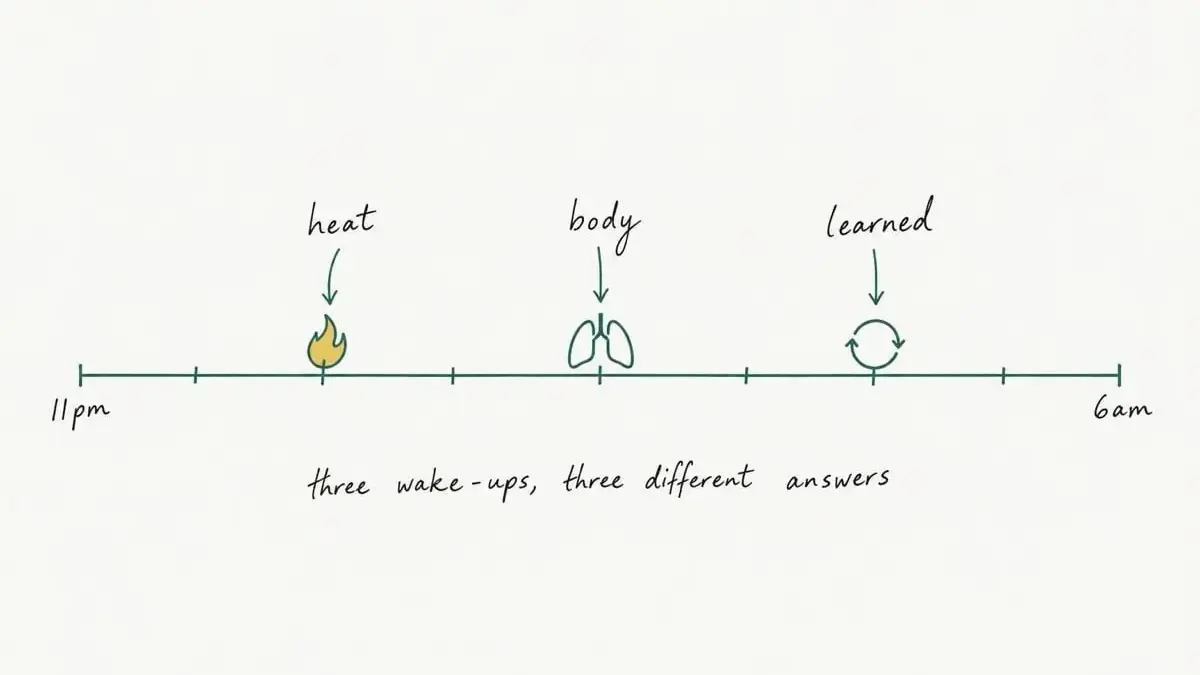
Menopause sleep problems cannot be categorized as a single uniform issue. Instead, they manifest as at least three distinct wake-up patterns wearing the same outward symptom: heat-driven waking, body-driven waking stemming from issues such as disordered breathing, and learned waking that persists long after the hormonal flashes have faded. A remedy aimed squarely at one of these patterns will naturally do little for the other two. Determining which specific pattern dominates a person’s nights is the critical step that transforms a random list of remedies into an effective decision-making strategy.
Heat-driven waking is the phenomenon everyone pictures, and its impact is thoroughly documented. Among 168 midlife women monitored using actigraphy, 78 percent of objectively recorded nocturnal hot flashes coincided directly with an awakening episode. Furthermore, women were significantly more likely to be awake in the five minutes immediately following a flash than in the minutes preceding it. While chronological concurrence does not mathematically prove that every awakening initiates with a flash, the physiological link is exceedingly difficult to dispute.
Body-driven waking represents the pattern that is most frequently missed by primary care providers. Data from the Sleep in Midlife Women Study revealed that the adjusted apnea-hypopnea index was roughly 31 percent higher after menopause than before it. This metric tracks breathing events rather than counting new clinical apnea diagnoses. What makes this finding crucial is how the condition presents clinically: women suffering from obstructive sleep apnea frequently visit primary care clinics reporting insomnia, fatigue, and low mood rather than the characteristic loud snoring typically associated with men. This presentation is a primary reason why sleep-disordered breathing remains vastly undiagnosed among women.
Learned waking explains why some women remain wide awake at 3 a.m. two years after their hot flashes have completely subsided. Over time, the bed has transformed into a psychological environment where an individual lies awake performing mental arithmetic about the upcoming day. This is no longer fundamentally a hormone problem; rather, it is a behavioral conditioning pattern backed by the most robustly evidenced non-pharmacological treatments available.
While sorting nights into these three distinct categories serves as a conceptual organizing framework rather than a rigid clinical classification—and real-world weeks frequently blend them—the categorization remains immensely useful. Each group points directly toward a different subsequent course of action.
Natural Remedies, Ranked by the Evidence Behind Them
When evaluated strictly by the strength of the scientific evidence supporting them, natural remedies for menopause sleep problems fall into a clear hierarchy: cognitive behavioral therapy for insomnia ranks first, regular exercise takes second place, and nutritional supplements trail as a distant third.
In a randomized clinical trial tracking 106 midlife women suffering from frequent hot flashes and insomnia, telephone-delivered cognitive behavioral therapy for insomnia improved insomnia severity scores by approximately 5.2 points more than a menopause-education control group at eight weeks, with those gains successfully maintained at the 24-week mark. No commercial supplement currently boasts clinical evidence matching that magnitude of improvement.

Cognitive behavioral therapy for insomnia functions as a structured therapeutic treatment rather than a collection of casual lifestyle tips. Typically delivered over four to eight sessions by a clinician, trained therapist, or guided digital platform, it targets the underlying mechanics of sleep. This involves establishing a single wake time maintained rigorously every day, restricting time spent in bed to closely match actual sleeping time, getting out of bed instead of lying awake ruminating, and dismantling the midnight thought loops that feed chronic insomnia.
Professional medical societies point to this intervention as the primary standard of care. The American College of Physicians recommends cognitive behavioral therapy for insomnia as the initial treatment for all adults suffering from chronic insomnia, issuing a strong recommendation based on moderate-quality evidence, with pharmacological options reserved for shared decision-making if behavioral therapy alone proves insufficient. While that clinical guideline addresses chronic adult insomnia broadly rather than menopause specifically, clinical trials focusing on midlife women with hot flashes validate its effectiveness in this specific demographic.
A vital distinction must be made regarding sleep hygiene. The American Academy of Sleep Medicine recommends the comprehensive multicomponent version of cognitive behavioral therapy for insomnia while explicitly advising against relying on sleep hygiene measures as a standalone treatment. The tidy checklist of maintaining a dark room, avoiding screens, and cutting off late-afternoon caffeine is not the treatment itself; it merely forms the foundational floor.
Exercise occupies the second tier of the evidence-based hierarchy, delivering a modest but honest effect size. Pooled individual-participant data across four trials conducted by the Menopause Strategies: Keeping Healthy and Aging Well network found that structured exercise reduced Insomnia Severity Index scores by an average of 2.1 points relative to control groups, compared to the 5.2-point reduction achieved by cognitive behavioral therapy. A two-point reduction represents a genuine, albeit modest, improvement—worth pursuing, but not capable of carrying the entire therapeutic load on its own.
Supplements occupy the third tier, requiring a clear look at what the scientific data actually demonstrates. Because supplements interact extensively with conventional medications and with each other, medical professionals invariably advise consulting a clinician or pharmacist prior to introducing them.
Regarding environmental adjustments, popular advice routinely urges women to cool their bedrooms. However, controlled clinical evidence demonstrating that lower room temperature directly treats menopausal insomnia is sparse. Controlled studies investigating healthy adult populations have shown that warming the skin of the trunk and upper legs by less than one degree Celsius can shorten sleep-onset latency by approximately three minutes. That research did not target menopause or ambient cooling, meaning it neither validates nor refutes standard bedroom cooling advice. Maintaining a fan and breathable bedding remains practical because experiencing a night sweat is undeniably less miserable when one is not trapped beneath heavy flannel. Ultimately, these measures serve as creature comforts rather than definitive medical treatments, and a thermostat cannot resolve a midnight psychological thought loop.
What One Week of This Actually Looks Like
In practical terms, adopting an evidence-based approach to midlife sleep disruption is remarkably straightforward, though rarely glamorous. An individual begins by selecting a single wake time and holding it rigidly, including on weekends. Each morning involves noting three basic details: the approximate time of waking, whether a vasomotor heat event was involved, and whether any respiratory issues or daytime exhaustion arose. This process avoids piling on multiple overlapping interventions. By the fifth day, a personal log—rather than a supplement bottle label—clarifies precisely which wake-up pattern is dominating the night.
Consider the hypothetical scenarios of two midlife readers. Tricia, aged 49 and in early perimenopause, maintains a log revealing four nocturnal wakings over seven nights. Three of those awakenings involved changing damp sheets and turning on a bedside fan, with no abnormalities noted in her breathing column. Her pattern is clearly heat-driven. Her weekly adjustment does not involve eight different lifestyle overhauls; instead, she establishes a fixed wake time of 6:15 a.m., incorporates regular daily walks, switches to breathable bedding, and logs her hot flash frequency to share at her next clinical appointment, all without purchasing commercial remedies.
Marlene, aged 54 and two years past her final menstrual period, experiences a different reality. Her hot flashes have largely resolved, yet she consistently wakes at 3:10 a.m. Her log records zero heat events but highlights a persistent habit of lying awake for ninety minutes composing mental to-do lists for the following day. Furthermore, her breathing column is not empty; her spouse has mentioned hearing her snore on multiple occasions, and she frequently finds herself falling asleep in front of the television by 8:00 p.m. Her log points toward two distinct next steps: discussing cognitive behavioral therapy for insomnia to address her learned behavioral patterns, and raising the issues of nocturnal snoring and daytime somnolence during the same medical appointment rather than dismissing them as ordinary fatigue. In the interim, she resolves to get out of bed after twenty minutes of wakefulness rather than training her brain to associate the mattress with cognitive arousal.
Both individuals maintain their logs for a full week before implementing any changes. This disciplined pause prevents the common trap of launching magnesium supplements, blackout curtains, specialized pillows, and sleep tracking applications simultaneously, which prevents any meaningful assessment of what actually helps.
When This Needs a Clinician, Not a Remedy
Certain nocturnal disturbances extend far beyond what self-care remedies can resolve. Loud snoring, breathing that repeatedly stops and starts, gasping or choking sensations during sleep, and persistent, overwhelming daytime fatigue are identified by major public health organizations as primary clinical indicators of obstructive sleep apnea. Medical guidance consistently advises consulting a qualified physician regarding these symptoms rather than navigating a retail supplement aisle. The same professional evaluation is warranted for sleep difficulties that persist at least three times a week for a duration of three months or longer—the established diagnostic threshold for chronic insomnia defined by the American Academy of Sleep Medicine.
Medical professionals caution that dismissing severe sleep disruption with the assumption that "it’s just menopause" is the single most common pitfall that can cost a patient years of unnecessary suffering. Because sleep-disordered breathing in women frequently presents as insomnia, chronic fatigue, and depressed mood rather than disruptive snoring, clinical oversight is essential.
For women whose sleep disruption is tightly coupled with vasomotor symptoms, hormone therapy remains a viable subject to raise during a medical consultation. Professional organizations, including The North American Menopause Society, have noted in clinical position statements that hormone therapy is the most effective available treatment for moderate to severe hot flashes and night sweats, delivering secondary improvements in sleep quality when disturbances are directly tied to those symptoms. However, hormone therapy is not classified as a standalone insomnia treatment, and its appropriateness depends entirely on an individualized benefit-risk assessment conducted by a licensed clinician.
Start With One Night, Not Eight Changes
The most effective initial action requires no financial investment, commercial application, or complex routine. An individual can begin tonight by placing a simple notepad beside the bed divided into three columns: the hour of waking, the presence or absence of heat, and any observations regarding breathing or daytime fatigue. Maintaining that log while holding a single, consistent morning wake time for seven consecutive days provides the necessary foundation.
This straightforward log serves as an inexpensive diagnostic tool, converting vague distress into concrete clinical data. It transforms a bewildering array of natural remedies for menopause sleep problems from a shelf of guesswork into a targeted conversation with a healthcare provider, ensuring that midlife sleep disruptions are addressed with the precision and seriousness they require.
Leave a Reply