The phenomenon of impulse buying continues to trap consumers even after they explicitly decide to stop, primarily because general financial resolutions must contend with highly specific, frictionless purchasing moments. A broad mental commitment to spend less money is constantly pitted against eleven-second transactions on living room couches, complete with logged-in shopping applications, saved credit card credentials, and psychological banners warning that a price will expire at midnight. This dynamic creates an uneven playing field where a general resolution must successfully win the psychological tug-of-war every single time, whereas it only needs to fail once a week to completely undo an entire month of fiscal restraint.
Consumers caught in this cycle are typically not careless with their financial resources. Many actively monitor their account balances, read financial advice articles, and attempt standard cooling-off periods, such as waiting a full day before finalizing a purchase. While these measures occasionally hold for brief periods, the spending behavior inevitably returns, typically manifesting in the exact same environments. It recurs in the same applications, during the same evening hours, and amid the same weekly stressors. Behavioral analysts note that while a single unplanned transaction can easily be dismissed as a temporary lapse in judgment, multiple purchases bearing the exact same behavioral fingerprint constitute a distinct pattern. Recognizing this distinction allows individuals to address the root cause of the behavior rather than viewing it as an immutable personal flaw.
The Mechanics of Failed Spending Rules
When examining where financial rules are written versus where purchasing decisions actually occur, a significant geographical and psychological disconnect becomes apparent. Rules are typically established in calm environments, such as a Sunday morning at a kitchen table, while spending occurs in high-friction psychological states, such as a Thursday night following an exhausting workday. A spending rule must successfully travel between these two disparate contexts, navigating checkouts engineered to require only three taps, urgent countdown timers, and the accumulated stress of daily life. Because traditional spending rules rarely address the immediate point of sale, they frequently fail under pressure.
This vulnerability is entirely by design within the modern retail landscape. Saved payment credentials, one-tap checkouts, free return policies, and expiring promotional banners are deliberately constructed to minimize the temporal gap between the initial desire for an item and its ultimate acquisition. Retail platforms arrange their digital storefronts and interfaces to ensure that completing a transaction requires fewer taps than it takes for a consumer to evaluate whether they genuinely need the product.
Consequently, much of the conventional advice regarding impulse spending—such as avoiding shopping malls, drafting strict shopping lists, implementing 24-hour waiting periods, or paying exclusively in cash—often falls short. While none of these strategies are inherently incorrect, they tend to target generic consumer behavior rather than the specific, individualized triggers that prompt unplanned purchases in the first place.
Shifting Focus from Generic Rules to Specific Triggers
Traditional financial advice often advocates for rigid rules before consumers fully understand the specific timing, context, and psychological states accompanying their purchases. A thorough review of a credit card statement from the preceding 30 days frequently reveals repeating patterns regarding when, where, and why unplanned expenditures occur. Determining whether purchases cluster around specific repeating situations is critical, as a financial rule is only effective when it directly intercepts one of those specific triggers.
Standard advisory concepts, such as mandatory 24-hour or 48-hour waiting periods, lack rigorous empirical backing in formal research measuring subsequent purchase retention or long-term buyer regret. Similarly, the ongoing debate surrounding cash versus card usage remains empirically unsettled regarding its direct impact on impulse control. While these basic rules remain harmless to try, relying on them as primary protective mechanisms often leads to misplaced frustration when a rule inevitably slips.
Instead, academic research consistently highlights two primary drivers behind unplanned purchases: the presence of urgency cues within the retail environment and the consumer’s emotional state during the purchasing hour. Identifying these underlying triggers allows individuals to implement targeted interventions specifically designed to block them.
Analyzing the 30-Day Financial Record
Addressing impulse spending effectively begins with a diagnostic review of financial records rather than an immediate enforcement of new restrictions. By examining card statements and order histories from primary shopping applications over a recent 30-day period, consumers can identify every transaction that would not have appeared on a morning shopping list. Documenting the transaction amount, date, time, location, and the immediate activity preceding the purchase provides clarity on spending habits.

This diagnostic audit typically yields two essential data points: the total monetary volume of unplanned spending and the specific contexts where entries cluster. Clustering might reveal that a significant portion of unplanned transactions occurs within a single application late at night, coinciding with natural decision fatigue as cognitive energy depletes toward the end of the day.
While comprehensive financial tracking packages combining budgeting, borrowing oversight, and behavioral reflection have been shown in academic field research—such as studies published in the Journal of Financial and Quantitative Analysis—to reduce online borrowing and delinquency charges primarily by curtailing entertainment spending, tracking functions most reliably as a diagnostic tool. It uncovers patterns rather than serving as a standalone cure for impulse acquisition.
Categorizing Purchasing Triggers
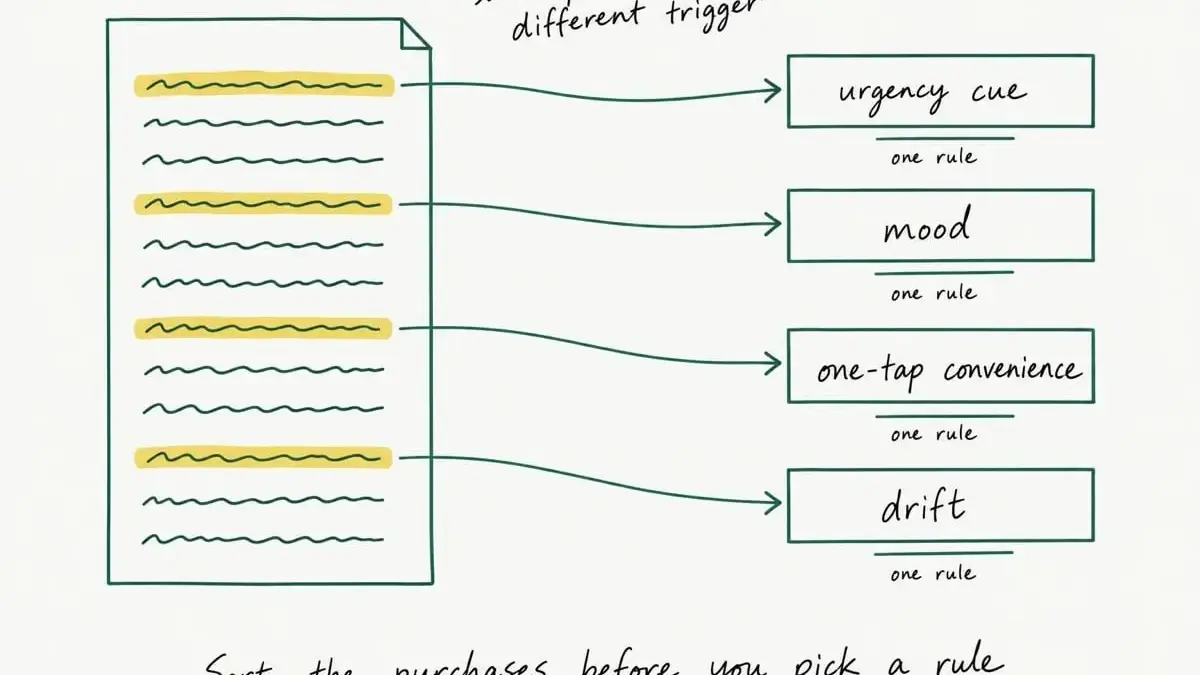
To address unplanned expenditures effectively, transactions can be sorted into distinct behavioral categories based on their primary triggers. The first category involves urgency cues, such as countdown timers, flash sales, and low-stock warnings. Research published in Current Psychology demonstrates that limited-time and limited-quantity scarcity appeals significantly influence impulse-buying intentions, with the fear of missing out acting as a primary psychological driver while anticipated regret modulates its strength.
The second category centers on emotional state, where academic literature particularly highlights the influence of sadness. Studies published in PLOS ONE indicate that sadness reliably increases the valuation of goods, leading individuals to set higher prices and engage in increased purchasing behavior compared to those in neutral emotional states. While stress and boredom are frequently blamed for similar outcomes, individual patterns dictate how specific emotional triggers manifest.
The remaining categories encompass one-tap convenience, where saved payment credentials and immediate application access facilitate frictionless spending, and drift, which occurs when a consumer enters a digital or physical store without a specific acquisition target and subsequently discovers one.
Implementing Contextual Rules and Periodic Reviews
Once primary triggers are identified, targeted rules must be established directly at the location of the trigger. Rather than relying on broad behavioral vows, effective rules pair the specific trigger with an exact, non-negotiable counter-action. For urgency cues, rules might dictate closing the browser tab immediately and recording the item in a dated note to be evaluated days later at full price. For one-tap convenience, removing saved payment credentials and logging out of specific applications disrupts the automated purchasing flow. For mood-driven spending, establishing alternative coping mechanisms during vulnerable hours prevents retail therapy, while addressing drift requires strict adherence to pre-written shopping lists before entering any retail environment.
Maintaining these rules requires regular evaluation through periodic check-ins. Re-evaluating spending records every two weeks allows individuals to assess whether unplanned purchase counts and totals have decreased. If a specific rule is repeatedly breached, replacing it with a more sustainable alternative prevents the accumulation of overly complicated systems that ultimately fail.
For most individuals, identifying underlying spending clusters provides sufficient insight to regain financial control. However, when persistent purchasing behaviors cause severe distress, financial strain, or emotional distress that aligns with clinical definitions of compulsive buying—a condition documented in psychiatric literature as affecting a notable percentage of the adult population—seeking guidance from a qualified healthcare professional remains the most appropriate course of action.