
The math of the modern workday rarely adds up. Fourteen distinct items stare from a morning task list, eleven of them stamped with high-priority markers. Two arrived via an early email from a supervisor, three emerged from a sudden customer escalation, and one is a strategic memorandum that has been pushed forward across four consecutive Mondays. Every single item on that register is defensible. That, as professionals across industries increasingly discover, is the core of the problem.
Priority levels were originally invented to sort this administrative chaos. In practice, however, they frequently end up renaming it. A new field is added to digital dashboards featuring options like P1, P2, and P3, and within a single month, every request that matters to anyone arrives pre-stamped as a top-tier emergency. The labels appear neat and organized, yet professionals still find themselves sitting at their desks at 7:00 PM on a Thursday, agonizing over which essential promise to break.
The fundamental flaw lies in how labels are treated. A priority level only functions effectively when it exacts a genuine cost: when it takes something away, such as a time slot, a day, or another task’s place in line. A label that costs nothing gets spent with absolute freedom. Ultimately, a tracking scale where every item sits at level one is nothing more than an ordinary list outfitted with extra steps. Understanding what these levels actually represent, why they inevitably degrade, and how to implement a scale that forces real choices reveals the hidden mechanics behind daily professional overload.
What Priority Levels for Tasks Actually Are
At their core, priority levels for tasks are designed as a fixed set of labels that rank work according to the specific damage it prevents and the speed with which it must be resolved. Within IT service management, these labels traditionally emerge from a structured matrix combining impact—the measurable scale of business loss—with urgency, which dictates the expected speed of resolution. The highest combination invariably maps to Priority 1, reserved for critical incidents. On a personal task list, a functional label is supposed to do the exact same job: dictate what must be done immediately and what must be dropped to accommodate it.
This operational heritage matters significantly. Incident response teams document their top-tier classifications in meticulous, painful detail. One major network vendor, for instance, formally defines a Priority 1 issue as a critical business outage that affects essential sites, multiple locations, multiple VPN users, or core applications. Notably, such definitions deliberately omit subjective factors such as who asked for the fix, how loudly they complained, or how recently the request landed in an inbox.
Organizations vary widely in how many tiers they employ. While there is no universal standard, and any insistence on a strict five-tier model merely describes an internal corporate rule, common frameworks abound. One prominent software provider relies on a three-tier model comprising P1 Urgent, P2 High, and P3 Normal. Cisco operates across four severity levels, ranging from Severity 1 for critical business impact down to Severity 4 for requests carrying no business impact at all. Industry platforms like PagerDuty note that schemes commonly run from P1 through P5, where lower numbers denote greater impact, with labels configured dynamically per account.
Three, four, or five tiers—all of these models are entirely legitimate and deployed daily within serious enterprises. Yet the numerical count is not what makes a scale functional. The strict, written entry test required for each level is what matters, and that is precisely the component that professionals almost universally fail to port over to their personal lists.
Why Priority Labels Stop Meaning Anything by Week Three
Labels inevitably inflate for a remarkably boring structural reason: the label itself is free, while an ordinary Tuesday is severely constrained. Anyone can mark a request as urgent at zero cost, including the overwhelmed professional receiving it. Consequently, the top tier fills rapidly until it ceases to carry any distinguishing information. By week three, a P1 designation no longer signifies a genuine crisis. Instead, it merely indicates that a task is recent, particularly loud, or backed by someone in a senior position.
The scale does not fail because people actively abuse it. It fails because nothing within the system is truly scarce. Urgency cues exert a powerful psychological influence over human decision-making. Across various experimental settings, individuals consistently opted for objectively lower-payoff tasks when those tasks carried a simple urgent or expiring cue, even when alternative options promised significantly higher returns. Researchers have dubbed this phenomenon the mere urgency effect. While those studies involved consumer choices with manufactured deadlines rather than complex professional inboxes, they highlight a persistent human tendency to gravitate toward flashing red flags, regardless of underlying value.
The classic distinction between urgent and important matters—a staple of productivity literature—traces its roots back decades. President Dwight D. Eisenhower famously introduced the concept during an address in Evanston, Illinois, in August 1954, attributing the line to a former college university president: "I have two kinds of problems, the urgent and the important. The urgent are not important, and the important are never urgent." The ubiquitous two-by-two grid now known as the Eisenhower matrix represents a later adaptation popularized in academic and corporate training.
Yet making this distinction does not automatically solve daily operational friction; it merely highlights its complexity. Sorting tasks into four distinct boxes still leaves professionals facing a reality where eleven items sit crammed into the important category while only a single Tuesday remains to address them. Furthermore, constant re-sorting is far from free. Laboratory studies examining task-switching behavior demonstrate that the time cost associated with alternating between tasks grows alongside the complexity of the underlying rules, shrinking only when a clear, explicit cue identifies the immediate next action. Deciding what matters dozens of times a day imposes its own cognitive tax, explaining why decision fatigue frequently manifests by late afternoon as an untouched task list.

Implementing a Structured Scale That Forces Real Choices
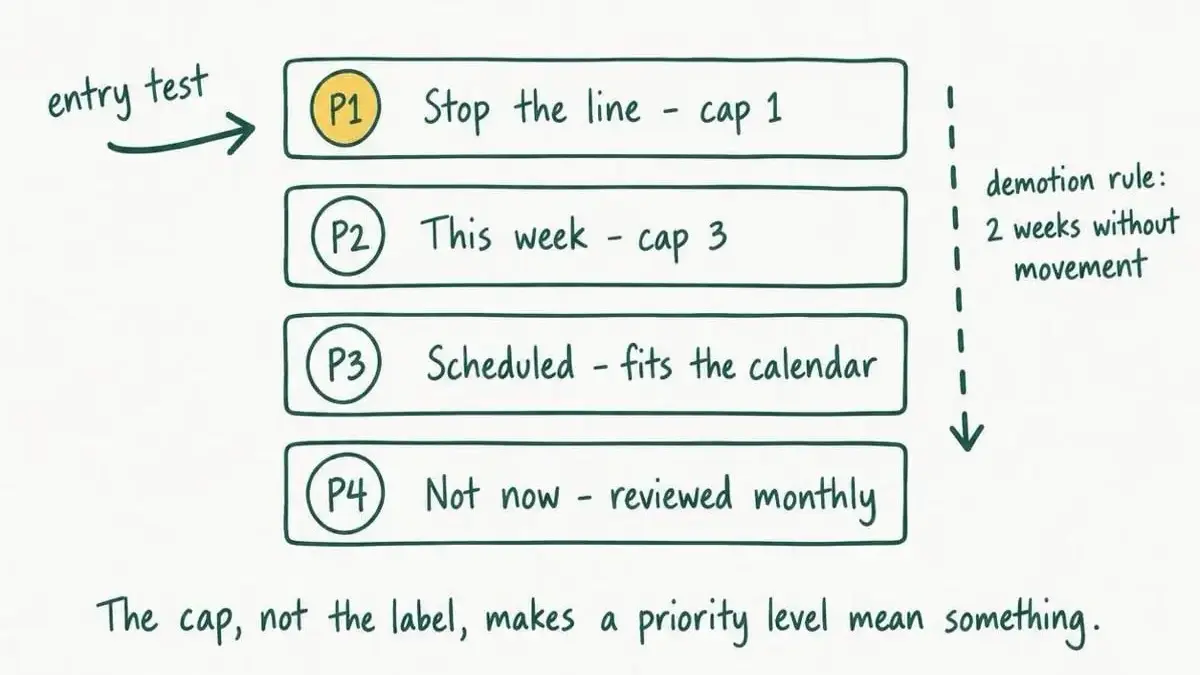
Constructing a reliable scale requires borrowing the core impact-and-urgency logic from incident management while integrating the two vital elements that personal task lists routinely omit: a strict numerical cap on how many items can occupy each level, and an explicit, stated cost for placing an item there.
Under a four-tier operational model, the top tier—often designated as P1 or "Stop the Line"—is strictly reserved for work that prevents active damage on the current day. To pass the entry test, someone outside the immediate team must be actively blocked at that exact moment, or an impending daily commitment faces imminent failure. The operational cost of this level is absolute: everything else shifts by a day, and that reality must be communicated openly.
The second tier covers dated commitments made to a specific, named individual, carrying a due date within the current week. No new items can enter this tier until an existing one is officially closed. The third tier accommodates scheduled work that requires a specific calendar slot but does not constitute an immediate crisis for the current week, subject to weekly review. The final tier holds everything else honestly, functioning as a holding space that is reviewed monthly and cleared out after ninety days.
The implementation of strict caps is what allows the entire system to function properly. Grounded in foundational operational principles like Little’s Law—which posits that the average number of items in a stable system equals the arrival rate multiplied by the average time each item spends within it—holding too many items open inevitably stretches the time required to finish anything. Four open mid-tier promises do not get completed any faster simply because they all share a high-priority label; instead, they get finished much later, one by one, while the professional carries the heavy psychological weight of them all.
Writing these explicit entry tests in advance, rather than attempting to judge each incoming request on the fly, provides an essential safeguard. Formalized rules established during quiet moments are significantly harder to talk oneself out of during the heat of a high-pressure afternoon than spur-of-the-moment judgments made while a colleague stands directly beside a desk.
Navigating Ordinary Operations and External Inputs
To observe this system in action, consider Curt, an operations manager for a mid-size logistics enterprise. His chief financial officer, Ellen, holds direct access to his schedule. On a typical Tuesday morning, Curt’s primary board memorandum occupies his second-tier slot, featuring a strict Thursday deadline and a named reader. His top-tier slot remains empty, representing an ideal start to the day.
At 9:12 AM, a warehouse integration breaks unexpectedly, blinding two major customers to their active shipments. By the written entry test, this qualifies instantly as a top-tier emergency because external parties are blocked. Crucially, the board memorandum does not get quietly demoted or left to languish; it moves deliberately to Wednesday, and Curt informs Ellen of the shift. Making that announcement out loud serves as the enforcement mechanism, preventing the hidden costs of a silently broken promise.
Later that morning, Ellen requests a comprehensive pricing analysis "as soon as possible, today if you can." With the top-tier slot already occupied by the warehouse failure, Curt delivers a precise capacity statement: he can begin the analysis at two o’clock once the integration is resolved, or he can take it on immediately and let the integration wait, leaving the choice to her. This approach replaces vague complaints of being overwhelmed with concrete operational options.
The most frequent objection raised against priority scales is that professionals rarely control their own inputs. When a chief executive marks every incoming email as critical, or a major client escalates matters purely by volume, an internally constructed scale seemingly holds little authority. Yet the system still provides immense value because its true output is not a neatly sorted list, but a visible trade that someone else must formally approve or decline.
When a request arrives pre-labeled as urgent, the conversation shifts instantly from arguing over vocabulary to evaluating consequences. By outlining precisely what must slip to accommodate the new demand, most senior leaders respond rationally to the resourcing trade-off. Ultimately, maintaining strict boundaries through a capped priority system transforms chaotic days from exercises in hollow busyness into manageable, predictable workflows.



Leave a Reply