Your alarm goes off at 6:10 in the morning. You are upright by 6:12, moving toward the kitchen by 6:15, and yet you still could not recite your own phone number if asked. You stand blankly in front of the open refrigerator, unable to make a single decision. You read the same text message three separate times without processing it. Around 6:40, the cognitive fog finally begins to thin, and you start to feel like a functioning person—which happens to be roughly the exact moment you need to walk out the door.
For the rest of the day, you carry the lingering assumption that you must have a chronic sleep problem.
Perhaps you do. However, the physiological phenomenon occurring between 6:10 and 6:40 has its own distinct name, a dedicated body of research literature, and a list of remedies that looks nothing like the conventional advice you have been handed over the years. Most of those supposed morning tricks are not quick maneuvers you perform frantically at 6:12. Instead, they are decisions you have already made the night before, or choices locked in when you initially set your alarm clock.
Sleep Inertia Is a Measured State, Not a Character Flaw
In clinical and scientific literature, this transition period immediately after waking is known as sleep inertia—a state in which alertness and both mental and physical performance are significantly degraded, as documented by researchers Hilditch and McHill in 2019. In clinical writing, it manifests as grogginess, disorientation, and a stubborn difficulty in becoming fully awake, as noted by Trotti in 2017. It is a temporary, completely ordinary condition that happens even to people who sleep well. Nobody is sharp the exact second their eyes fly open.
Naturally, you have likely tried the standard catalogue of fixes. You have placed your alarm across the room, splashed freezing water on your face, left your phone out in the hallway, poured a larger cup of coffee, or attempted an earlier bedtime for three consecutive days. Some of those habits are reasonable enough. None of them, however, actually changed the texture of those twenty helpless minutes. The reason for this is not that you executed the strategies poorly.
The reality is that almost everything with genuine scientific evidence behind it happens long before you ever open your eyes.
The Honest Answer to "How Do I Get Rid of It" Is Disappointing First, Useful Second
When people search for ways to eliminate morning grogginess, the remedies they reach for immediately tend to have thin and mixed evidence behind them. The factors that possess the most consistent scientific support are decided much earlier: how much total sleep you actually managed to get, and where your alarm lands relative to your internal body clock. Consequently, the better question is not what clears the fog at 6:12, but rather why your fog is running this thick to begin with.
Three primary variables govern the severity of sleep inertia.
The first is sleep debt. People consistently wake up performing worse after partial sleep deprivation than after a full eight-hour sleep opportunity. Furthermore, a long stretch of prior wakefulness before trying to sleep can make the subsequent wake-up considerably harder, according to Hilditch and McHill. Of the three main variables, this is typically the one you have the most control over, yet none of that control is exercised during the morning hours.
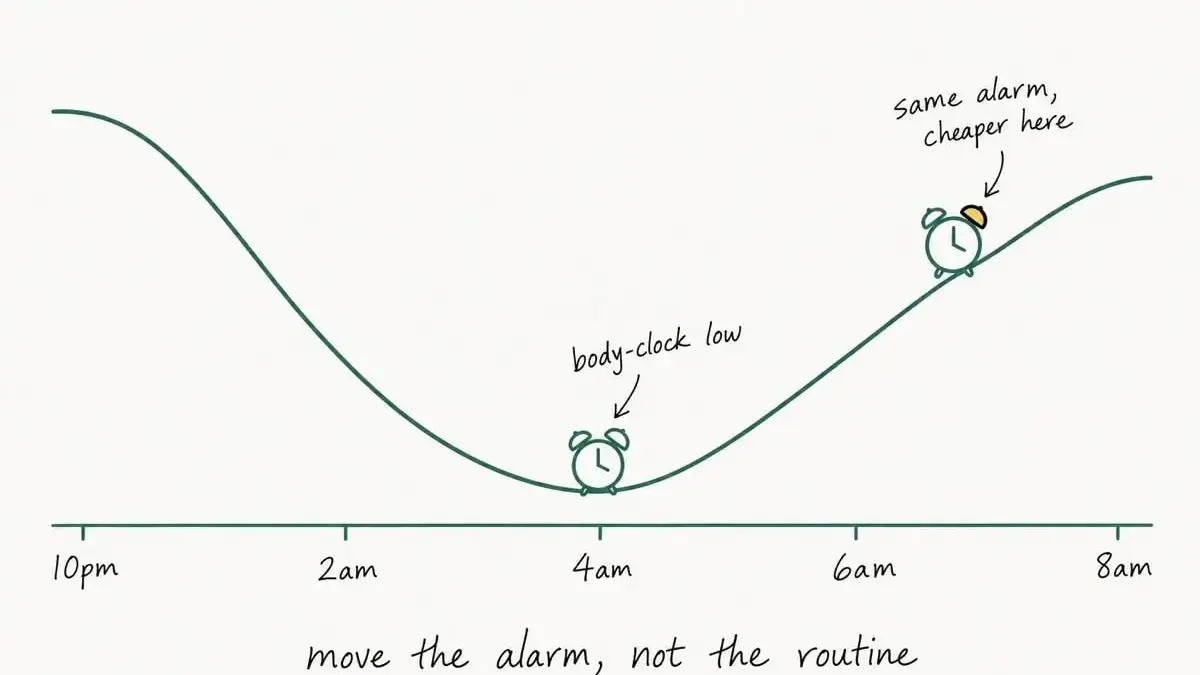
The second factor is body-clock timing. Waking during the circadian trough—the low point of your biological night—makes sleep inertia significantly worse. For an individual sleeping roughly from 11:00 PM to 7:00 AM, reviewers have estimated that biological trough to sit between approximately 3:00 AM and 5:00 AM, as outlined by Kovac and colleagues in 2023. Those specific clock numbers are not universal; they shift depending on your individual schedule and chronotype. The practically usable version of this insight is simple: an alarm set directly inside your own biological low point costs significantly more in terms of grogginess than the exact same alarm set thirty minutes later.
The third variable is the specific sleep stage you are pulled out of. Waking directly from deep, slow-wave sleep has been linked to stronger sleep inertia in several studies, although findings sometimes disagree, and underlying sleep pressure can confound the apparent stage effect. While this is useful to know, it is also a primary reason to remain skeptical of consumer apps promising to time your alarm to a light sleep stage and magically spare you from the morning fog.
What Helps, Ranked by How Good the Evidence Is
When looking at what actually helps mitigate the transition, two major interventions carry the most robust scientific support, and both occur before you even wake up: securing more total sleep and moving your alarm out of your biological low point. Caffeine and morning light sit a tier below, where the evidence is real but limited, and part of the benefit lies in how waking feels rather than how sharply you perform. Familiar morning tricks sit at the very bottom. Several have been tested thoroughly, and they simply prove to be weak.
Protecting your sleep opportunity must come first. Sleep loss directly worsens how you wake up, meaning the honest first move is unglamorous: more sleep on more nights, rather than a sharper wake-up ritual. If your nights are broken rather than chronically short, that constitutes a different problem with a different set of solutions.

Following that, you should move the alarm rather than your routine. If you find yourself consistently waking inside your biological low, the cheapest available change is a later alarm, even if pushed back by twenty or thirty minutes, bought by rearranging something else in your morning. Individuals who feel permanently unable to wake up early often suffer from a timing conflict rather than a willpower deficit.
Caffeine can be useful when understood as a delayed tool. There is limited experimental evidence that caffeine reduces sleep-inertia impairment, such as a small caffeine-gum study showing post-nap vigilance improved twelve to eighteen minutes after waking, demonstrated by Hilditch, Dorrian, and Banks in 2016. The lag is what people frequently misunderstand. In direct crossover comparisons, the median time to peak blood caffeine levels was about forty minutes for caffeinated gum and thirty-eight minutes for a caffeinated drink, with no significant difference between them, according to Sadek and colleagues in 2017. Caffeine enters the blood before that peak, but the switch is not instantaneous. Treat your first morning mouthful as the start of a twenty-minute waiting period, not an immediate fix.
Light helps primarily with how the morning feels. In two home-based studies, an artificial dawn light ramping up before waking reduced reported sleep-inertia complaints over a two-week period, as found by Giménez and colleagues in 2010. A later crossover study went further, finding that among adults woken shortly after bedtime, light-emitting glasses improved self-rated alertness and energy, even though psychomotor vigilance performance did not measurably improve, according to Hilditch and colleagues in 2023. Light may make waking feel significantly better without making you technically sharper. At 6:12 in the morning, that distinction is still worth purchasing, provided you understand which outcome you are actually getting.
By contrast, popular reactive countermeasures such as cold water on the face, a large glass of water, breakfast as a direct grogginess cure, or a shock workout carry much weaker evidence. The main reviews of these non-drug options describe the supporting evidence as mixed or limited, translating in practice to small or short-lived effects rather than a true neurological reset. Drink water because you are thirsty, eat because you are hungry, and move because physical activity is generally beneficial. Just do not expect any of them to end sleep inertia prematurely, and do not conclude that you have failed when they inevitably fall short.
Give the First Twenty Minutes Nothing That Can Go Wrong
Since the morning cognitive fog is largely priced in by the moment you wake up, the remaining strategic question is what you should do with twenty minutes that you cannot possibly make smart. Stop trying to win them. Put nothing in that window that punishes a bad decision.
Consider the example of a commuter who once spent his first twenty minutes on tasks that felt productive: answering overnight work messages, deciding how to handle a contractor quote, or choosing between gym classes. Three of those are complex decisions. By shifting all three to the train ride an hour past waking, he freed up his early morning window for things that easily survive a foggy brain: taking a shower, dressing in clothes laid out the night before, starting a cup of coffee, and spending ten minutes sitting by a window with the curtains wide open.
Nothing in that list is particularly impressive, which is precisely the point. The window stopped producing bad decisions, and the mornings stopped feeling like personal failures, even though the underlying morning fog itself did not get any thinner.
Others face different versions of the same structural challenge, such as night-shift workers who nap during breaks and wake up feeling worse than when they went in—a situation thoroughly documented in nap research. In laboratory protocols, ten-minute naps produce little post-nap change, while thirty–minute naps involve heavier slow-wave sleep and measurable performance deterioration that can persist for nearly an hour after waking, according to Hilditch and colleagues in 2016. On a night shift where alertness is demanded the moment you stand, a shorter nap remains the safer operational bet.
When This Belongs to a Clinician Instead of a Routine
Some degree of morning grogginess is not merely a scheduling problem. Prolonged, severe difficulty waking—sometimes referred to as sleep drunkenness—is particularly associated with conditions like idiopathic hypersomnia, as highlighted by Trotti in 2017. Unrefreshing sleep and daytime sleepiness can also accompany obstructive sleep apnea, according to clinical literature from StatPearls in 2024.
Individuals experiencing these persistent patterns should describe them clearly to a qualified physician: noting how long they remain unusable, how often it happens, what activities it prevents them from doing, and detailing their exact sleep and wake schedules. Bringing the gap between natural circadian timing and required wake times is equally crucial, as that biological mismatch profoundly alters how a hard wake-up feels. Allowing a professional to evaluate whether the symptoms require medical intervention is vital when persistent tiredness forms a larger story than mere morning friction.
Pick the Earlier Change, Not the Morning One
If there is one fundamental takeaway from the science of sleep inertia, it is to stop auditioning fleeting morning tricks and instead examine the two primary inputs with the strongest empirical backing. Tonight, either protect an extra thirty minutes of sleep opportunity or move tomorrow morning’s alarm thirty minutes later, buying back that time elsewhere in your day. One of those options is usually available, even during a heavily packed week.
From there, give your first twenty minutes nothing that can go wrong. Lay out what you need in advance, push critical decisions to the other side of the cognitive fog, and let the biological state pass on its own natural schedule. It will always clear eventually. The transformative change is simply ensuring that it stops costing you productive energy on the way out.