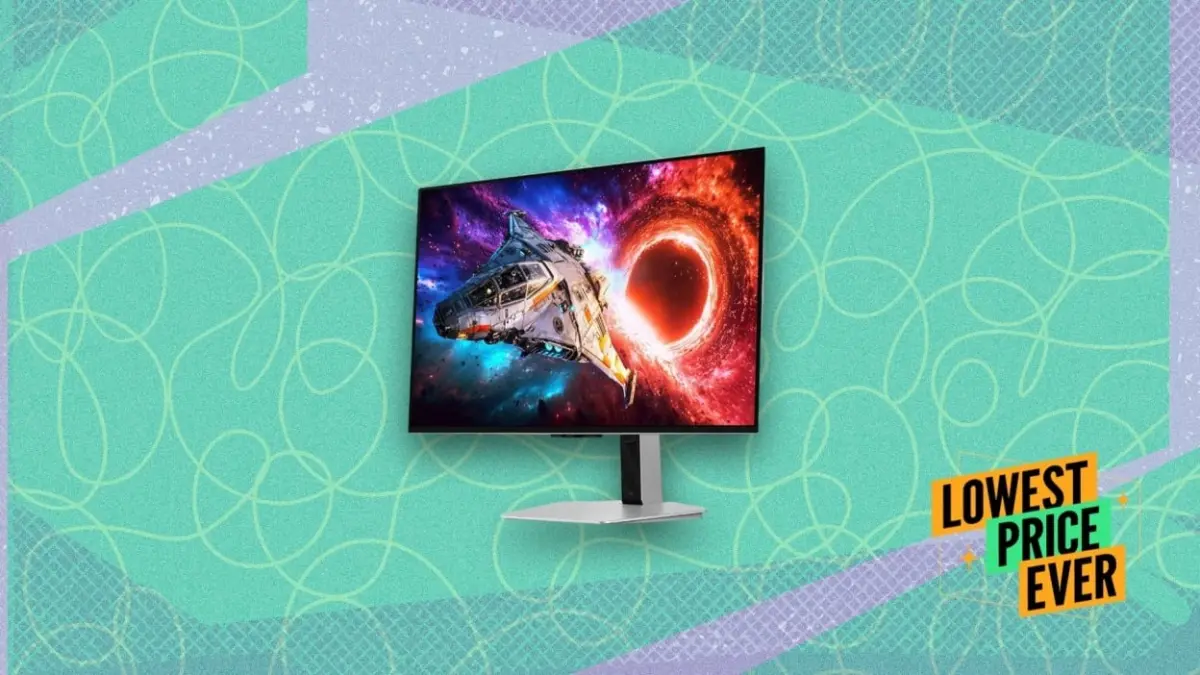
Amazon has officially reduced the price of Samsung’s premier 32-inch gaming display, the Odyssey OLED G8 (model G80SH), bringing the flagship monitor down to $999.99. Discounted from its original manufacturer’s suggested retail price of $1,299.99, this $300 price drop represents the lowest historical price recorded for the monitor according to online price-tracking data. The discount marks a notable milestone for premium computer hardware, placing a current-generation 4K Quantum Dot OLED display below the thousand-dollar mark for the first time. Designed to serve as an high-end solution for competitive gaming, cinematic entertainment, and desktop productivity, the G80SH combines ultra-high-definition resolution, extreme refresh rates, and workstation connectivity within a standard 32-inch desktop form factor.
As display manufacturers continue to expand their flagship OLED product lines, pricing shifts on flagship 4K panels serve as key indicators of broader market accessibility. The reduction of the Odyssey OLED G8 to $999.99 on Amazon signals an aggressive effort to make cutting-edge QD-OLED technology more appealing to PC builders looking to upgrade their desktop configurations. While high-end gaming monitors historically commanded steep premiums for extended periods following their initial market release, historical price trackers indicate that promotional pricing is bringing high-refresh 4K displays into reach for a broader segment of builders. However, as with most major retail promotions on premium electronics, deal pricing and stock availability remain subject to change over time, making immediate tracking relevant for consumers seeking top-tier display components.
Navigating Samsung’s display catalog requires careful attention to specific model designations, as subtle differences in model codes denote vastly different panel technologies and target applications. Prospective buyers should distinguish the discounted Odyssey OLED G8 (G80SH) from similarly named displays in Samsung’s lineup, such as the G80HS. While the G80HS relies on a 6K resolution In-Plane Switching (IPS) panel engineered primarily for high-density color accuracy and static productivity work, the G80SH features a native 4K QD-OLED panel designed specifically to merge high-frame-rate gaming performance with deep High Dynamic Range (HDR) visual reproduction. Understanding this distinction is essential for consumers: the G80SH utilizes self-emissive OLED pixels that deliver near-instantaneous response times and infinite contrast, whereas IPS variants rely on traditional backlighting assemblies with entirely different motion characteristics and black levels.
At the core of the Odyssey OLED G8 G80SH is its 32-inch 4K panel, which operates at a native resolution of 3840×2160 pixels alongside a 240Hz refresh rate. Combining native 4K clarity with a 240Hz refresh rate represents one of the most demanding performance benchmarks in contemporary display engineering. In fast-paced competitive environments, such as first-person shooters, esports titles, and racing simulations, the 240Hz refresh rate provides fluid motion rendering, crisp target tracking, and minimal motion blur. Simultaneously, the dense 4K pixel structure ensures that slower, atmospheric single-player titles render detailed textures and visual fidelity across the 32-inch screen. This balance allows the G80SH to function as a versatile center point for setups intended to handle both high-speed competitive play and graphically intensive single-player games.
Taking full advantage of a 4K display operating at 240Hz requires a significant commitment in graphics processing power. Achieving frame rates that approach the display’s 240Hz maximum ceiling at native 4K resolution places heavy demands on graphics hardware, typically requiring modern high-end dedicated graphics processing units alongside high-performance system components. While mid-range graphics hardware can comfortably run desktop software and lighter titles at 4K, driving demanding modern games at elevated frame rates will necessitate modern graphics processing capabilities or substantial GPU headroom. For users equipped with high-end PC builds, the G80SH acts as a display capable of fully displaying the output of top-tier graphics cards without creating visual bottlenecks in resolution or frame delivery.
To handle the immense bandwidth required to transmit uncompressed 4K video signals at 240Hz, Samsung has equipped the Odyssey OLED G8 G80SH with modern interface standards. The display includes DisplayPort 2.1 and HDMI 2.1 inputs, ensuring compatibility with current PC graphics hardware as well as modern gaming consoles. HDMI 2.1 connectivity enables modern gaming consoles to output high-frame-rate 4K signals where supported, while DisplayPort 2.1 provides the robust bandwidth headroom necessary to maintain maximum refresh rates, elevated bit depths, and HDR signals without forcing image compression artifacts on PC desktop systems.

Beyond its primary focus on high-end gaming, the G80SH includes connectivity options engineered to support hybrid work-from-home setups and dual-device desktop environments. The monitor comes equipped with a USB-C port supporting Power Delivery of up to 98W. This high-wattage power delivery feature allows compatible laptops—ranging from standard thin-and-light notebooks to mobile workstations—to connect to the display using a single USB-C cable. Over this single connection, the laptop can send video signals to the 32-inch screen while receiving up to 98W of charging power, eliminating the need for a separate laptop charging brick and reducing desktop cable clutter. For users who switch between a dedicated gaming PC and a work laptop throughout the day, this single-cable docking functionality provides practical utility to the overall workstation setup.
To maintain visual stability during gameplay, the G80SH supports major adaptive synchronization standards, including AMD FreeSync Premium Pro and NVIDIA G-SYNC compatibility. These technologies dynamically synchronize the monitor’s refresh rate with the real-time frame output of the connected graphics card, eliminating screen tearing and mitigating input stutter when frame rates fluctuate. However, users evaluating an OLED monitor should remain aware of specific panel behaviors, such as variable refresh rate (VRR) flicker. On self-emissive OLED panels, sharp fluctuations in frame delivery during dark in-game scenes can occasionally cause visible micro-flickering in shadow details due to how panel voltage adjustments interact with gamma response at lower frame rates. Ensuring stable frame delivery helps minimize this effect during real-world gaming sessions.
The visual performance of the G80SH is defined by its Quantum Dot OLED (QD-OLED) panel architecture, which differs fundamentally from traditional Liquid Crystal Displays (LCDs). Standard LCD monitors rely on a LED backlight positioned behind a liquid crystal layer, frequently utilizing local dimming zones to adjust contrast levels. In scenes featuring small, bright light sources—such as stars against a night sky or bright streetlights—LCD monitors can suffer from "blooming" or haloing, where backlights glow around bright objects into surrounding dark areas. In contrast, QD-OLED pixels emit their own light independently and can turn off completely to achieve true black levels. This pixel-level control yields an infinite contrast ratio, allowing deep shadow areas to exist directly alongside vibrant highlights without any light bleed or haloing effects.
While QD-OLED panels deliver exceptional contrast performance in light-controlled environments, their optical construction presents specific characteristics in brightly lit rooms. QD-OLED displays do not utilize the traditional internal polarizing filter layer found in standard OLED panels. Consequently, when direct sunlight or strong ambient overhead lighting strikes the quantum dot layer, dark areas on the screen can take on a subtle purplish or dark magenta tint rather than remaining absolute black. In brightly lit office environments with unmanaged light sources, this optical effect can slightly diminish perceived black depth. Prospective buyers planning to place the monitor in brightly illuminated rooms may want to consider room lighting arrangements to ensure they experience the panel’s maximum contrast performance.
A key consideration for consumers evaluating OLED displays for daily desktop use is the potential risk of permanent image retention, commonly referred to as "burn-in." Because desktop operating systems feature persistent static user interface elements—such as taskbars, browser headers, application borders, and fixed game HUDs—static pixel wear can theoretically develop over extended periods of continuous use. To address this concern, Samsung has integrated active cooling hardware inside the chassis of the G80SH, designed to dissipate heat away from the OLED panel and lower overall operating temperatures. In addition to hardware cooling, the monitor incorporates automated software protection features, including pixel shifting, static screen dimming, and automated background panel refresh routines engineered to distribute subpixel wear evenly and extend panel longevity.
Backing up its hardware and software mitigation systems, Samsung offers manufacturer warranty coverage that explicitly includes protection against burn-in. The manufacturer specifies that image retention resulting from normal daily usage is covered under the monitor’s warranty policy. This explicit coverage offers an important safeguard for consumers who plan to use the 32-inch display for a combination of daily office tasks, content consumption, and extended gaming sessions, addressing traditional hesitations surrounding the adoption of OLED technology as a primary desktop display.
Ultimately, the $999.99 sale price positions the Samsung Odyssey OLED G8 (G80SH) as a compelling option within the high-end display market. For enthusiasts equipped with the graphics hardware required to drive native 4K resolution at high frame rates, and for users who prioritize deep contrast, fast response times, and HDR performance, the $300 discount makes this flagship 32-inch display significantly easier to justify. Conversely, gamers operating mid-range graphics hardware or those who do not require OLED contrast characteristics may find that high-end OLED displays provide more performance capability than their hardware requires. For buyers seeking a top-tier display that bridges high-performance gaming with clean workstation integration, this historic low price marks a notable buying opportunity in the high-end monitor market.