As artificial intelligence models grow exponentially in scale, training them requires moving massive volumes of data between machines at unprecedented speeds. High-performance communication is the backbone of modern machine learning and distributed systems, driving researchers to constantly engineer faster networks and discover smarter ways to leverage existing bandwidth. While the vast majority of scientific inquiry focuses on cutting-edge optical fibers, high-speed Ethernet, and software-defined routing, a recent academic paper took a decidedly more whimsical approach to the problem by investigating an alternative network medium: carrier pigeons.
The concept of avian data transmission is far older than the modern cloud computing era. On April 1, 1990, the Internet Engineering Task Force published RFC 1149, a classic satirical Request for Comments describing a method for transmitting Internet Protocol packets via "avian carrier." Although the publication was an April Fools’ Day joke, the idea captured the imagination of engineers worldwide, leading to several real-world demonstrations where a pigeon carrying a physical memory card actually outpaced sluggish broadband connections over short distances.
However, beneath the lighthearted exterior of avian data transport lies a genuine, fundamental networking problem that resonates deeply with modern systems architecture. Contemporary data centers increasingly rely on optical switches to dynamically reconfigure their internal physical links based on shifting communication demands. This capability raises complex logistical questions regarding how network topology reconfiguration can be executed efficiently. A closely related academic field involves temporal graphs, where network connections are only available intermittently at specific moments, making the precise chronological order of transmissions critical for successful message delivery.
These exact computational challenges emerge organically when attempting to design and operate an operational pigeon-based network. While RFC 1149 outlined the basic premise of transmitting data payload via birds, it omitted any algorithmic framework for organizing their flights with maximum efficiency. To address this gap, a collaborative research team from TU Berlin and the Technion published a paper titled "The Carrier Pigeon Internet Protocol: An Algorithmic (and Lighthearted) Perspective," exploring how to construct such a network while minimizing the total avian workforce required.
From the Internet to Pigeon Post
The primary logistical hurdle of a carrier pigeon network stems from the unique biological imperative of the animals: carrier pigeons naturally fly home to the exact location where they were bred and raised. Suppose an engineer needs to transmit a data message from the Technical University of Berlin to the Technion in Haifa. Accomplishing this requires utilizing a pigeon that was originally born and raised at the Technion, physically transported to TU Berlin beforehand, and subsequently released to fly back to its home loft carrying the digital payload.
Once that pigeon arrives safely at its destination in Haifa, it cannot simply be turned around and flown back to Berlin to deliver a return message. Fulfilling a return communication demands an entirely separate bird. Unlike traditional copper cables or fiber-optic lines that can transmit signals back and forth indefinitely, a biological carrier pigeon is effectively consumed—or utilized up—upon the completion of a single one-way delivery. This fundamental constraint creates a complex resource allocation puzzle: if an organization were to genuinely operate a pigeon-based postal network, how many birds would be required, and where should their breeding lofts be strategically established?
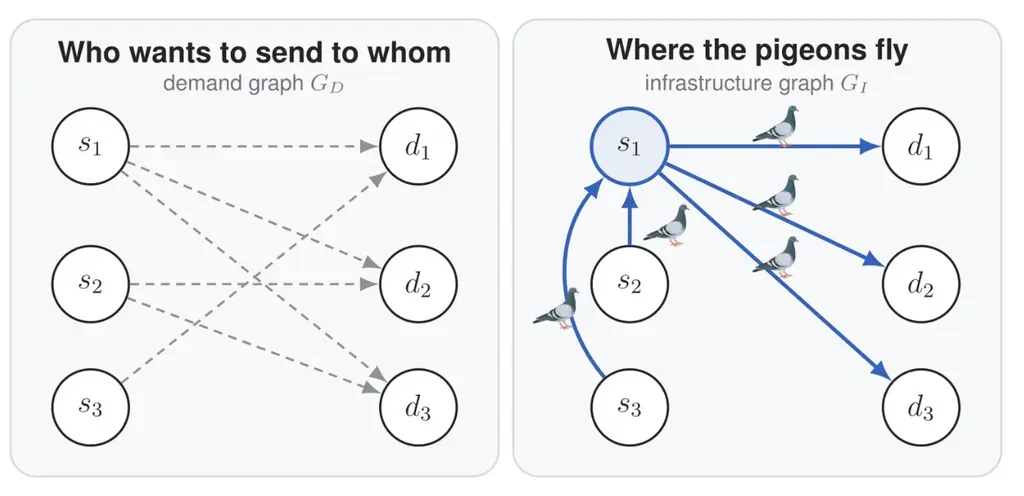
To analyze this logistical dilemma rigorously, the researchers modeled the overarching communication requirements as a directed graph. In this mathematical representation, nodes corresponded to specific geographical locations, while directed edges represented individual messages that needed to be successfully delivered from a sender to a receiver. The computational task involved determining precisely where pigeons should be raised, where they ought to be housed, and how their individual flight schedules should be coordinated to minimize the absolute total number of pigeons required. Furthermore, the model permitted messages at remote locations to be temporarily buffered and held indefinitely, allowing multiple payloads to be bundled together and combined for a subsequent flight.

The research team examined three distinct architectural variations of the routing problem, ranging from direct point-to-point delivery to multi-stop itineraries. Allowing intermediate stopovers yielded profound efficiencies, drastically reducing the total number of birds needed to fulfill the global communication demands. However, introducing multi-hop routing routes also introduced significant computational complexity, rendering the underlying optimization problem substantially harder to solve from an algorithmic perspective.
Results and Algorithmic Solutions
In the baseline single-hop scenario where direct flights are mandatory, the system requires exactly one dedicated pigeon for every single source-destination communication pair. While this straightforward approach achieves an optimal direct route, the sheer quantity of required birds scales rapidly out of control. For instance, if a modest network of just twenty distinct research locations needs to communicate bidirectionally with every other node, the operation would demand an astronomical 380 individual pigeons.
As soon as the protocol permits messages to make stopovers along their journey, finding the globally optimal delivery schedule becomes an NP-hard problem. The authors established this theoretical difficulty by providing formal mathematical reductions from classical computational hardness problems, specifically 3SAT and Vertex Cover, for both the two-hop and multi-hop network architectures.
Fortunately, the researchers successfully devised efficient heuristic algorithms capable of finding high-quality solutions without requiring exhaustive computational searches. The paper introduces what the authors term the "Coordinator algorithm." Under this strategy, the network identifies the specific geographical location possessing the highest volume of communication links and designates it as a central coordinator node. Subsequently, every individual source location transmits its accumulated messages to this designated coordinator. The coordinator node then sorts the incoming data payloads by their ultimate destinations and dispatches a single pigeon directly to each respective receiver.
Applying this innovative strategy to the earlier scenario involving twenty interconnected locations dramatically alters the resource requirements. The Coordinator algorithm successfully reduces the total number of necessary pigeons from 380 down to just 38. Specifically, the network requires 19 pigeons to successfully collect all originating messages at the central coordinator, followed by another 19 pigeons to distribute those sorted payloads onward to their final destinations. The research team mathematically proved that the Coordinator algorithm guarantees an approximation ratio of never using more than twice as many pigeons as the absolute optimal solution, while executing swiftly in polynomial time. For calculating exact optimal solutions on smaller problem instances, the authors also formulated integer linear programs tailored for both the two-hop and multi-hop cases.
Open Problems and Real-World Applications
To maintain mathematical clarity and keep the underlying computational model tractable, the researchers made simplifying assumptions, such as treating carrier pigeons as vessels capable of carrying unlimited amounts of data storage. A natural and pressing direction for future research involves investigating how the system
behaves when pigeons are constrained by realistic physical carrying capacities.

Additionally, the initial theoretical model focused exclusively on minimizing the headcount of the avian workforce while disregarding temporal constraints. Because fewer pigeons generally necessitate a higher frequency of intermediate stopovers, and every stopover inherently introduces delivery latency, the theoretical network configuration utilizing the absolute minimum number of pigeons might simultaneously constitute the slowest possible communication channel.
Further complicating real-world deployments is the energy footprint associated with physically transporting carrier pigeons back to their remote home lofts. Such logistical overhead incurs both financial and environmental costs, suggesting that birds headed toward the same general geographic region could theoretically share a ride. Moreover, the current model assumed complete a priori knowledge of all message demands in advance. In practical operational environments, communication requests arrive dynamically over time, either following predictable stochastic processes or driven by adversarial network traffic.
Despite the inherently lighthearted framing of the study, the underlying algorithmic principles bear direct relevance to serious, real-world engineering challenges. The predictable data center traffic patterns analyzed in the paper closely mirror the operational realities of modern machine learning infrastructure, where optical switches dynamically rewire network links to accommodate shifting AI training workloads.
Indeed, a wide array of optimization problems encountered in modern telecommunications rely heavily on precise demand matrices, including sophisticated traffic engineering methodologies. Beyond networked computer communications, demand-aware graphs—such as the mathematical structures employed by the researchers to optimize avian traffic—are routinely utilized across operations research to determine optimal routing strategies for vehicular logistics and physical commodity flows. Ultimately, the humble carrier pigeon continues to offer valuable lessons for the design of efficient, resilient communication systems.
The research was co-authored by Matthias Bentert, Shay Kutten, Darya Melnyk, Tijana Milentijević, and Stefan Schmid, representing both the Technical University of Berlin and the Technion. Tijana Milentijević is a PhD student at TU Berlin whose broader academic research bridges machine learning and distributed systems, with a particular emphasis on robust federated learning and distributed algorithmic design.