The transition from IPv4 to IPv6 is frequently marketed and understood as a routine protocol upgrade. Inside a controlled laboratory environment, that perception holds true: engineers enable an address family, advertise a prefix, ping a destination, and consider the task complete. However, within a large-scale production broadband network, the reality is vastly different. Transitioning to IPv6 is not merely a routing update; it represents a comprehensive subscriber-management overhaul, a complex Customer Premises Equipment interoperability initiative, a critical Layer 2 project, and a massive challenge in logging and observability, with IPv6 acting as the catalyst that exposes all of these moving parts simultaneously.
WorldLink Communications initiated its internal IPv6 testing phase back in May 2016 before officially pushing the protocol live to customers in July 2019. Today, the network successfully carries more than one million Internet Protocol over Ethernet subscribers, achieving a milestone where 100% of these users are IPv6-enabled, and roughly 70% of the total network traffic flows smoothly over the protocol. Reflecting on the journey reveals important architectural insights alongside the inevitable operational scar tissue gathered along the way.

Why IPoE, and why dual-stack?
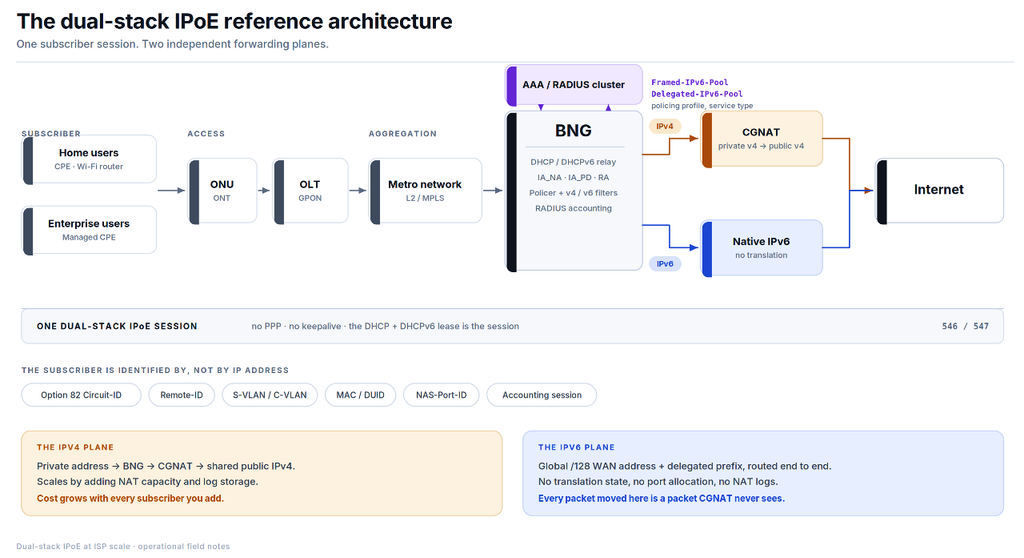
Traditional broadband deployments historically relied on Point-to-Point Protocol over Ethernet. IPoE fundamentally streamlines this architecture by eliminating the PPP session overhead entirely. Instead, the customer premises equipment simply executes a DHCP transaction, while the Broadband Network Gateway accurately identifies the subscriber using attributes attached by the access network, such as Option 82 circuit-IDs, remote-IDs, VLAN tags, and MAC addresses, with RADIUS servers applying policy enforcement on top. This approach proves significantly simpler for the end user and cheaper to scale from an operational standpoint. Crucially, it means there are no active PPP keepalives; the active DHCP and DHCPv6 leases effectively constitute the session itself.
When evaluating transition mechanisms, the engineering team examined various translation and encapsulation strategies before ultimately selecting a dual-stack model. This decision was driven by the realization that dual-stack was the only viable path that avoided placing an active translator in the data path of every single customer indefinitely. IPv4 address exhaustion was already forcing the network toward Carrier-Grade Network Address Translation. CGNAT introduces substantial capital expenditure that scales linearly with every new subscriber added, requiring additional hardware boxes, session tracking, port blocks, and rigorous legal logging obligations. Native IPv6 bypasses these complexities entirely, ensuring that every packet moved via IPv6 is one that CGNAT infrastructure never has to process.

Operating dual-stack successfully requires acknowledging that IPv4 and IPv6 function as two independent forwarding and service planes that happen to share a single subscriber session. Treating them as a single unified entity during troubleshooting typically leads to frustrating diagnostic dead ends.
The addressing plan and allocation hierarchies
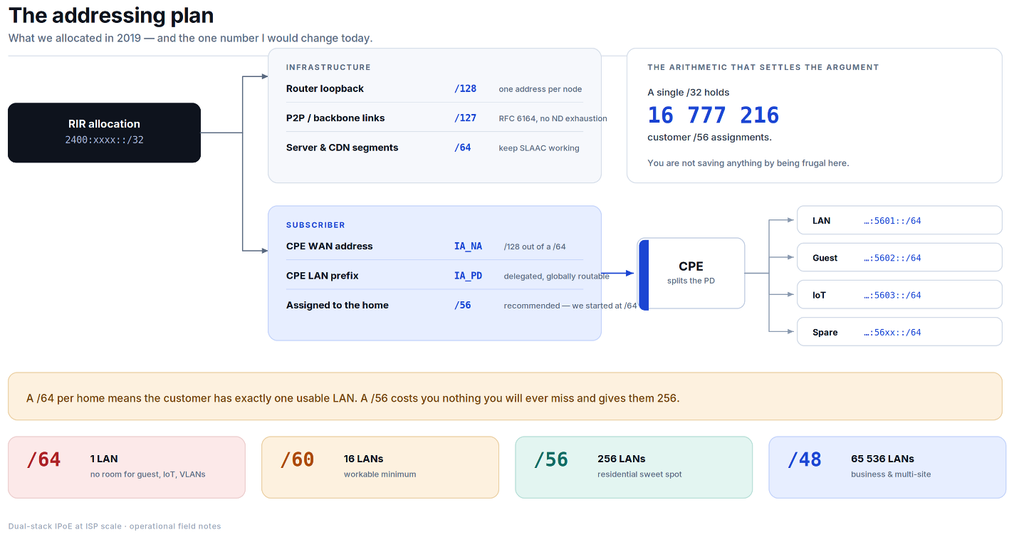
Receiving a /32 IPv6 allocation from APNIC allowed WorldLink to establish a conventional and structured addressing plan. Router loopbacks were assigned /128 addresses, point-to-point backbone links utilized /127 prefixes to prevent neighbor discovery cache exhaustion, and server and Content Delivery Network segments were organized into /64 blocks to preserve Stateless Address Autoconfiguration functionality. For customer management, CPE WAN interfaces received /128 addresses carved out of larger /64 blocks, while home networks were provisioned with delegated prefixes.
Reflecting on the initial design, however, engineers noted that delegating a single /64 prefix to a customer home limits them to exactly one usable LAN segment, precluding guest networks, separate Internet of Things devices, or internal VLANs. Given that a single /32 allocation contains over 16 million /56 assignments, address conservation provides no practical long-term benefit. A more forward-thinking approach would provision a /56 or a /60 as the absolute minimum baseline for residential users, and a /48 for business accounts, fully embracing the abundance that IPv6 was designed to provide.
Navigating the complexities of DHCPv6
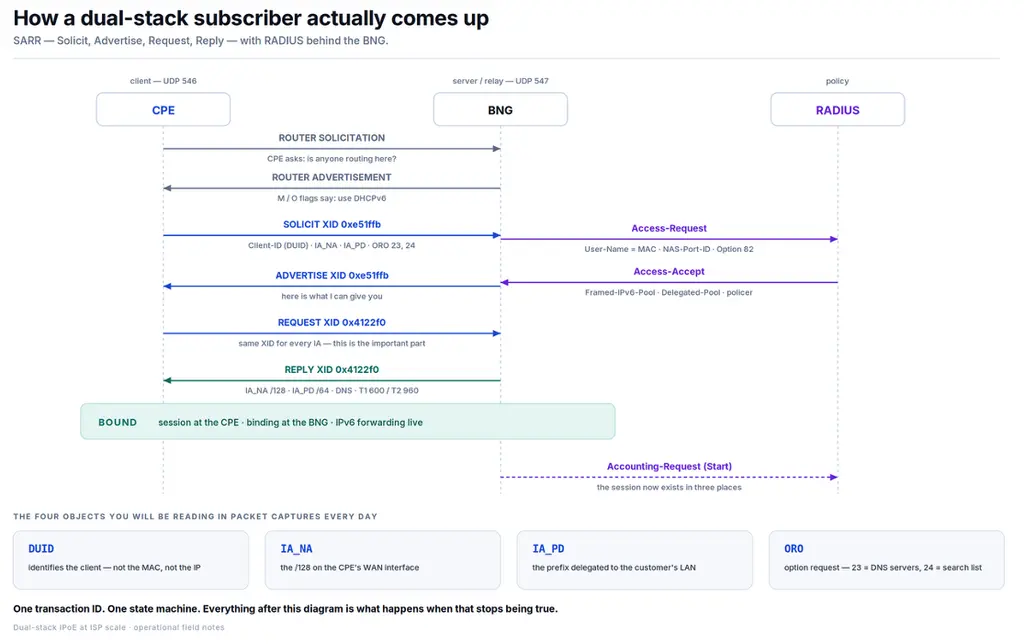
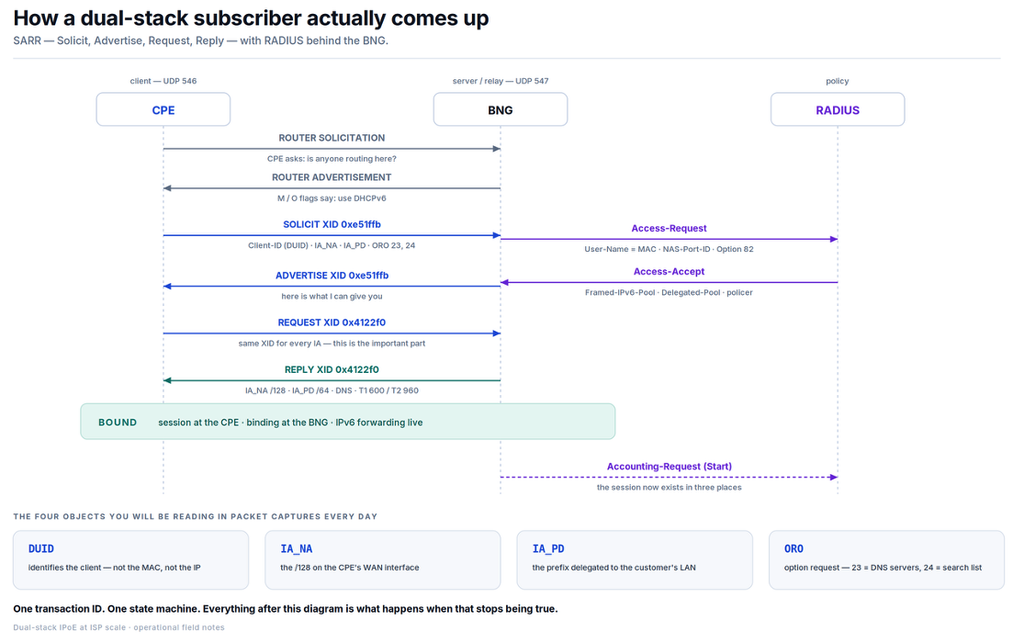
Transitioning to DHCPv6 introduces distinct operational challenges that differ significantly from managing legacy IPv4 infrastructure. Four core objects—the Client Dual-Stack User Identifier, Identity Association for Non-Address Assignment, Identity Association for Prefix Delegation, and Option Request Options—form the backbone of packet analysis during troubleshooting. The standard exchange follows the Solicit, Advertise, Request, and Reply sequence, operating over UDP ports 546 and 547 via multicast messaging.
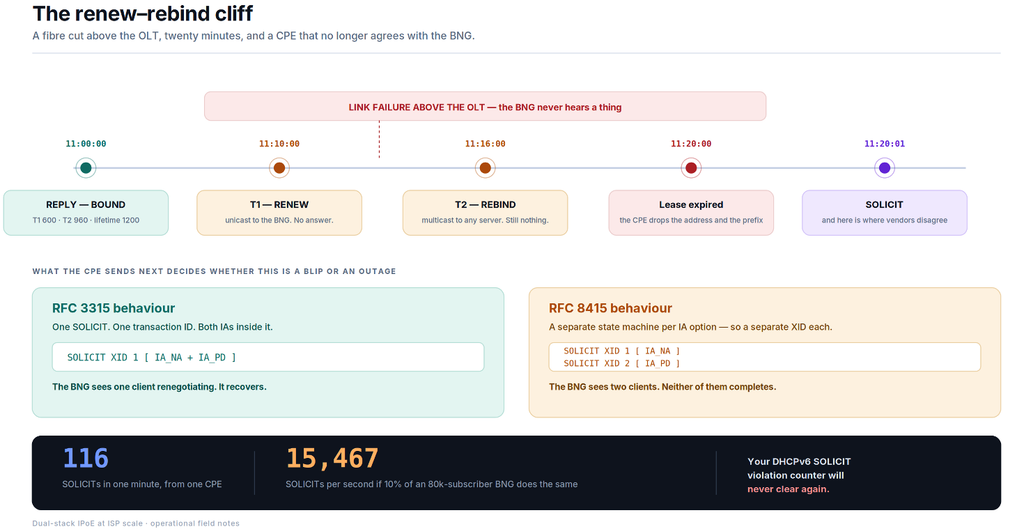
A major operational hurdle involves the intricate dynamics of lease renewals and rebinds. During network disruptions, such as a fiber cut upstream of an optical line terminal, the BNG often remains entirely unaware of the outage, considering the subscriber session securely bound. As the timers progress, the CPE attempts to renew its lease, receives no response, shifts to rebind mode, and eventually allows the lease to expire before initiating a completely fresh solicitation process.
This behavior frequently exposes interoperability friction between different CPE firmware implementations. While older standards envisioned a unified transaction handling both address and prefix assignments within a single state machine, newer interpretations permit clients to maintain independent state machines per identity association option. When a device sends separate solicitations with different transaction identifiers for its WAN address and its delegated prefix, the gateway can misinterpret the signals as multiple concurrent clients attempting to connect.
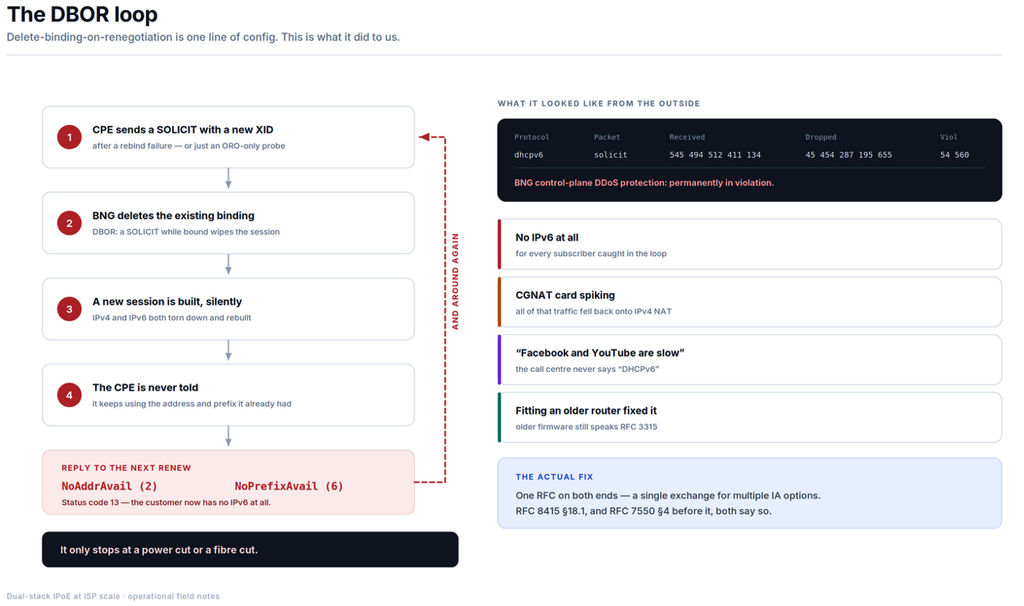
This mismatch can trigger aggressive retransmission storms, flooding the network with thousands of solicitation requests per second and overwhelming control-plane violation counters. Compounding this issue is the Delete-Binding-on-Renegotiation feature. Originally designed for IPv4 to clean up stale states, DBOR can inadvertently tear down active subscriber sessions when processing ambiguous DHCPv6 requests, forcing constant renegotiation loops that persist until a physical power or fiber interruption occurs.
Addressing Layer 2 and operational surfaces
Beyond protocol mechanics, early deployments faced fundamental Layer 2 hurdles. Because DHCPv6 relies heavily on multicast traffic, access networks that had been meticulously tuned over the years to suppress multicast required careful reconfiguration. Furthermore, aggressive DHCP snooping configurations on access nodes occasionally caused bottlenecks during mass power restorations, as forwarding tables became overwhelmed and inadvertently dropped control packets.
Managing dual-stack broadband introduces operational overhead across multiple domains. Dynamic bandwidth shaping requires translating a single RADIUS profile into distinct filter sets for both IPv4 and IPv6 traffic. Security paradigms also shift significantly; because NAT no longer acts as an implicit barrier, robust bogon filtering, control-plane protection, and strict Reverse Path Forwarding are mandatory. Furthermore, providing customers with globally routable prefixes places a heavier security burden on CPE firewalls, which historically offered less robust protection for IPv6 traffic compared to their IPv4 implementations.
Building robust observability and data models
Operating at a scale of over a million active sessions requires a centralized, subscriber-centric operational data model. Relying on disparate monitoring systems without a unified key makes rapid troubleshooting nearly impossible. Engineering teams must monitor IPv4 and IPv6 key performance indicators independently, tracking DHCP and DHCPv6 success rates as separate metrics rather than assuming overall connectivity implies protocol health.
Furthermore, Broadband Network Gateways must be provisioned based on resource exhaustion thresholds rather than simple subscriber counts. Metrics such as active session counts, control-plane transaction rates, neighbor discovery states, and forwarding table entries dictate the true capacity limits of gateway hardware during massive regional reconnection events.
Ultimately, the true measure of network transition success lies not in the percentage of subscribers provisioned with an IPv6 address, but in the volume of actual user traffic successfully traversing the protocol. By maintaining rigorous observability, establishing strict vendor compliance agreements early, and addressing architectural challenges head-on, network operators can successfully transition IPv6 from a complex deployment project into a seamless, highly functional foundation of modern internet delivery.