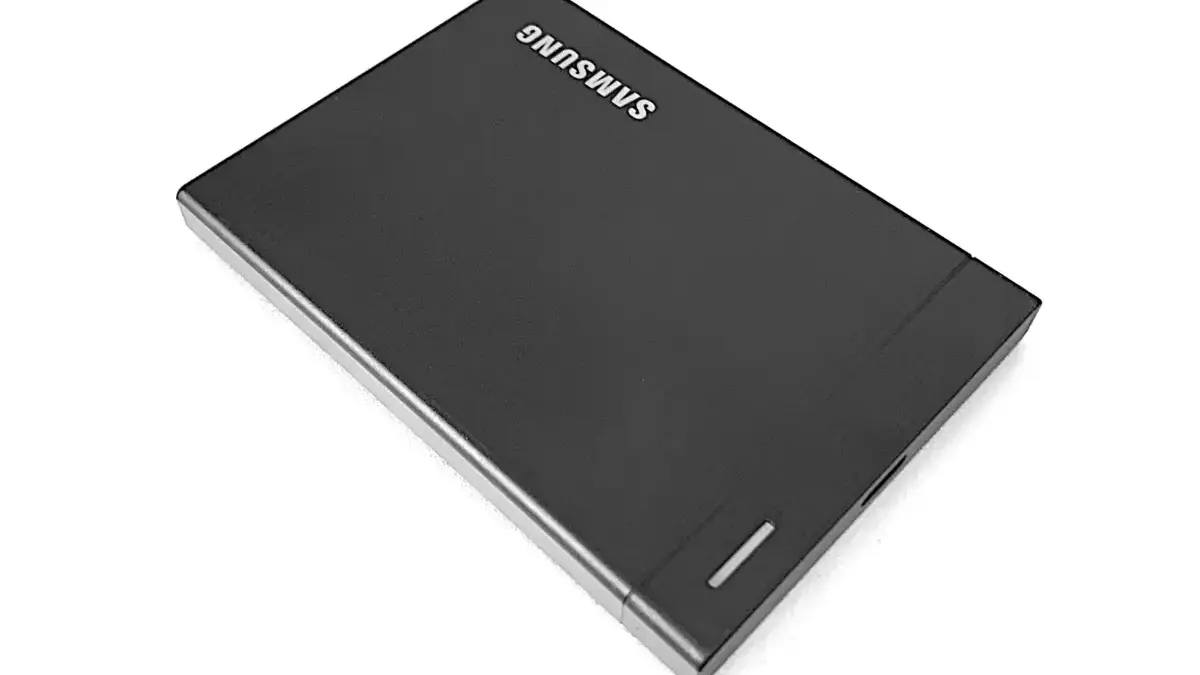
Samsung’s latest entry into the competitive external storage market is turning heads for its combination of blistering speed, impressive thermal management, and massive capacity options. The new Samsung P9 USB4 solid-state drive is designed for professionals and power users who demand high-performance storage in a pocket-friendly form factor. While it delivers exceptional performance across both synthetic benchmarks and heavy real-world file transfers, prospective buyers will face steep pricing and potential stock availability hurdles common to top-tier storage solutions in the current market.
The P9 is a 40Gbps USB4 external SSD that strikes an impressive balance between physical dimensions and raw technical capability. Measuring approximately 3.5 inches long, 2.6 inches wide, and a mere 0.3 inches thick, the drive is exceptionally compact. It tips the scales at a miniscule 3.3 ounces, making it easy to slip into a pocket, laptop bag, or mobile workstation kit without adding noticeable weight.

While the P9 does not carry an official IP rating for water and dust resistance, its casing is tightly sealed along all seams. The only potential vulnerability is the standard Type-C connector port. However, like many modern portable drives in this class, the robust construction of the Type-C port generally offers a degree of protection against minor spills and everyday elements, sparing consumers the high costs associated with formal IP certification testing.
Durability and peace of mind are further reinforced by Samsung’s inclusion of a limited five-year warranty. This surpasses the three-year coverage typically bundled with many competing external solid-state drives on the market. Although the warranty terms carry standard caveats regarding extreme physical damage or abnormal write volumes, the five-year guarantee underscores Samsung’s confidence in the hardware’s longevity. While an official TBW rating—indicating the total terabytes that can be written before the drive potentially shifts to read-only mode—was not explicitly provided by the manufacturer, industry standards for drives of this caliber generally place expected endurance within the 600TBW range.

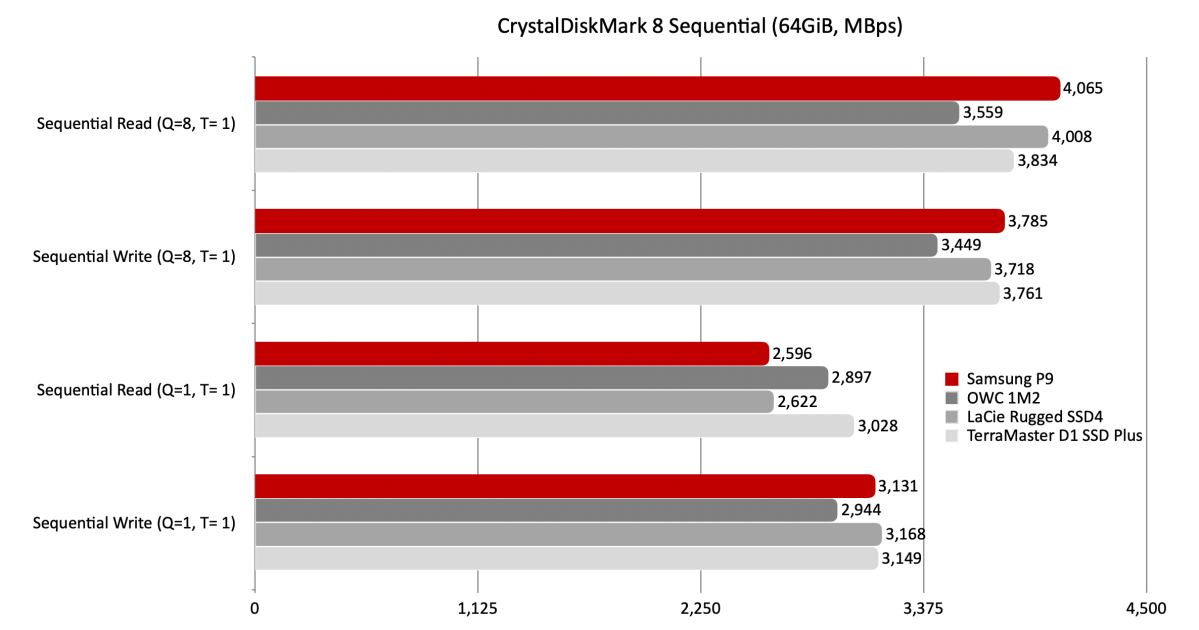
Performance testing reveals that the Samsung P9 is more than capable of keeping pace with the demands of modern workflows. In synthetic benchmark evaluations, the 2.5-inch form factor drive secured a strong position among elite external storage devices. Evaluated alongside a field of competitive USB4 drives, the P9 demonstrated that the 40Gbps interface standard delivers on its promise of rapid data throughput.
In CrystalDiskMark testing, the P9 produced strong sequential and mixed 4K performance numbers. During practical file transfer evaluations utilizing a 48GB data set, the drive performed admirably, handling standard folder transfers with strong overall metrics despite minor variances in smaller file handling. Writing a massive 450GB data set proved to be a straightforward task for the hardware, smoothly moving data across both Fastcopy and Windows Explorer environments.

One of the most notable technical achievements of the P9 is its ability to maintain high-level performance when writing exceptionally large quantities of consecutive data. Many high-speed solid-state drives suffer from performance degradation once their internal caches are exhausted during extended write operations. By contrast, when a 900GB file was copied to the P9 immediately following a 450GB transfer, the drive maintained its transfer rates without experiencing significant throttling. This sustained write capability mirrors the performance profiles typically associated with high-end internal PCIe storage rather than traditional external enclosures.
Equally impressive is the drive’s thermal management. Despite lacking bulky external heatsinks, cooling fins, or active internal fans, the P9 remained nearly cool to the touch throughout prolonged, heavy write sessions. While detailed power consumption metrics for the internal NAND flash and controller chips remain pending from the manufacturer, the drive’s passive thermal dissipation design represents a significant engineering achievement for a compact 40Gbps external storage device. Although it may not capture the absolute top spot in every isolated speed metric, its combination of thermal efficiency, sustained transfer consistency, and ultra-portable dimensions positions it as a standout option in the current USB4 landscape.
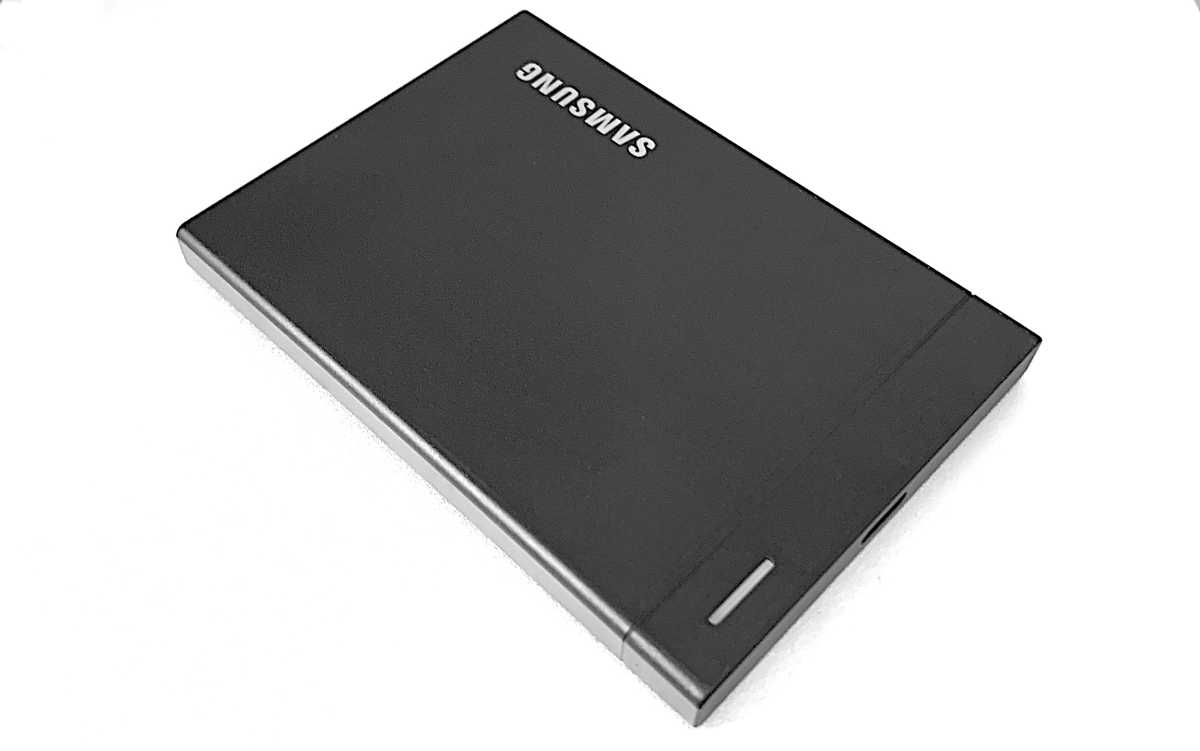
Acquiring the Samsung P9 requires a substantial financial investment, reflecting the broader pricing realities of high-capacity flash storage. Official manufacturer pricing lists the 1TB model at $340, the 2TB version at $650, the 4TB configuration at $1,440, and the top-tier 8TB model at $2,880. These figures average out to approximately $350 per terabyte. Furthermore, official manufacturer channels currently list multiple configurations as out of stock, though regional retailers such as Amazon have maintained periodic availability for select capacities like the 2TB variant.
Storage analysts note that the current market dynamics continue to fluctuate, driven by supply chain realities and the proprietary sourcing of NAND components by manufacturers like Samsung. For users balancing budget and performance, a multi-tiered storage strategy—utilizing faster, smaller solid-state drives for active tasks and traditional high-capacity hard drives for archival storage at a fraction of the cost—remains a practical approach.
For users whose workflows demand fast, reliable, and sustained data transfer speeds in a highly portable chassis, the Samsung P9 meets those requirements while backed by a robust five-year warranty. Despite its high cost and current stock scarcity, its thermal efficiency and consistent performance under heavy loads make it a compelling choice for media professionals, producers, and power users seeking top-tier external USB4 storage.