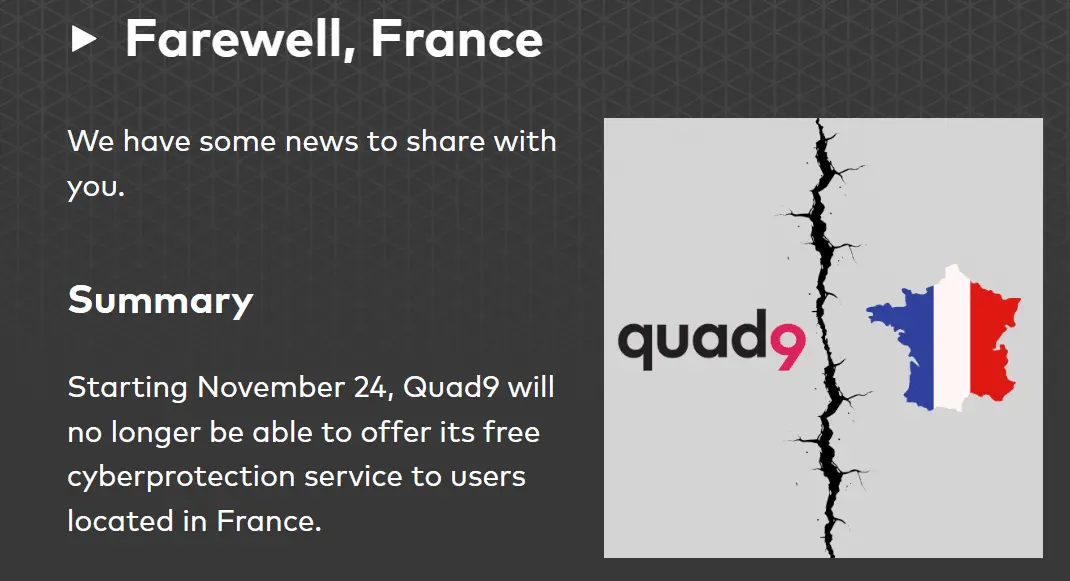
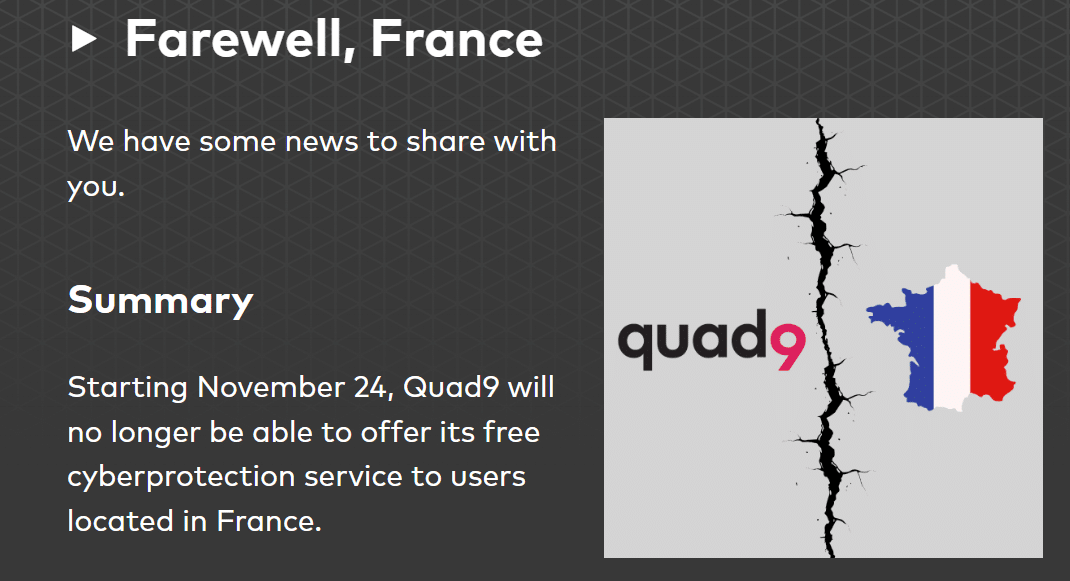
Swiss non-profit DNS resolver Quad9 has announced that it is pulling out of France entirely after a Paris court slapped the organization with daily financial penalties for failing to comply with controversial website-blocking orders. Starting November 24, Quad9 will formally stop serving internet users in France, making it the second major public DNS provider to abandon the country over escalating legal pressures related to online piracy.
The decision arrives in the wake of a definitive ruling handed down by the Paris Judicial Court, which targeted the foundation over its refusal to block unauthorized streams of tennis matches. The case was brought forward by sports broadcaster beIN Sports, which initially pushed for astronomical daily fines against the Swiss provider for leaving specific pirate domains accessible to the public.
While the court ultimately rejected beIN Sports’ most extreme demands, the resulting penalty has left the privacy-focused non-profit with what it describes as no viable path forward. Faced with the immediate ruling alongside approximately 20 other pending legal challenges across French courts, Quad9 concluded that continuing operations in the country would pose an existential threat to the organization.
The €1,000-a-Day Penalty
The legal showdown began earlier this year when beIN Sports secured a May blocking order requiring network operators and infrastructure providers to restrict access to a growing list of domain names associated with unauthorized sports broadcasts. That initial mandate eventually expanded to cover 58 distinct domain names.

While major internet service providers and certain infrastructure intermediaries implemented the blocks, Quad9 chose a different path. Operating on the core tenet that a recursive DNS resolver should remain a neutral party that does not tamper with internet traffic, the foundation took no action to block the targeted domains.
In response, beIN Sports petitioned the Paris court to levy severe financial penalties against the non-profit, demanding a staggering €10,000 per day for every single domain that remained accessible through Quad9’s servers. At its peak, beIN’s total requested fines could have climbed as high as €580,000 daily.
The Paris court struck a middle ground in its final judgment, rejecting beIN’s most exorbitant demands in favor of a flat penalty of €1,000 per day. The court noted that Quad9 had consciously chosen to take no action whatsoever, contrasting its stance with other tech firms that had made partial efforts to comply.
The penalty period runs until the underlying blocking measures expire on November 14. Quad9 calculated that the total fine amounts to roughly €24,000, excluding the foundation’s own mounting legal expenses. Although significantly lower than what the broadcaster requested, Quad9 acknowledged that it is now subject to the financial sanction because it firmly refuses to block the domains before the deadline.

This outcome stands in stark contrast to earlier rulings from the same jurisdiction. Earlier in the month, the Paris court rejected similar penalty requests from beIN Sports directed at Cloudflare and several virtual private network providers. In those instances, the court ruled that because those companies had successfully blocked at least a portion of the contested domains, they had demonstrated a reasonable effort to comply. Similarly, broadcaster Canal+ lost a parallel penalty bid against Cloudflare in September. Because Quad9 explicitly stated in court submissions that it had not blocked a single domain, it could not claim to have made a reasonable effort under the court’s interpretation.
A Matter of Principle and Technical Reality
For Quad9, the conflict extends far beyond financial calculations or a single court order. The Swiss foundation views recursive DNS resolution as an essential public utility that must remain impartial, arguing that altering DNS lookups fundamentally breaks trust with internet users.
In an official statement addressing the situation, the foundation emphasized its strict adherence to digital integrity. The organization stated that it categorically refuses to alter or misrepresent the Domain Name System responses that users receive in a way that contradicts their expectations.
Furthermore, Quad9 highlighted the technical impossibility of tailoring its services exclusively to users residing within France. Because its public-facing DNS service operates without requiring user registration or account creation, the non-profit maintains that it possesses no reliable mechanism to distinguish French internet users from the rest of its global audience.
Complying with the French court order would have required Quad9 to either block the designated domains worldwide or cease operations in the country altogether. The foundation firmly rejected the notion of applying a localized French judicial mandate to internet users across the globe.
Quad9 also questioned the practical efficacy of DNS-level blocking, arguing that website blocks do little to curb actual copyright infringement. The organization noted that determined users can effortlessly bypass such restrictions by switching to any of the thousands of other open public DNS resolvers available on the internet. Describing the measure vividly, the foundation compared the judicial order to holding a small piece of newspaper in front of a stadium full of people in an attempt to block their view of a concert.
Piling Pressure from Pending Cases
The final straw for the Swiss non-profit was not isolated to the dispute with beIN Sports. Quad9 faces roughly 20 other active legal blocking cases in France, many of which are moving through the judicial system with outcomes that the foundation expects will mirror the current dispute.
The accumulation of potential fines from these pending cases presents a financial liability that a non-profit foundation simply cannot absorb. Quad9 explicitly noted that it cannot survive the compounding effect of penalties assessed across twenty concurrent cases, nor can it withstand the wave of similar litigation anticipated in the future.

This strategic retreat marks a growing trend among public DNS providers operating in France. Earlier in 2024, OpenDNS similarly suspended its public resolution service in France after running afoul of a web-blocking order issued in favor of broadcaster Canal+.
Beyond logistics and finances, Quad9’s leadership frames the departure as a crucial defense of digital rights and open internet architecture. The foundation expressed deep concern that legal instruments originally introduced for specific piracy issues will inevitably pave the way for broader, unchecked censorship. In the organization’s view, once the foundational tools of digital censorship are established, they are rarely applied sparingly or justly.
An appeal against the Paris court’s ruling remains pending, and the non-profit has indicated that it will continue challenging court-ordered DNS blocking in higher legal forums. For everyday internet users in France, however, the immediate reality requires a practical transition. Quad9 has confirmed that its service will officially go dark for French traffic on November 24, leaving individuals with a strict deadline to switch to alternative DNS resolvers if they wish to avoid disruptions to their internet connectivity.