The community centered around Opensource.com is hard at work on something new. Visitors to the platform may have noticed a distinct quietness settling over the site lately, signaling a transition period as a new project quietly takes shape behind the scenes. While specific details regarding the initiative remain limited and official announcements are yet to be made, there is already plenty of anticipation and discussion circulating among contributors, readers, and advocates. What better way to start a conversation about community, connection, and the future than by looking at the very fabric that binds the digital world together—the entire internet itself.
The Internet, and Top-Level Domains
To understand where the Opensource.com community is heading, it helps to examine where the digital landscape originated. Most internet users recognize that the internet is fundamentally a network. By definition, a network is a group of interconnected connections, a concept reflected in the very term "internet," which is a portmanteau combining "interconnected" and "network."
In its earliest days, the internet was a smaller, more specialized system consisting primarily of two distinct networks: the military network and the academic network. As the technology matured and gained popularity far beyond those initial groups, it quickly became apparent that different designations were necessary to categorize and differentiate various entities operating online. Society needed a way to distinguish a commercial business from a charitable organization, a university from a governmental department, or a personal project from a public institution.
These vital designations are formally known as top-level domains, or TLDs. Today, internet users can choose from a vast and diverse ecosystem of available TLD extensions. However, for a long time, the digital world relied on only a handful of foundational options. These original TLDs remain exceptionally popular and deeply embedded in digital culture. Most web users instantly recognize that navigating to a .com address typically leads to a commercial site, while visiting a .org address generally signifies a non-profit organization dedicated to a public mission.

These suffixes are more than just technical routing tools; they act as digital signposts that tell visitors who is behind a website and what overarching purpose drives their work. They categorize the internet into functional sectors, creating order out of a vast web of global connections.
Open Source Is a Network
Just as the internet relies on a web of interconnected systems, open source can represent many different things to many different people. It can take on a commercial form, driving enterprise software and global cloud infrastructure. It can operate as a non-profit initiative, championing digital rights, privacy, and public goods. It can exist within academic institutions, fostering collaborative research and education. It can even manifest as a cultural movement, shaping how art, literature, and knowledge are shared across borders.
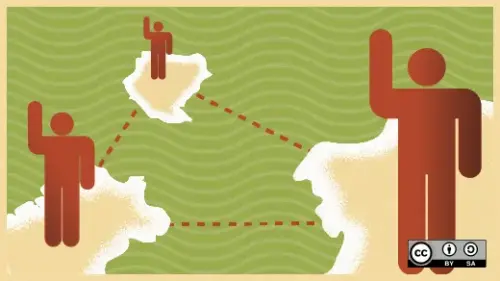
No matter what form open source takes, or which sector it operates within, it is always fundamentally a network. Sometimes that network consists of computers, servers, repositories, and lines of code shared across global code-hosting platforms. But most importantly, and most powerfully, open source is a network of people.
Whether individuals are gathering in person at a bustling technology conference, sharing ideas over a casual conversation at a local pub, or collaborating asynchronously in an online chat room, the heart of the open source movement remains a vibrant community of human beings working toward shared goals. Technology provides the tools, but human collaboration provides the momentum, creativity, and dedication required to sustain it.

For the past twelve years, the website Opensource.com has been supported by a commercial entity, providing a steady platform for voices from across the ecosystem to share their experiences and insights. Yet, the people who actually make up the Opensource.com community—the writers, editors, readers, advocates, and creators—are not commercial entities. They are individual people driven by a shared passion for openness, collaboration, and the belief that software and knowledge should be accessible to all.
As the digital landscape evolves, aligning the platform more closely with the true nature of its community has become a central focus. In one month, Opensource.com is going to resolve that long-standing misalignment, opening the door to a fresh chapter for the platform and its contributors. Stay tuned for further announcements as the community prepares to share what comes next.