Modern automotive electrical and electronic architectures are undergoing a profound consolidation phase. The automotive industry is steadily shifting away from distributed networks composed of hundreds of small, single-function electronic control units (ECUs) toward centralized and zonal architectures. This architectural evolution pulls heavy computing power toward a small number of zone and central controllers, streamlining vehicle wiring harnesses and reducing overall system complexity. However, for the motors, sensors, and lighting modules that sit physically at the edges of the vehicle, this centralizing shift raises a critical engineering question: how much intelligence should remain locally at the node, and in what precise form should it be delivered?
Ken Ye, Product Line Director for Signal Chain at NOVOSENSE, sees no ambiguity in the overall trajectory of the automotive market. "The trend is very clear," he says, noting that the entire industry is moving toward zone control. While adoption timelines naturally differ from one original equipment manufacturer (OEM) and geographic region to the next, the ultimate destination is shared across the global automotive supply chain.
What this industry-wide transition does not do, however, is eliminate the need for capable local control at the vehicle’s extremities. To illustrate this reality, Ken points to heating, ventilation, and air conditioning (HVAC) flap actuators. Some modern electric and hybrid vehicle models carry as many as 12 individual flap motors distributed throughout the cabin. Furthermore, the mass adoption of vehicle electrification has transformed acoustic behavior into a major design requirement in its own right.
"Inside the cabin of an electric car, it’s very, very quiet," Ken explains. "Even if there is some small motor noise coming from the air conditioning flap, the driver will notice it." Keeping that mechanical and electrical noise down requires precise, real-time control of current harmonics in every single motor. Driving a dozen actuators to that exacting standard directly from a centralized controller is simply not practical with current architectural approaches. Moreover, much of the specialized engineering know-how required for low-noise motor operation resides with the Tier 1 suppliers that build these modules, rather than with the designers of the zone controllers themselves.
While Ken expects this balance of responsibilities to shift gradually as central processing power increases over time, the change will not happen overnight. "Especially over the next five to ten-year range, there are still some components that cannot be integrated into zone control," he emphasizes. "They remain local."
Even as newer in-vehicle networking standards such as 10BASE-T1S Ethernet and CAN XL provide zone controllers with significantly greater reach and bandwidth, precision edge functions are expected to follow a strict command-and-execute model. The zone controller will issue high-level commands, but the edge nodes must retain internal intelligence to execute them locally. According to Ken, this local intelligence does not necessarily require a full-fledged general-purpose microcontroller; it can take the form of a smart digital device capable of controlling the end load with high precision.

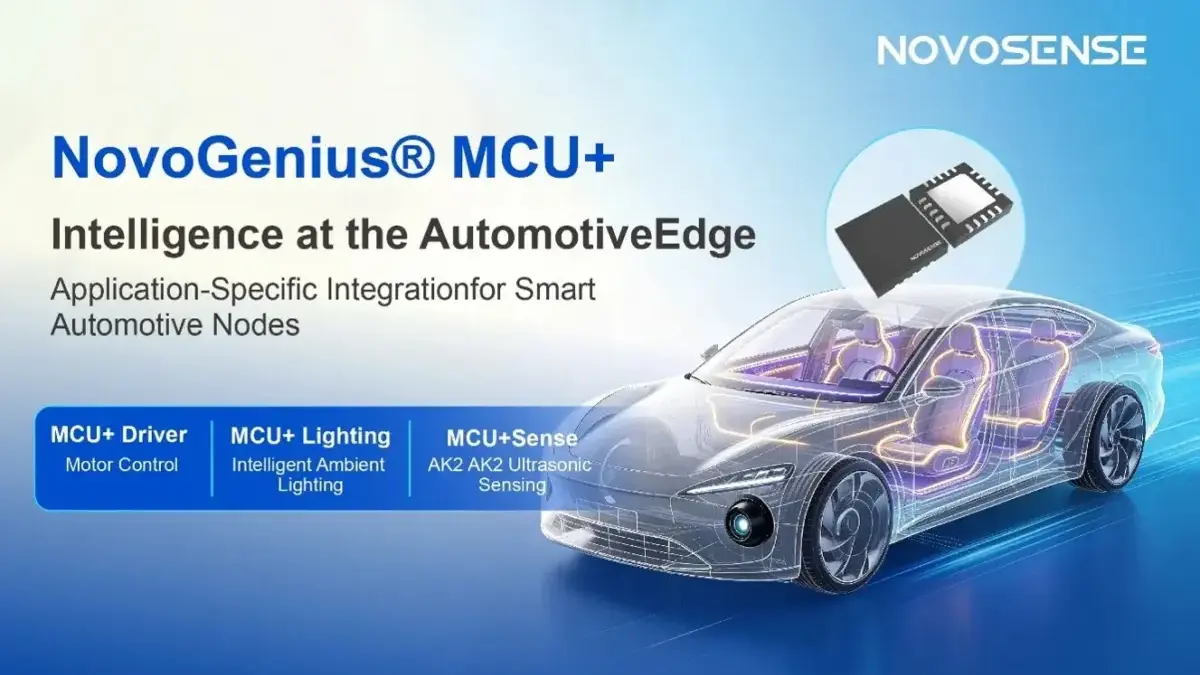
This balancing act between centralization and local intelligence is the precise territory addressed by NovoGenius, NOVOSENSE’s dedicated family of application-specific automotive processors. Ken joined NOVOSENSE in 2019 as marketing director for the sensor product line before being appointed to lead the broader signal chain product line, which encompasses the NovoGenius MCU+ portfolio spanning motor control, ultrasonic sensing, sunlight and rain sensing, and advanced ambient lighting.
What MCU+ Means in Practice
A conventional automotive edge node typically pairs a general-purpose MCU with a collection of discrete companion chips. This traditional bill of materials includes a voltage regulator, a bus transceiver, a gate driver or power stage, and an analog front end. NovoGenius devices take a fundamentally different starting point, engineered from the ground up as application-specific processors whose analog peripherals are tailored to one target function at a time.
"The idea of MCU+ is an all-in-one IC for one kind of automotive application," Ken says, explaining that a single integrated circuit is designed to cover a complete subsystem.
The company’s motor-control devices offer a clear illustration of this architectural approach. An integrated automotive low-dropout (LDO) regulator runs directly from the 12-volt vehicle battery to generate the internal 5-volt supply required by the MCU, while that same battery rail powers the motor through the bridge. A LIN transceiver, an analog-to-digital converter (ADC), a MOSFET driver, and the MOSFET bridge itself are all integrated onto a single silicon die. Consequently, a single device can drive a stepper motor, a brushless DC motor, or a brushed DC motor with virtually nothing else needed on the printed circuit board (PCB) apart from passive components.
According to Ken, a comparable traditional design built using a general-purpose MCU, an external LIN transceiver, and various discrete supporting components consumes roughly three times the PCB area. This drastically smaller footprint yields significant architectural benefits, allowing the controller board to be physically mounted directly inside the motor housing itself. "They can put the PCB into the motor itself, without any external ECU," Ken notes. "That makes the motor a smart motor." NOVOSENSE applies this exact same philosophy to vehicle sensor modules and ambient lighting subsystems.
Customization That Scales
Every NovoGenius device begins with a thorough analysis of the customer’s system requirements rather than a generic, one-size-fits-all feature list. Customers routinely ask for complete integration, but Ken points out that integration is fundamentally an engineering and economic tradeoff rather than an end in itself. Semiconductor wafer processing imposes strict limits on which functions can safely share a single die, while physical constraints such as thermal power dissipation introduce additional boundaries.

"When we integrate everything into one IC, it does not always bring value to the customer for the system cost," Ken explains. "Sometimes it adds cost." The ultimate deciding factor is the customer’s primary design priority. Where cost reduction leads the project, NOVOSENSE defines the device around minimizing overall system cost. Where physical size is the highest priority, the engineering team strives to integrate as much functionality as possible directly into the monolithic IC.
Customization typically increases manufacturing costs and narrows production volumes, raising valid questions about how an application-specific product family remains commercially viable. Ken points to the established structure of the automotive supply base to explain the economic model. In mature automotive markets, a small handful of suppliers often dominate any given application category, with the top three players frequently holding around 70 percent of the market share.
"Even for one customer, the volume is usually enough for you to generate such kind of IC for them," Ken observes. Furthermore, leading suppliers bring a clear, forward-looking perspective on where their specific applications are heading. "The leading customer usually has a very clear definition of the trend," he adds. "They understand what the next generation looks like."
Development speed is accelerated significantly through the reuse of shared intellectual property blocks. NOVOSENSE operates multiple distinct product lines, each contributing its own specialized analog strengths. The NovoGenius family draws directly upon these internal resources, sourcing LIN interface intellectual property from the isolation and interface product line and power supply IP from the power management group. These modular blocks are ported into a common wafer process, which is ideally suited for automotive edge nodes because their underlying system requirements overlap heavily. Almost all of these nodes are powered directly from the 12-volt battery, and their communication interfaces, such as LIN and CAN, are highly standardized.
"The unique role of this group is system integration," Ken says, "understanding the customer’s system, bringing that knowledge in, and integrating every analog IP into one part to generate this kind of SoC."
The impact of this IP reuse strategy on development schedules is easily measurable. The first-generation NovoGenius motor driver required two and a half years to develop from scratch. Once its core building blocks were successfully converted into reusable IP blocks, the second-generation device was completed in just 15 months. Similarly, the first-generation rain and light sensor IC was also delivered within a 15-month timeframe. "The first part on this platform takes a lot of time," Ken explains, "but for the second and the third one, it’s almost reduced by half."

Motor Control, Sensing, and Lighting Portfolios
The company’s motor-control offerings span a remarkably wide power spectrum. Devices such as the NSUC1610 and NSUC1612 integrate the complete power stage for small actuators utilized in thermal management systems and body control applications. Meanwhile, the NSUC1602 pairs the internal MCU with an integrated pre-driver and external MOSFETs to handle larger motors requiring up to 1,500 watts of power.
The dividing line between full integration and split architectures is dictated by thermal management and economic realities. "If the power is too high, it will be very difficult to manage the power in a normal IC package, and the cost will dramatically increase," Ken explains. "So we let the MOSFETs go outside and only integrate the MOSFET driver. The cost and the limitations of physics decide that."
Placing high-power switching circuitry and sensitive analog signal processing on the same silicon die also makes electromagnetic compatibility (EMC) a primary design challenge. Because customers expect the IC to be the only active semiconductor on the board, NOVOSENSE treats module-level EMC compliance as a strict chip-level design requirement. "When we design this IC, we do a system-level EMC simulation," Ken says. The engineering team gathers the stringent EMC thresholds that customer modules must pass during type testing and simulates against them throughout the IC development cycle. The explicit goal is to minimize or eliminate the external EMC filtering components that customers would otherwise be forced to add, thereby driving down the total cost of the module.
In the realm of park assist and low-speed vehicle maneuvering, the NSUC1800 integrates advanced digital signal processing capable of calculating precise distances between the vehicle and nearby obstacles. The device adheres strictly to the physical and data link layers of DSI3, an open interface standard, enabling seamless communication with existing DSI3 master devices already deployed in legacy architectures.
Ultrasonic edge nodes also highlight the rapidly growing importance of functional safety and diagnostics. When ultrasonic sensors served primarily as simple parking aids for human drivers, safety requirements were relatively modest. The advent of automated parking systems changes those requirements entirely. "There is no real person driving the car," Ken points out. "So every sensor node needs to be monitored and diagnosed." Modern ultrasonic ICs must actively detect failures within themselves as well as in external components, such as the tuning capacitor in the transducer circuit, issuing timely warnings or safely halting automated parking maneuvers when necessary.
For sunlight and rain sensing, the NSUC183x IC family is offered across varying levels of integration, a choice Ken characterizes as a commercial decision. Some customers seek to reduce the cost of existing designs without introducing major structural changes, prompting NOVOSENSE to offer a pin-compatible, analog-front-end-only version. For next-generation vehicle programs, those same customers frequently demand full MCU integration. NOVOSENSE accommodates both strategies using a flexible two-die architecture housed within a single package—one die dedicated to the MCU and another dedicated to the analog front end. "We are using a two-die approach with one development," Ken says, "but with different integration levels for the customer."

The functionality of rain and light sensor modules is similarly expanding. While traditional modules were limited to controlling windshield wiper speeds and automatic headlamps, newer implementations measure ambient light levels directly at the windshield to dynamically adjust head-up display (HUD) brightness. Furthermore, advanced versions measure solar loads independently on the driver and front passenger sides, allowing multi-zone HVAC systems to regulate cabin temperatures accordingly. The NSUC183x family supports this increased functional consolidation by incorporating additional light-sensing channels.
In the cabin, ambient lighting is shifting rapidly from static decoration to interactive cockpit communication, driving new demands on controller hardware. The NSUC1527, a multichannel ambient lighting controller, features an onboard CAN interface that provides the higher communication bandwidth required to synchronize dynamic lighting effects with audio systems, allowing interior lights to shift in real time with music.
Display brightness is another major pressure point for automakers, who increasingly demand brighter ambient illumination that requires higher LED drive currents. Because these controllers reside physically inside the lighting modules, power consumption and thermal conversion efficiency become critical design parameters. Ken notes that automated driving exterior indicators, particularly prevalent in China, utilize bright blue exterior lighting to signal when a vehicle is operating in autonomous mode, pushing drive currents even higher. The next generation of the NSUC1500 series is engineered specifically to meet these heightened efficiency demands.
Maintaining strict color consistency across varying operating temperatures and compensating for LED aging remains a central engineering challenge. NovoGenius lighting devices continuously monitor the forward voltage across each individual LED, which serves as a reliable proxy for junction temperature. Internal algorithms then adjust drive currents to compensate for temperature fluctuations and long-term optical degradation. Because every lighting module must be precisely calibrated on the production line, NOVOSENSE provides dedicated manufacturing tools for both brightness and color calibration. "We give them a complete system-level solution," Ken says, "the algorithms for the compensation and the algorithms for manufacturing calibration, and they can use it very easily." The NSUC1503 extends the family further by offering a cost-optimized variant tailored specifically for budget-sensitive vehicle programs.
Moving Toward MCU-less Architectures
As vehicle intelligence is continually redistributed between central domain controllers and smart local nodes, Ken identifies two primary categories of edge nodes that will retain an integrated MCU for the foreseeable future. The first category performs highly specialized, precise local control tasks, such as the multi-motor HVAC flap configuration. The second category delivers optional, value-added features that vary from vehicle to vehicle. While base vehicle configurations are increasingly managed directly from the zone, optional modules ordered by individual buyers—along with entirely new functional features not yet supported by large zonal integration chips—remain anchored at the edge node.
Over time, however, Ken anticipates that some of these established edge nodes will eventually shed the MCU altogether. Automotive electronics are relentlessly driven by cost reduction, and once an application stabilizes technically, fixed-function digital logic can efficiently replace programmable control. "Maybe after three or four years, when the application starts to be stable, the MCU functionality will be replaced by pure digital logic," he explains. "That’s going to be another approach, an MCU-less approach. But in between, it’s still the MCU+ approach."

NOVOSENSE is already pioneering this transition by implementing field-oriented control (FOC) algorithms directly in dedicated digital hardware logic rather than relying on MCU software execution. Ken points to driver’s seat ventilation fans as a prime candidate for this methodology, where the central zone controller transmits only a basic speed command—such as off, low, or high—and a dedicated hardware FOC engine executes the operation seamlessly without requiring an MCU.
The primary engineering hurdle in this transition is motor-to-motor variation, as each motor model has traditionally required customized software tuning. To preserve flexibility while eliminating the MCU, NOVOSENSE provides dedicated configuration registers that describe the specific electrical and mechanical characteristics of the motor, enabling the hardware logic to adapt dynamically. A graphical user interface (GUI) tool, described by Ken as intelligent or AI-based, captures operating current and voltage from the running motor, derives an accurate mathematical model, and automatically generates the precise parameters to write into the device, ensuring smooth and quiet operation. "We call it MCU+," Ken concludes, "but finally it’s going to be MCU-less."
Software, Quality, and International Outlook
Application-specific hardware accelerates customer development schedules only if the accompanying software is robust and dependable. The NovoGenius motor-control turnkey software solution supplies comprehensive low-level drivers and has successfully achieved ASPICE Capability Level 2 certification. Development strictly follows the standard automotive V-model methodology, involving rigorous testing at the software unit, module, function, and system levels.
Ken stresses that high software standards are vital across all global markets. "The customer doesn’t want to develop everything from the very beginning," he notes. "They ask NOVOSENSE to give them the software, and the software needs to be robust." Short program timelines, particularly prevalent in fast-moving markets like China, make pre-validated software a strict prerequisite. "It’s not only for the customers outside China," he adds. "It’s also for the customers inside China."
For European and international Tier 1 suppliers evaluating a new semiconductor vendor, quality management systems and supply chain continuity carry equal weight to the technical specifications of the silicon itself. NOVOSENSE operates an automotive-grade quality management framework backed by a dedicated quality organization, having successfully passed stringent supplier certifications from multiple global Tier 1 manufacturers. Its packaging and testing operations rely on leading outsourced semiconductor assembly and test (OSAT) partners adhering strictly to automotive quality standards. Ken notes that NOVOSENSE has established itself as a leading domestic automotive IC supplier within China.
Outside of its home market, the NovoGenius portfolio has already gained significant commercial traction across East Asia and Europe. A prominent example includes a Japanese supplier holding a leading global market share in HVAC flap actuators, for which NOVOSENSE engineered a customized IC. According to Ken, that customer achieved the best acoustic noise performance in its history when driving its motors with the NovoGenius device.

Looking ahead, the product family’s foundational concept is well-positioned to expand beyond the automotive sector entirely. In applications such as dexterous robotic hands, every individual finger requires an ultra-compact motor equipped with its own dedicated driver, communication interface, and magnetic encoder—mirroring the exact combination of functions that MCU+ integrates for automotive actuators. NOVOSENSE plans to introduce specialized family members tailored for robotics applications within the next two years. "Estamos looking at customers that need high integration, where the integration brings system-level value," Ken says, emphasizing that the company’s robust analog IP portfolio and advanced system-level algorithms form the bedrock of its competitive differentiation.
Within the automotive sphere, NOVOSENSE continues to identify persistent engineering challenges that existing semiconductor components fail to address adequately. One active area of research involves automotive camera lens cleaning systems, where water droplets accumulating on exterior lenses during rainy conditions degrade the visual data relied upon by advanced driver-assistance systems and human drivers alike.
For automotive engineers evaluating the NovoGenius platform for upcoming vehicle programs, Ken advises starting with the specific application requirements. Each device is defined around a clear use case aimed at reducing overall system cost by eliminating external discrete components—including EMC filtering circuitry—while maximizing system-level performance. Where a suitable standard device does not yet exist, the collaborative definition process that birthed the current product family remains open to accommodating new customer requirements. "When the customer has some kind of special requirement for those kinds of applications," Ken says, "they can come to NovoGenius and talk with us about the approach."