
The Resource Public Key Infrastructure (RPKI) has firmly established itself as the internet’s primary line of defense against Border Gateway Protocol (BGP) route hijacks, accidental leaks, and severe network misconfigurations. By empowering network operators to cryptographically authorize specific Autonomous Systems (ASes) to originate designated IP prefixes, RPKI has transformed how the global internet secures its routing infrastructure. However, as the adoption of RPKI accelerates worldwide, a critical technical question has persistently loomed over the networking community: Does the continuous stream of RPKI-related modifications pose a hidden threat to the stability of the global routing system?
To answer this complex question, a comprehensive study analyzing more than eleven years of historical RPKI and BGP data has been conducted. The research sought to measure precisely how much routing activity can be directly attributed to RPKI-related changes over time. The findings offer reassuring news for network operators across the globe, indicating that while RPKI-induced routing updates are indeed increasing in tandem with the technology’s widespread adoption, they currently remain an exceedingly small fraction of overall BGP traffic and do not constitute a harmful source of routing noise.
RPKI is growing fast

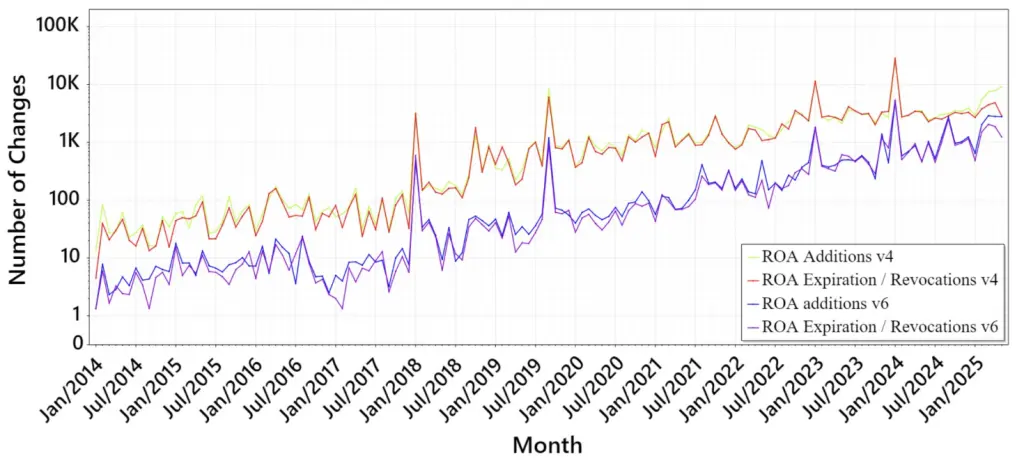
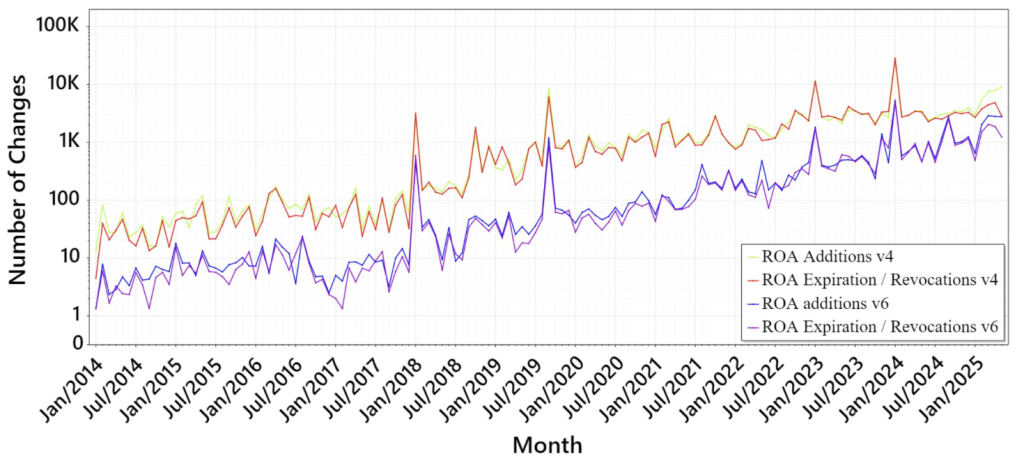
To contextualize the findings regarding routing stability, researchers first examined the rapid and continuous evolution of the RPKI ecosystem over the past decade. The volume of Route Origin Authorization (ROA) creations, expirations, and revocations has surged significantly between 2014 and 2025 across both IPv4 and IPv6 address spaces. This remarkable trajectory reflects a broader industry movement driven by regulatory initiatives, enhanced security standards, and the universal promotion of routing best practices among network operators seeking to protect their valuable address space.
This unprecedented growth carried a theoretical operational implication: if each individual RPKI modification possesses the potential to trigger subsequent routing updates across the internet, then a rapidly expanding volume of RPKI events could theoretically translate into a massive surge in BGP activity. The central motivation behind the multi-year study was to determine whether this consequential BGP activity would remain practically negligible or escalate into a significant operational burden for backbone providers and autonomous system administrators.
Building an 11-year RPKI time machine
Quantifying the exact impact of RPKI on BGP behavior over a prolonged historical window proved to be a formidable technical challenge. The first major hurdle involved accurately identifying the exact moments when RPKI changes could realistically influence interdomain routing decisions. The research team noted that a simple ROA creation or revocation does not automatically trigger an immediate routing change. Instead, the determining factor is whether the specific set of cryptographic authorizations perceived by validating routers undergoes a fundamental shift.

These critical instances are defined by researchers as RPKI events. A formal RPKI event occurs whenever a validated ROA payload, often referred to as a Validated ROA Payload or VRP, either becomes newly available or vanishes from repositories. Such changes have the potential to alter validation states, influence path selection algorithms, and subsequently trigger one or more BGP announcements across the network fabric.
The second major obstacle was historical visibility. While observing contemporary RPKI activity in real time is relatively straightforward with modern monitoring platforms, obtaining an equivalent, high-fidelity view spanning more than a decade required reconstructing past events from archival databases. To overcome this limitation, the researchers engineered a specialized methodology combining archival RPKI repositories with granular BGP update measurements, effectively constructing an eleven-year analytical time machine capable of tracking how RPKI’s routing footprint evolved from its infancy to the modern era.
RIPE Archive and Flutter data
To ensure accuracy and robustness, the investigation relied upon two complementary data sources to track RPKI events and their downstream BGP consequences. By cross-referencing historical records preserved within the RIPE Archive with contemporary observations gathered from advanced monitoring systems like Flutter, the researchers could bridge the gap between early deployment phases and present-day operations.
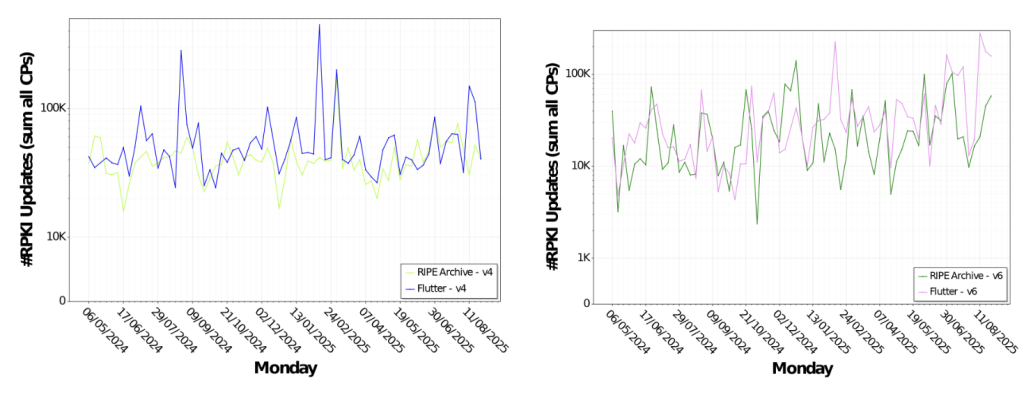
A comparative analysis of the data overlapping between May 2024 and August 2025 revealed a striking alignment between the two datasets. The number of RPKI-related BGP updates identified through Archive-derived historical events closely mirrored those observed directly through Flutter events for both IPv4 and IPv6 address families. This high degree of correlation demonstrated that the Archive-based methodology provides a remarkably reliable estimate of historical RPKI-induced routing activity, validating the decision to extend the analytical scope far beyond the timeframe covered by newer tools.
RPKI is not a harmful source of BGP noise
The core empirical findings of the eleven-year study paint a clear and encouraging picture of the internet’s routing health. When tracking the fraction of all observed BGP updates that can be definitively associated with RPKI events over time, researchers observed a steady upward curve that nonetheless remains extraordinarily small when measured against the staggering total volume of background BGP activity crossing the global network.
Even when applying analytical methodologies intentionally designed to overestimate the true number of RPKI-induced updates, the observed contribution consistently remained well below one percent of the total BGP update volume. While the data undeniably reveals a rising trend—driven by the fact that a larger percentage of global address space is now shielded by ROAs and evaluated via Route Origin Validation—the absolute contribution to overall routing chatter remains remarkably modest.
What should you worry about?
From an operational perspective, these empirical conclusions offer significant reassurance to network engineers and architects considering or expanding their RPKI deployments. First and foremost, the study provides robust evidence that RPKI is not currently acting as a disruptive source of harmful BGP noise. Although individual RPKI events can and do induce localized routing updates, the aggregate volume generated globally remains statistically negligible.
Second, the findings strongly imply that network operators should not view potential routing instability as a prohibitive barrier to adopting RPKI and implementing strict Route Origin Validation. Provided that ROAs are managed with care and standard operational best practices are rigorously followed, the additional routing overhead introduced into the global BGP ecosystem is remarkably low.
Nevertheless, the research underscores that internet infrastructure management requires ongoing vigilance. As RPKI deployment continues to mature and ROV becomes a universal standard enforced by nearly all major transit providers, the operational dynamics of the ecosystem will continue to evolve. Consequently, continuous monitoring remains essential to ensure long-term stability. However, after thoroughly auditing over a decade of empirical measurements, the networking community can rest assured that RPKI delivers its critical security guarantees while preserving the fundamental stability of the global routing table.
Leave a Reply