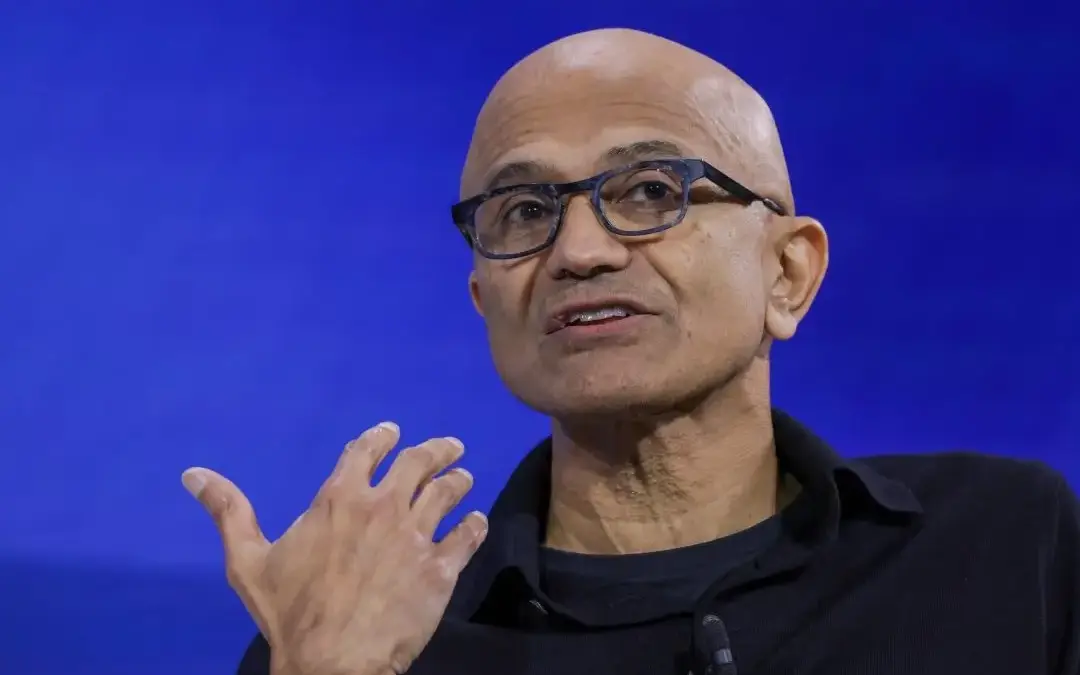
Microsoft Chief Executive Officer Satya Nadella has opened up about one of the most drastic workforce moves in the tech industry in recent memory: the decision to offer voluntary buyouts to roughly 60,000 employees. Speaking at the high-profile New York Times DealBook Summit, Nadella addressed the motivations behind the sweeping restructuring program, making it clear that the move was designed to give workers agency during an unprecedented technological transition rather than relying on traditional, abrupt corporate layoffs.
The short answer, according to Nadella, is artificial intelligence. However, the Microsoft chief insisted that the situation is far more nuanced than simple automation. He is not arguing that machines are coming for every job, nor is he saying that human software engineers are suddenly obsolete. Instead, Nadella envisions a fundamental reorganization of Microsoft into an enterprise where every single employee utilizes AI as a core component of their daily work, shifting their primary responsibilities toward managing and directing those intelligent systems.
The massive buyout initiative, which was first reported in October, was intended to ensure that employees felt they retained a sense of personal choice and control during a turbulent era of corporate evolution. As Nadella explained to interviewer Andrew Ross Sorkin during the DealBook Summit, the leadership team wanted to make sure that at least everyone felt like they had agency in making choices about their professional futures.
Reflecting on the rapid pendulum swing of public and professional sentiment surrounding artificial intelligence, Nadella pointed to the software engineering sector as a prime example. The industry narrative has shifted dramatically over a remarkably short period. Initially, many doubted whether AI could ever handle software development tasks effectively. That skepticism quickly swung to the opposite extreme, triggering panic and the pervasive question of why companies would need human software engineers at all.
Now, Nadella notes, the industry is rediscovering a balanced reality: software engineering is very much alive and is poised to thrive. However, the fundamental way a team is organized, and the day-to-day work that a software engineer performs, has shifted to a completely new operating point. For some individuals, Nadella acknowledged, navigating that level of reorganization and cultural change is undeniably difficult, but it remains a necessary transformation for a company striving to stay ahead of the curve.
To illustrate this new operational paradigm, Nadella offered a compelling real-world example from within Microsoft itself: the team responsible for building Cowork, the advanced AI agent integrated into Microsoft 365 applications. According to the CEO, this critical product is built and maintained by a remarkably lean team of just 11 developers who have mastered the art of leveraging artificial intelligence to do their jobs. They are not writing every line of code by hand in the traditional manner; rather, they have built a software factory that in turn builds the product. They build the system that builds the software, rather than building the software directly.
Nadella firmly believes that this structural shift is not an isolated anomaly confined to a single product team. Instead, he predicts that this level of strategic direction and high-level management will eventually become the baseline for all jobs across the modern corporate landscape. Every employee will, in some capacity, become a manager of digital agents rather than a direct, manual executor of routine tasks.
Yet navigating this transition presents unique historical challenges for a legacy enterprise. Microsoft, as a 51-year-old corporate institution, did not grow up as an AI-first organization. It was built during an entirely different era of computing, with established workflows, legacy hierarchies, and deeply ingrained operational habits. The central question facing executive leadership is how quickly an incumbent enterprise of this massive scale can successfully transform its work processes, workflows, and core artifacts, all while maintaining the necessary wage support and institutional stability for its global workforce. Nadella admitted that this monumental shift is inevitably going to take a bit more time than anyone expects. Within that lengthy process of reinvention, there will inevitably be employees who look at the changing landscape and decide they want to make other choices for their careers.
The rationale behind offering voluntary departures rather than forcing sudden, involuntary reductions was further clarified by Nadella during a recent appearance on The Pragmatic Engineer podcast hosted by Gergely Orosz. During that conversation, Nadella expanded on the psychological and cultural toll that rapid technological disruption takes on a workforce.
He noted that the tech industry has inadvertently created enormous anxiety among working professionals, many of whom feel that they have lost control of their own professional destinies due to the hyperbolic and breathless rhetoric surrounding the artificial intelligence revolution. When public discourse is dominated by dramatic predictions about the technological singularity—the hypothetical future point at which artificial intelligence surpasses human intelligence—and widespread warnings that AI is going to eliminate all human jobs, it triggers a powerful defensive reaction. Nadella pointed out that all of that apocalyptic talk leads anyone who might otherwise be willing to embrace change to feel anxious and insecure. Consequently, corporate leadership has to walk the hard walk of making difficult structural changes, getting people properly slotted into new paradigms, and giving them genuine opportunities to adapt or move on.
In practical terms, the buyout offer served as a clear message from executive leadership to the company’s massive workforce. Employees were given a stark choice: they could choose to embrace the new AI-first program, which promises to radically transform their daily jobs and career trajectories, or they could take the buyout package and choose to pursue their lives and careers elsewhere. By structuring the transition around voluntary agency, Microsoft attempted to mitigate the trauma of a traditional workforce reduction while aggressively clearing the path for its inevitable future as an AI-driven enterprise.