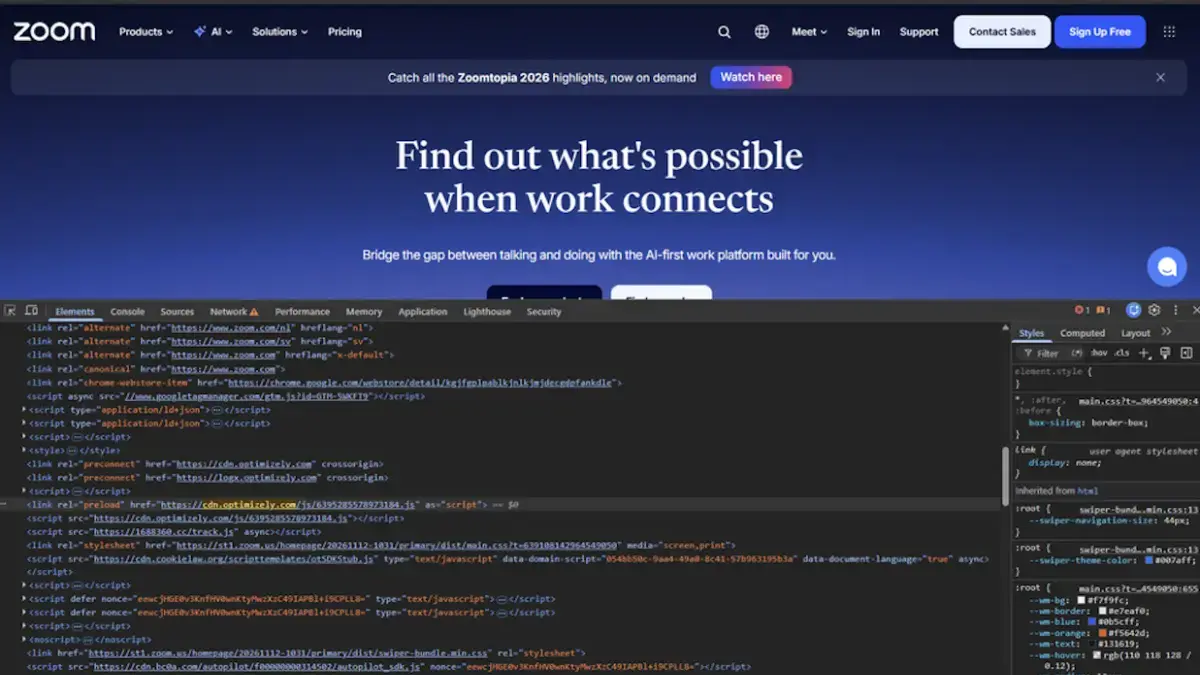
At least 178 top-tier web destinations unwittingly served a variety of malware exploits against everyday visitors over a 24-hour period due to a severe security vulnerability involving Optimizely, a prominent industry platform that helps websites customize user experiences and test out new features. Cybersecurity experts note that the incident—which saw data-stealing malicious software silently injected into globally recognized sites such as the BBC, CNN, Equifax, Ledger, and Zoom—was severely exacerbated by a systemic industry weakness: few popular websites enforce strict, restrictive rules on the external sources of third-party content loaded onto their pages.
According to an incident analysis published by the security firm Report URI, malicious JavaScript code was served on November 16 to visitors across 178 major organizations through compromised pathways in Optimizely’s platform. Report URI researcher Scott Helme reported that the payload delivered by the malicious script was continuously modified and rebuilt 26 times throughout the course of a single day. The kit deployed a multi-purpose malware package designed to harvest sensitive payment card data, browser cookies, and screenshots, while also executing malicious routines to swap out legitimate cryptocurrency payment addresses with those controlled by the attackers.
Helme further observed that the affected websites served exploit code specifically engineered to target known security vulnerabilities in older Apple iPhone and iPad devices. Identified in threat intelligence circles by names such as "DarkSword" and "Coruna," these sophisticated, zero-click exploit kits seamlessly chain together roughly half a dozen distinct security flaws to seize absolute control over outdated mobile devices and extract stored data without requiring any user interaction.
The incident underscores a pervasive and mounting peril in modern software architecture. As Helme emphasized in his analysis, trusted JavaScript does not always remain trustworthy, and a website can be thoroughly compromised through a third-party dependency without its core infrastructure or proprietary code ever suffering a direct breach.
When contacted for comment regarding the breach, Optimizely confirmed that on November 16 it identified a security incident in which an unauthorized party exploited a vulnerability within the Optimizely Experimentation product to inject malicious JavaScript code into select customer projects.
In a formal written statement shared by the company, representatives stated that they acted swiftly to contain the security event and have fully remediated the identified vulnerability. The remediation measures included blocking access to the vulnerable path, deploying a permanent software fix, removing all injected malicious code from affected customer projects, ending active user sessions, revoking security tokens, and resetting access credentials for compromised user accounts. Furthermore, Optimizely implemented additional protective measures within Cloudflare to prevent any future delivery of malicious code. While the company maintains that the incident has been fully resolved, it continues to work alongside third-party security experts to conduct a comprehensive investigation.
The mechanics of the attack highlight the deep reliance modern web architecture places on third-party scripting. Today, many leading web properties refuse to fully render or display content unless visitors consent to letting dozens of external third parties execute JavaScript. As a powerful web scripting language that enables interactive content, analytics, and personalization, JavaScript executes directly on the end user’s device. This gives the script extensive capabilities to read information displayed in the browser, track user interactions, and even modify the visual appearance or core content of a webpage.
The extensive deployment of JavaScript is driven largely by the need for precise browser fingerprinting, user tracking, and audience measurement. Data from the 2025 Web Almanac compiled by the HTTP Archive indicates that the median homepage loads at least 22 distinct JavaScript files. However, as the Optimizely incident vividly demonstrates, a security compromise at a single third-party vendor’s website can rapidly snowball into a massive supply chain attack, forcing downstream websites to unwittingly serve tampered and dangerous files to their visitors.
Zach Edwards, a researcher at Infoblox and co-founder of the ad-tracking service DecryptAds, explained that Optimizely operates as a vendor that frequently collects data outside standard user consent flows. Because its product is primarily built for real-time A/B testing and user experience optimization, Optimizely’s JavaScript snippets are deliberately embedded as close to the top of the webpage’s source code as possible to ensure they render immediately upon loading.

Edwards noted that to make the product function as expected, the code is configured to fire immediately on page load rather than being restricted or delayed behind a user consent dialog box. Consequently, this supply chain attack did not require any user clicking or consent to trigger; most of the impacted client websites immediately served the malicious payload the exact moment a visitor loaded the page, drastically increasing the risks associated with a compromised third-party script snippet.
Websites can significantly minimize the probability that a security breach at a third-party content provider spirals into a destructive supply chain attack by fully implementing and enforcing Content Security Policies, commonly known as CSPs. These security headers explicitly define and restrict the exact domain names that are authorized to serve third-party content and scripts to a webpage.
However, Edwards pointed out that the vast majority of websites—with the notable exception of the largest e-commerce platforms, major social media networks, and Tier-1 financial institutions—either fail to implement CSPs entirely or maintain policies that are far too permissive to satisfy marketing and analytics requirements.
He explained that across virtually all websites embedding third-party JavaScript resources, the absence of a robust content security policy means that if any single partner is compromised, attackers can effortlessly inject new, unauthorized domains into the host website via JavaScript without encountering any technical blocks. The digital ecosystem is currently navigating the era of JavaScript supply chain attacks, yet remarkably few organizations discuss why CSPs were originally created or how they serve as the primary operational defense, despite the initial deployment complexities.
An examination by Report URI of the specific websites impacted by the Optimizely attack revealed a stark lack of effective defenses. Out of the 178 affected sites, 68 maintained no Content Security Policy at all, while another 50 utilized a CSP that was configured so permissively that it permitted both the malware payload execution and the subsequent data theft. Only 24 of the affected sites—representing a mere 15 percent of the total victims—had deployed CSPs capable of fully blocking the malicious payload.
Broader internet telemetry reflects a similarly low adoption rate across the wider web. According to data from Helme’s tracking platform crawler.ninja, which daily scans the top one million websites for security configurations, the overall deployment of effective CSPs across the busiest sites on the internet hovers around just 10 percent. Helme expressed hope that this high-profile incident will compel more organizations to adopt stringent and effective CSPs. He noted that the situation could have been significantly worse: based on Report URI’s preliminary estimates, the threat actors behind the campaign managed to steal approximately $7,500 worth of virtual currency from affected users, alongside an undetermined volume of sensitive payment card records.
Reflecting on the broader state of web security, Helme frequently compares the prevailing lack of foundational security controls to the Wild West. Organizations continue to execute vast quantities of third-party code without maintaining visibility into its actual behavior or operational impact. This absence of checks and rules makes large-scale breaches practically inevitable once code execution is achieved. With the advent of modern artificial intelligence tools assisting threat actors in writing and optimizing malicious scripts, technical barriers to executing complex web attacks have lowered dramatically.
While internet users have historically relied on simple script-blocking browser extensions like NoScript to control which JavaScript elements execute on visited pages, these tools have traditionally appealed primarily to advanced security and privacy enthusiasts willing to manually evaluate dozens of JavaScript requests on every new site. In contrast, modern ad-blocking software has evolved to handily block most third-party JavaScript requests automatically. While standard cybersecurity guidance a decade ago centered on installing traditional antivirus software and enabling local firewalls, modern web browsing realities suggest that an effective ad and script blocker functions as an essential layer of digital defense.
Optimizely published a formal incident report detailing its initial findings and forensic conclusions regarding the security event.