

September 1, 2026
By Alma F.
The landscape of digital publishing has shifted dramatically. In 2026, the question is no longer whether writers and content creators should utilize artificial intelligence, but rather how to integrate it responsibly without sacrificing quality, brand voice, or audience trust. According to recent insights from digital content strategists, the most successful publishers treat AI as an advanced writing assistant rather than an autonomous publishing machine.
Simply accepting a generative model’s first raw output without human intervention is a fast track to generic, uninspired content. True AI-assisted blog writing requires a meticulous, multi-stage workflow. In this framework, artificial intelligence handles the heavy lifting of planning, organizing, drafting, and preliminary structuring, while human editors retain absolute responsibility for factual accuracy, original examples, deep expertise, distinct brand voice, and final publication decisions.
Building articles in carefully managed stages allows editorial teams to catch weak ideas, unsupported claims, and formulaic writing long before the content reaches the public eye.

Preparing the Comprehensive Blog Post Brief
The foundation of any successful AI-assisted article begins long before the software generates its first sentence. It starts with a precise, highly detailed brief.
When creators submit vague prompts—such as asking an AI model to write a general post about product photography—the software is forced to guess critical context. Without guidance, the model does not know whether the target audience consists of seasoned commercial photographers, busy e-commerce enterprise owners, or everyday consumers snapping pictures with a smartphone. These missing parameters inevitably produce broad, generalized advice that fails to resonate with the actual reader.
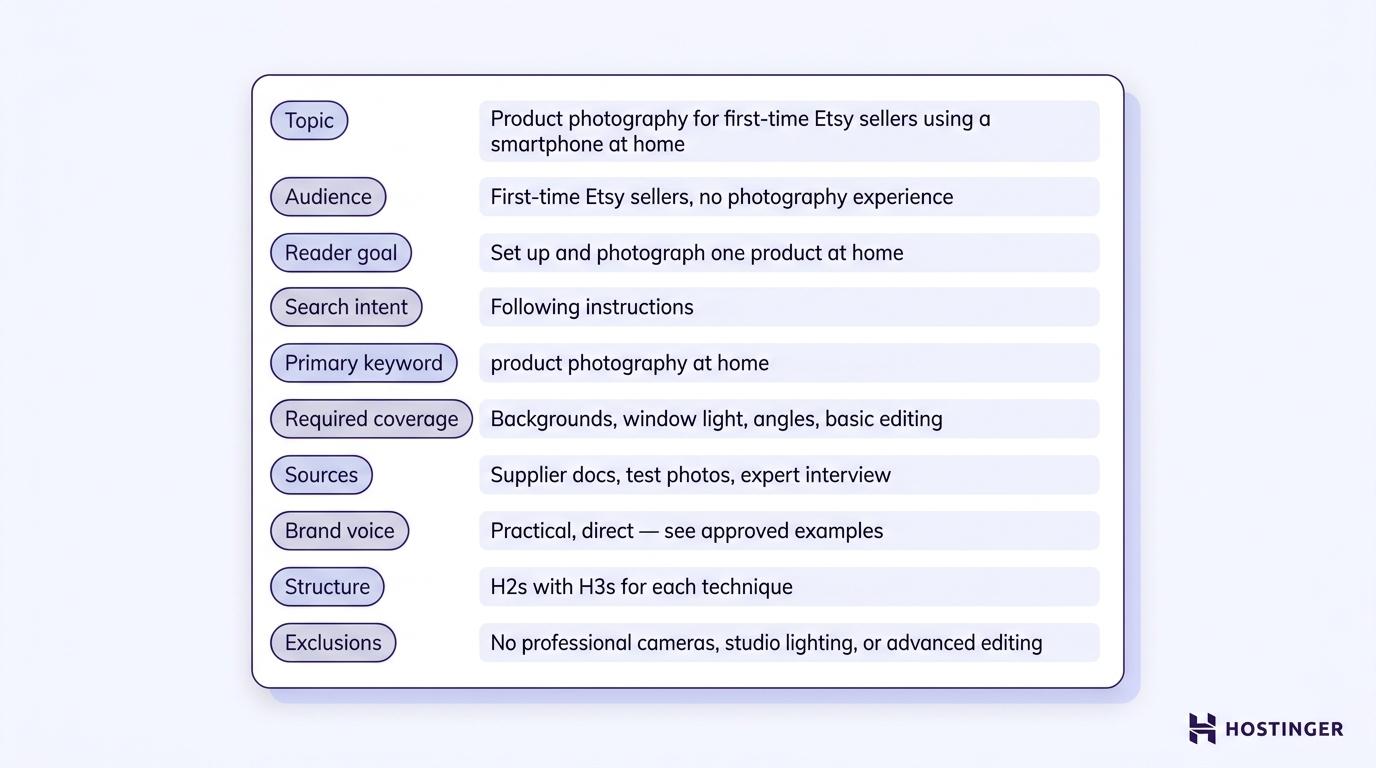
A properly constructed brief must explicitly define the target readership, the specific problem the reader needs solved, the intended scope of the article, and the approved sources for factual claims. For example, a well-defined brief might specify that a tutorial targets first-time digital marketplace sellers wanting to photograph handmade goods at home using only mobile devices. By outlining clear boundaries—such as excluding professional studio lighting or advanced editing software—creators give AI systems a defined audience, a tangible outcome, and strict operational boundaries.
Before advancing to the next stage, editors should review the brief as though handing instructions to a human freelance writer. If a human would still need to ask fundamental questions about the target audience or required outcomes, the brief needs more refinement.

Selecting the Right AI Writing Ecosystem
Navigating the vast ecosystem of generative technology can feel overwhelming, but creators do not need to test dozens of competing platforms. Instead, publishers should evaluate tools based on how well they execute specific operational tasks, such as deep web research, long-form drafting, SEO integration, or multi-agent collaboration.
Different platforms serve different functions. General chat assistants like ChatGPT and Claude handle broad conversational drafting and structural planning effectively. Specialized platforms like Jasper or integrated Content Management System plugins embed writing capabilities directly into publishing workflows. Meanwhile, advanced specialized platforms such as Hostinger Agent deploy dedicated digital assistants tailored explicitly for writing, search engine optimization, and marketing tasks.
When evaluating these technologies, editors must verify whether a tool can securely process source material, maintain conversational context across multiple prompts, and cite external web sources transparently. Crucially, web access does not guarantee factual correctness; human oversight remains mandatory to verify that cited sources genuinely support the claims being made. Furthermore, organizations must exercise strict caution regarding data privacy, ensuring that confidential corporate information, unpublished client work, and sensitive customer details are never uploaded into third-party AI models.
Creating and Refining the Blog Outline
Once the brief is locked in, the next phase involves translating those instructions into a logical sequence of headings. Rather than asking an AI to draft an entire article at once, professional workflows demand a careful review of the structural outline first.

By reviewing the sequence of headings before prose generation begins, editors can easily spot redundant concepts, missing steps, or inverted logic. For instance, if an AI-generated outline places product positioning instructions before the necessary lighting setup, the editor can adjust the flow in a matter of seconds. This preventative step eliminates the need to reorganize massive blocks of text later.
Furthermore, AI-generated outlines frequently include unnecessary filler sections simply because those topics appear frequently in similar web content. An article about smartphone product photography, for example, rarely requires a lengthy philosophical preamble explaining why visual marketing matters. Readers arrive searching for direct instructions, and a streamlined outline ensures the content respects their time.
Generating the First Draft in Controlled Segments
With an approved outline in hand, creators can proceed to draft generation. For short pieces with minimal factual requirements, generating the entire outline in one pass may suffice. However, for technical tutorials, extensive guides, or source-heavy investigations, drafting one section at a time prevents the AI from drifting off-topic or misunderstanding complex nuances.
Vague prompts yield vague prose. Instructing an AI to simply "write a section about lighting" forces the software to reinvent the scope, frequently resulting in omitted parameters or irrelevant information. Conversely, utilizing detailed prompts that incorporate the specific notes from the approved outline—such as explaining window placement, handling harsh shadows, and utilizing white cards for light reflection—ensures the generated text remains tightly aligned with the editorial vision.
Refining and Elevating the Draft
After the initial draft is compiled, the editing process shifts toward enhancing utility. Every paragraph must answer a fundamental question: what does this help the reader understand or accomplish?
Vague generalities must be systematically replaced with concrete, actionable instructions. Where raw AI output might state that good lighting helps present products professionally, a refined draft provides exact physical measurements, placement angles, and visual cues for the creator to look for during their shoot.
Rather than asking an AI to "make this text better," human editors must provide precise diagnostic feedback. Directing the model to rewrite a specific passage for a distinct audience while preserving core facts and prohibiting the introduction of unverified claims keeps the editorial process firmly under human control.
Infusing Human Expertise and Brand Voice
Perhaps the most critical phase of modern publishing involves injecting genuine human expertise and maintaining a consistent brand voice. Artificial intelligence cannot invent authentic personal experiences, proprietary company testing data, or original industry insights.

Publishers must weave in real-world case studies, firsthand test results, expert quotes, and unique observations that no automated model could possibly replicate. Once these elements are integrated, the entire manuscript must be polished to match the publication’s distinct stylistic voice. AI can assist in smoothing out overly stiff phrasing when provided with clear brand voice examples, but human oversight must ensure the resulting tone sounds natural and authentic.
Under no circumstances should automated tools be permitted to fabricate customer testimonials, fake quotes, personal anecdotes, or unverified research scenarios. If hypothetical examples are used for illustrative purposes, they must be transparently labeled.
Rigorous Fact-Checking and Editorial Oversight
Even the most sophisticated language models are prone to hallucinating facts, misinterpreting source documentation, or summarizing conditional software features incorrectly. Consequently, rigorous fact-checking remains a non-negotiable step before publication.
Editors must open original source links directly rather than trusting citations at face value. Every factual claim, software integration, pricing tier, and technical instruction must be independently verified against current documentation. Whenever possible, writers should test instructions hands-on to ensure that software menus, button names, and procedural sequences have not changed.

In high-stakes industries—such as legal, financial, or medical publishing—expert review by qualified professionals is mandatory. Automated tools and general editors can verify grammar and surface-level consistency, but they cannot replace specialized professional judgment where incorrect advice could cause tangible harm.
Final Structural Editing and Publishing Preparation
The final phases of the workflow involve holistic editorial reviews and technical pre-publication checks. Editors must read the completed manuscript from start to finish to evaluate overall flow, ensuring smooth transitions between sections and eliminating any lingering repetition.
Once the text is finalized, production teams run through standard publishing checklists. This includes verifying metadata, optimizing search descriptions, confirming image formatting, testing internal and external hyperlinks, and reviewing responsive display layouts across various devices.
By maintaining rigorous editorial standards, treating generative technology strictly as an assistant rather than an author, and placing human judgment at the center of every publishing decision, modern content creators can leverage artificial intelligence effectively while preserving the accuracy, integrity, and trust that audiences demand.


Leave a Reply