

A coalition of major international book publishers has formally asked a New York federal court to enter a $19.5 million default judgment against WeLib, a notorious shadow library that allegedly cloned both its underlying codebase and the vast majority of its catalog from the prominent pirate site Anna’s Archive. The legal move comes after WeLib’s anonymous operators opted to ignore the copyright infringement lawsuit filed earlier this year, paving the way for a severe financial and structural penalty.
The case highlights an escalating legal battle between the traditional publishing industry and underground digital archives that leverage modern web technologies to distribute copyrighted academic texts, textbooks, and literature on a massive scale. Interestingly, a close examination of the legal documents filed by the publishers reveals that the prosecution’s briefs carry an ironic twist: the text closely mirrors—and in some places accidentally repeats—arguments, typos, and specific claims originally drafted for the publishers’ parallel lawsuit against Anna’s Archive.
The conflict surrounding WeLib first surfaced within the shadowy digital library ecosystem itself. Late last year, the operators of Anna’s Archive publicly cautioned their user base against interacting with WeLib, branding the platform as a suspicious new entrant. According to warnings issued by Anna’s Archive at the time, WeLib had effectively scraped their entire collection and duplicated their software architecture using a fork of their codebase. Because WeLib’s administrators allegedly contributed nothing back to the community in terms of novel content acquisition, software improvements, or collaborative development, the original shadow library urged users to avoid the platform entirely, writing explicitly that they recommended not utilizing the site.

By June, a formidable coalition of major publishing houses arrived at a similarly critical conclusion regarding WeLib’s operations, albeit driven by the enforcement of intellectual property laws rather than ecosystem etiquette. Prominent corporate publishers, including Penguin Random House, Elsevier, HarperCollins, Macmillan, Wiley, and Pearson, banded together to file a federal lawsuit in the U.S. District Court for the Southern District of New York. The formal complaint accused WeLib of orchestrating a sweeping copyright infringement scheme, alleging that the site was brought into existence specifically after its anonymous operators copied the source code and the vast majority of the contents hosted by Anna’s Archive.
Despite being properly served through digital channels and public notice, WeLib’s operators chose not to mount a legal defense. Their ongoing failure to respond, appear in court, or file an answer to the allegations prompted the presiding court clerk to formally enter a default against the site in August. With procedural hurdles cleared, the path was left open for the plaintiffs to motion the court for a definitive final judgment, complete with statutory damages and restrictive injunctive relief.
On Monday, the collective group of publishers petitioned U.S. District Court Judge Victor Marrero to grant a default judgment against WeLib and its unidentified administrators. In their legal memorandum, the publishers did not mince words regarding the platform’s commercial nature, asserting that the defendant is fundamentally a pirate site whose sole business model revolves around the unauthorized distribution of protected literary works in direct violation of the legal rights held by the plaintiffs and the broader copyright community.
To calculate the steep financial penalty, the publishers invoked statutory damages under U.S. copyright law, requesting the maximum allowable amount of $150,000 for each of the 130 distinct works explicitly listed in the complaint. This calculation assigns ten infringed titles to each of the thirteen corporate publishing entities involved in the litigation. The resulting sum reaches precisely $19.5 million. This figure mirrors the exact monetary judgment handed down by U.S. District Judge Jed Rakoff in the analogous copyright lawsuit targeting Anna’s Archive earlier this year.

The distribution of the requested damages breaks down evenly across the corporate plaintiffs, with each of the thirteen publishing companies—including Apress Media, Cengage Learning, Hachette Book Group, John Wiley & Sons, McGraw Hill, Simon and Schuster, and Taylor & Francis—seeking $1.5 million apiece, culminating in the cumulative $19.5 million total.
Beyond the massive financial penalties, the publishers’ proposed judgment seeks a comprehensive permanent injunction designed to dismantle WeLib’s web infrastructure. If approved by Judge Marrero, the injunction would legally compel domain registries and domain name registrars to immediately disable core web portals such as welib.org, welib.st, and welib-public.org. Furthermore, the order would prohibit the transfer of these domains to any entity other than the plaintiffs themselves, while internet hosting providers and cloud infrastructure companies would be legally mandated to cease serving the illicit platforms entirely.
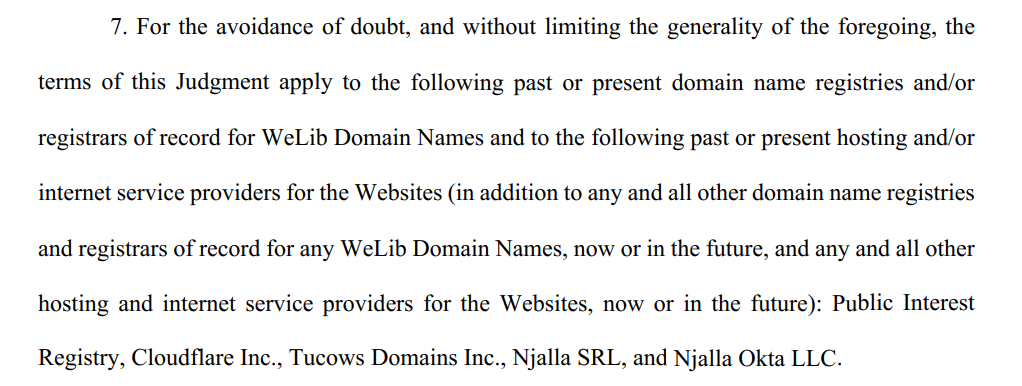
While the injunction would technically bind all applicable intermediaries operating within the legal jurisdiction, the proposed court order specifically names five pivotal infrastructure entities: the Public Interest Registry, Cloudflare, Tucows, and two separate entities associated with the privacy-centric hosting provider Njalla. Notably, this named list is considerably more concise than the sweeping injunction secured in the Anna’s Archive litigation, which targeted more than twenty distinct intermediaries and internet service providers.
The legal filings submitted by the publishing coalition also draw sharp focus to WeLib’s operational funding model. While the platform presents itself as a free service to casual visitors, investigators and lawyers pointed out that the site actively solicits financial contributions labeled as donations, with suggested tiers reaching up to $90 per month. According to the publishers’ legal team, these solicitations are not genuine philanthropic donations but rather commercial transactions functioning as paywalls for significantly faster download speeds and prioritized server access.

However, the legal filings also exposed some curious editorial anomalies, revealing that large portions of the memorandum submitted against WeLib were directly copied and pasted from the briefs previously filed against Anna’s Archive by the specialized intellectual property law firm Oppenheim + Zebrak. While reusing successful legal templates and standardized copyright arguments is standard practice in complex intellectual property litigation, certain transferred sections failed to align with the factual realities of the WeLib case.
Most notably, the WeLib brief argues that the platform diverts revenue from copyright holders at a scale made progressively worse by its use of the viral BitTorrent protocol. Independent reviews of WeLib and its complaint filings, however, indicate no public evidence or technical indication that WeLib relies on BitTorrent architecture for its distribution network. Instead, the cited paragraphs appear to have been directly transplanted from the Anna’s Archive memorandum, where references to BitTorrent accurately described Anna’s Archive’s dedicated torrent distribution pages used for bulk data sharing.
By contrast, WeLib’s own public documentation outlines a different technical mechanism, describing a system where files are served directly from central web servers via tiered download speeds, contrasting slow free downloads against paid fast options. Additional traces of the recycled text appeared elsewhere in the brief, including assertions that WeLib’s infringement continued despite multiple prior legal actions—a statement that accurately described the long-running target Anna’s Archive, but one for which there is no public record regarding prior lawsuits specifically directed at WeLib’s anonymous operators.
Even minor grammatical quirks, typos, and awkward phrasing survived the copy-and-paste process intact. Both the Anna’s Archive brief and the WeLib brief utilize the identical typographical error regarding what occurs if the court "is satified" that default standards have been satisfied. Additionally, both legal documents feature identical, convoluted phrasing arguing that the respective defendants "cannot establish that they have not presented any meritorious defenses."
With the paperwork submitted, the decision now rests in the hands of Judge Marrero, who must rule on the motion for default judgment and the accompanying injunction. Legal observers note that regardless of whether the court grants the full $19.5 million award, the publishers are statistically unlikely to recover any significant financial restitution. Because WeLib’s operators maintain strict anonymity behind privacy services and offshore infrastructure, identifying and seizing real-world assets remains an exceedingly difficult hurdle.
The ongoing persistence of similar platforms suggests that judicial victories in U.S. federal courts often amount to symbolic or structural roadblocks rather than permanent operational shutdowns. For instance, despite facing a massive $340 million judgment and losing several high-profile domain names following previous court orders, Anna’s Archive has consistently managed to evade total elimination by migrating its web presence to alternative top-level domains like .gl, .pk, and .gd, which rely on registries and registrars located entirely outside American jurisdiction.
Whether WeLib will follow a similar trajectory of domain hopping and resilience remains to be seen, but the publishers’ aggressive legal posture signals an ongoing, uncompromising campaign by the traditional literary industry to systematically dismantle the infrastructure supporting the modern shadow library network. Representatives for Oppenheim + Zebrak were approached for comment regarding the mismatched BitTorrent references in the brief, but did not provide a statement prior to publication.



Leave a Reply