

The price of bitcoin retreated on Wednesday following the release of fresh economic data indicating that U.S. consumer prices escalated faster than anticipated in September, driven largely by surging gasoline costs.
The world’s largest cryptocurrency by market capitalization was recently changing hands at approximately $82,827, marking a decline of nearly 1% over a trailing 24-hour window. Selling pressure intensified during morning trading hours in New York, pushing bitcoin down to an intraday low of nearly $82,331. The modest pullback extends a broader cooling trend over the past seven days, during which the digital asset has shed more than 1%.
The recent dip contrasts sharply with the digital asset’s robust performance over the preceding months. Bitcoin enjoyed one of its strongest quarters in years, fueled by a powerful summer rally in August and September that convinced many market analysts and institutional participants that the cryptocurrency had successfully left its prolonged bear market behind. However, the latest macroeconomic readings underscore that stubborn inflation continues to exert downward pressure on the market, at least in the short term.
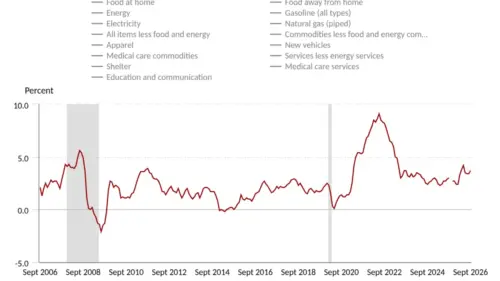
According to data published Wednesday by the Department of Labor’s Bureau of Labor Statistics, the Consumer Price Index (CPI) advanced by 0.6% in September, picking up the pace from a 0.4% increase recorded in August. On an annualized basis, looking at the 12 months through September, the CPI advanced 3.7%, accelerating from the 3.4% annual rate registered the previous month. The acceleration was heavily influenced by climbing energy prices, compounded by broader economic headwinds.
Price pressures in the United States have been further complicated by geopolitical friction. Escalating tensions in the Middle East, including the military actions involving Iran and Israel earlier this year—which occurred against the backdrop of foreign policy decisions by the Trump administration—have reverberated through global commodity markets, keeping energy prices volatile and feeding directly into domestic inflation metrics.
These persistent inflationary pressures have complicated the policy outlook for the Federal Reserve. Central bank officials have increasingly signaled that borrowing costs may need to remain elevated for a longer duration to cool economic demand and bring inflation sustainably down toward the central bank’s target. In September, Federal Reserve leadership reiterated that subduing inflation remains their paramount objective, prompting another round of tightening measures.
Historically, bitcoin and other digital assets have exhibited high sensitivity to shifts in monetary policy and interest rate adjustments. Higher borrowing costs tend to drain liquidity from the broader financial system, restricting the capital inflows required to sustain speculative and risk-on assets. Cryptocurrencies, alongside growth-oriented technology stocks, rely heavily on abundant market liquidity to fuel price appreciation and trading activity.
Despite this well-established correlation, bitcoin demonstrated notable resilience throughout September. The cryptocurrency managed to push higher during the month even as Federal Reserve officials maintained a hawkish tone and continued talking tough on inflation, leading some market observers to question whether the digital asset was beginning to decouple from traditional macroeconomic catalysts. Nevertheless, Wednesday’s price action demonstrates that macroeconomic data releases still hold the power to trigger sudden volatility across cryptocurrency markets.
Market participants are now turning their attention toward the central bank’s upcoming policy meeting scheduled for October 28, where officials will announce their next steps regarding interest rates. As of Wednesday, investor sentiment reflected in fed funds futures pricing—tracked via CME Group’s FedWatch tool—indicated a 47% probability that the Federal Reserve will implement another rate hike at the conclusion of the October gathering.


Leave a Reply