

As the summer months fade and Americans turn their attention toward the changing seasons, the annual reminder of tax obligations looms large once again. For the 2025 tax filing season, however, the process carries a significantly heavier weight for millions of digital asset holders across the United States. Following the rollout of sweeping new mandates from the Internal Revenue Service (IRS), the federal agency now possesses deeper and more granular insight into the cryptocurrency trading activities of everyday Americans than ever before. Under these freshly implemented rules, centralized brokers and digital asset platforms are legally required to report the gross proceeds stemming from specific digital asset sales directly to the government.
Yet, rather than streamlining the often-dreaded tax season, the arrival of standardized paperwork from exchanges has inadvertently created an administrative headache for many taxpayers. Far from simplifying compliance, the introduction of these mandatory broker reports has left a substantial portion of the crypto community scrambling to piece together their financial histories before facing strict federal deadlines.
The scope of this friction became apparent following a comprehensive survey conducted in August by Awaken Tax. Polling 1,000 United States-based crypto investors who had either filed their returns or opted to file for an official tax extension, the survey revealed that 21% of respondents were still actively waiting on critical financial information from their chosen exchanges or crypto trading platforms. Furthermore, one in every five surveyed investors reported that their Form 1099-DA—the official tax document utilized by brokers to report digital asset transactions—arrived incomplete, or left them entirely uncertain as to whether the figures accurately reflected their actual trading volume for the year.
These figures illustrate the messy realities of a tax filing season operating under unprecedented oversight. Taxpayers who secured an extension were granted a final submission window stretching until October 15, giving them additional breathing room to untangle the complex web of reporting discrepancies, missing documentation, and calculation hurdles.
At the core of the friction is a fundamental limitation in how the reporting requirements were structured for 2025. While brokers were legally mandated to report gross proceeds—reflecting the exact monetary amount for which a digital asset was sold—they were generally not required to report the cost basis, which is the original purchase price paid by the taxpayer.
Consequently, the burden of calculating net capital gains and losses falls squarely back onto the shoulders of the individual taxpayer. While this manual computation can be a minor nuisance for casual investors who execute only a handful of trades annually, it transforms into an intensely time-consuming labyrinth for active traders who execute high volumes of transactions across multiple decentralized and centralized networks.
Chris Herbst, the managing director of CountDeFi tax reporting, highlights the sheer magnitude of this discrepancy when speaking about active market participants. For a frequent trader, Herbst explains, the gross proceeds figure reported to the federal government can be many times higher than their actual real financial gain. This distortion occurs because each individual sale is automatically counted at its full market value by the automated reporting systems, completely omitting the baseline cost of acquiring the asset in the first place.

This dynamic strikes at the very heart of the prevailing dilemma: while the IRS can easily track and verify the sale of an asset, the individual taxpayer is still forced to reconstruct their entire transaction history to determine what profit was genuinely realized.
What the New Form 1099-DA Actually Tells the IRS
To understand the friction, one must examine how the newly minted Form 1099-DA interacts with standard financial transactions. For a straightforward, singular trade, the mathematics remain uncomplicated. An investor who purchases Bitcoin for $9,000 and later liquidates it for $10,000 registers a straightforward net capital gain of $1,000.
However, a 2025 Form 1099-DA issued under the current regulatory framework might display the $10,000 in gross proceeds while omitting the vital $9,000 cost basis required to properly calculate the taxable profit. When an investor lacks immediate records of their original acquisition cost for a specific token, calculating the correct tax liability evolves into a deeply complex exercise.
This reality necessitates that taxpayers maintain their own exhaustive records to bridge the data gaps, stitching together transaction histories that often span across numerous different exchanges, web3 wallets, individual trades, and even multiple calendar years.
According to Herbst, the gap is entirely real, though he points out that it represents a record-keeping deficit on the part of the taxpayer just as much as it reflects a regulatory reporting gap on the side of the exchange platforms.
When the Forms Do Not Match
Tax professionals across the country report that they are already encountering systemic hurdles as clients attempt to reconcile these novel tax documents against their verifiable transaction histories.
Sharon Yip, the founder of Crypto Tax Advisors, notes that her firm has repeatedly uncovered noticeable discrepancies between the Form 1099-DA documents received by her clients and the comprehensive crypto tax reports compiled by her team for filing purposes. According to Yip, some forms omitted entire batches of client trades executed throughout 2025, while different exchanges adopted wildly inconsistent formatting conventions for their client statements. In certain instances, platforms elected to report the cost basis for some transactions while arbitrarily omitting it for others, despite the fact that basis reporting was not formally mandatory for the 2025 tax year.
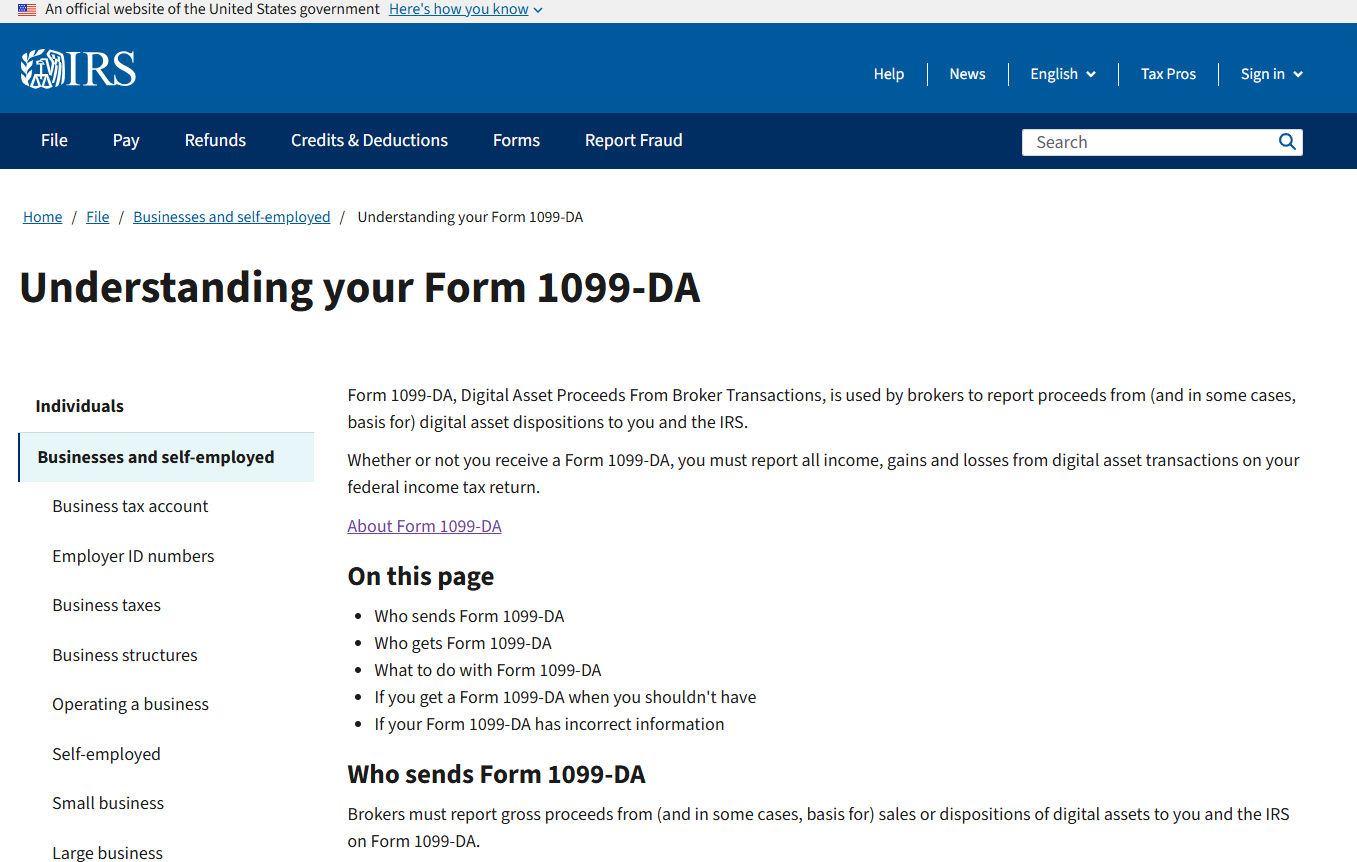
This lack of standardization creates immense confusion. Yip notes that it is exceptionally difficult for everyday recipients to understand how to reconcile their official 1099-DA forms against the specialized crypto tax reporting software reports required to successfully file an accurate return.
To illustrate the scale of these inconsistencies, Yip points to a case involving stablecoins. One of her firm’s clients executed more than $300,000 worth of stablecoin trades across a major exchange in 2025, yet the platform’s official Form 1099-DA reported less than $100,000 in total stablecoin proceeds.
Moreover, these structural problems frequently manifest before taxpayers even reach the calculation phase. Andrew Duca, the founder of Awaken Tax, emphasizes that his firm witnessed numerous clients receiving their Form 1099-DA documents dangerously late in the filing cycle. Because these regulations represent a brand-new compliance frontier, many mainstream exchanges struggled to adapt their internal infrastructure in a timely manner. Duca points to major platforms such as Kraken, noting that some users did not receive their required forms until a mere two weeks before the traditional April 15 tax deadline. In some instances, Duca adds, clients received Kraken 1099-DA forms that completely lacked any reported transaction data whatsoever.
The Information Taxpayers Still Need
Despite the introduction of federal reporting forms, these documents were never designed to serve as a complete substitute for an individual’s personal financial record-keeping. The IRS maintains the strict position that taxpayers are legally obligated to report all digital asset income, gains, and losses accurately, regardless of whether they successfully received a Form 1099-DA from a broker.
In scenarios where the cost basis is omitted from the paperwork, taxpayers are forced to rely entirely on their own historical logs to complete their tax filings. This process rapidly deteriorates in complexity when digital assets are transferred fluidly between disparate platforms. An investor might purchase Bitcoin on a centralized exchange, withdraw the asset into a self-custodial software wallet, transfer it to a secondary trading platform, and eventually liquidate it there—leaving the second exchange completely blind to the original acquisition price.
What taxpayers ultimately require from exchanges is their complete transaction history spanning from the very day the account was originally opened, according to Herbst. This comprehensive dataset must incorporate every individual trade, platform fee, deposit, withdrawal, and cryptographic transaction identifier associated with the movement of funds. Because the cost basis travels alongside the asset as it traverses different network ecosystems, a single missing piece of historical data can distort capital gains calculations executed years later on an entirely different platform.
More Data for the IRS, More Work for Taxpayers?
Andrew Gordon, the executive director of Digital Asset Tax Action, argues that taxpayers are locked in a continuous struggle to reconcile their 1099-DA documents with their personal financial ledgers. Gordon notes that the vast majority of existing crypto tax software solutions lack the native capabilities required to seamlessly import and reconcile Form 1099-DA data. The few platforms that do offer compatibility often still demand intensive manual data entry because brokers failed to deliver 2025 tax forms in a standardized, machine-readable format.

For active market participants, this manual data entry requirement translates into hundreds of painstaking individual line items. Gordon contends that brokers should be legally obligated to provide a clean, machine-readable digital file alongside every traditional Form 1099-DA to allow seamless data integration into specialized tax preparation software. Furthermore, he advocates that exchanges should be required to maintain exhaustive, uncorrupted transaction histories that explicitly track historical acquisition dates, amounts paid, administrative fees, and cross-platform transfers.
Gordon’s primary concern is that heightened visibility for the federal government does not equate to a simplified or complete tax calculation experience for the citizen. While the 2025 forms successfully captured gross proceeds and granted the IRS unprecedented oversight capabilities, the absence of corresponding cost basis data creates what he describes as the zero-basis problem.
Industry experts strongly advise taxpayers against blindly transcribing figures printed on a Form 1099-DA directly onto their federal returns. Duca urges individuals to rigorously cross-reference these documents against their complete transaction ledgers rather than uncritically accepting potentially flawed calculations generated by third-party exchanges. The federal government ultimately expects tax returns to accurately reflect true economic gains and losses, rather than relying on automated printouts that may contain systemic errors.
Will 2026 Make Things Easier?
Even as crypto investors continue to navigate the lingering administrative hurdles of the 2025 filing season, additional regulatory adjustments are already on the horizon. Beginning in 2026, federal rules will mandate that brokers report the cost basis for covered digital assets, a shift designed to provide taxpayers with more complete foundational data for calculating capital gains and losses.
Even so, structural blind spots will persist, particularly for assets transferred onto a broker from external wallets or unlinked platforms that remain outside the immediate reporting network. Ultimately, while federal agencies continue to expand their visibility into the digital asset economy, the responsibility of preserving meticulous financial records and proving actual tax liability remains firmly in the hands of the individual investor.



Leave a Reply