
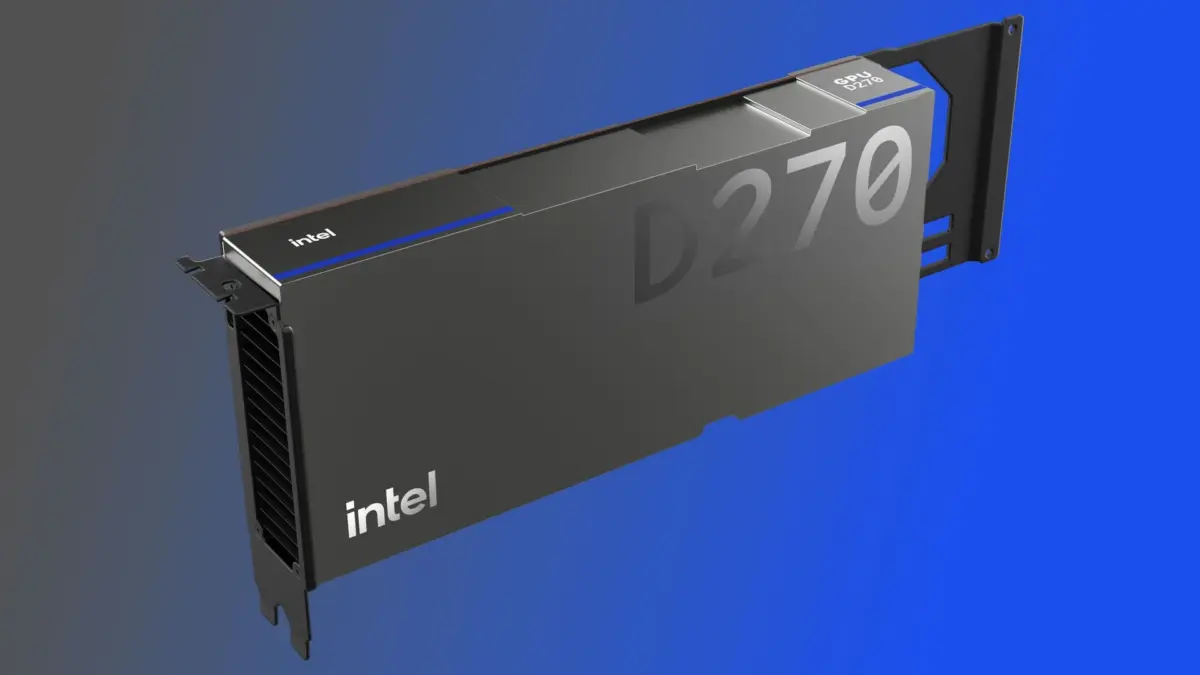
At the Open Compute Project (OCP) 2026 summit today, Intel officially removed the codename from its highly anticipated upcoming AI accelerator, previously known to the industry as Crescent Island, giving it a proper commercial identity: the Intel GPU D-Series. Alongside the official naming announcement, the semiconductor giant provided the tech community with a clearer look at the hardware’s capabilities by sharing its first theoretical peak performance targets and final memory specifications.
For the first time since the company began a slow drip of disclosures regarding the architecture throughout 2026, Intel revealed that the GPU D-Series is targeted to deliver an impressive 1.3 PFLOPS of FP8 theoretical peak performance. In addition to this headline performance metric, Intel disclosed the final memory bandwidth users can expect from these specialized artificial intelligence inference accelerators, clocking in at a robust 1.5 TB/s. These technical revelations significantly flesh out the profile of a product that has generated substantial industry interest as data centers look for increasingly specialized hardware to handle booming AI workloads.
Long before today’s unveiling at OCP 2026, industry observers and hardware enthusiasts already understood the foundational architecture underpinning the project. Crescent Island—now officially designated the Intel GPU D-Series—serves as the very first silicon product to be constructed on Intel’s advanced Xe3P graphics architecture. However, industry insiders note that describing it strictly as a traditional graphics processor is a misnomer. In reality, it functions as a massively parallel computing architecture tailored explicitly for computational workloads, as the chip lacks most or all of the traditional graphics-specific functional units that would typically characterize a true, general-purpose consumer or workstation GPU.
By stripping away legacy display blocks and graphics-centric pipelines, Intel has been able to dedicate the entirety of the silicon real estate toward accelerating parallel processing tasks, a design philosophy that is becoming increasingly standard for dedicated enterprise AI inference hardware. To fit into existing enterprise server ecosystems, Intel has confirmed that it will release the GPU D-Series products in a standard air-cooled PCIe form factor. This design choice ensures that data center operators can integrate the new accelerators into existing server racks without requiring dramatic overhauls to their current cooling or chassis infrastructures.
Furthermore, the hardware will operate within a thermal design power envelope of 350W, balancing high-density compute capabilities with manageable power consumption profiles for air-cooled environments. Another major architectural highlight disclosed by Intel is the inclusion of up to 480GB of LPDDR5X memory on the accelerator. By opting for a massive pool of LPDDR5X memory rather than more traditional high-bandwidth memory variants, Intel is positioning the GPU D-Series to handle exceptionally large model footprints and expansive context windows required by modern large language models and complex enterprise AI inference tasks, all while maintaining competitive memory bandwidth figures anchored at 1.5 TB/s.


Leave a Reply