
Federal Bureau of Investigation agents have arrested a high-profile executive at a Canadian cybersecurity firm in connection with an escalating international investigation into the notorious ShinyHunters hacking collective. The arrest comes on the heels of a devastating cyberattack orchestrated by the group that successfully compromised the FBI, relieving the federal law enforcement agency of sensitive personal and professional data belonging to thousands of its agents.
According to multiple sources familiar with the matter, the suspect was taken into custody while visiting Pennsylvania to attend a prominent cybersecurity and insurance conference. The New York Times was first to report the arrest of the Canadian man on suspicion of providing assistance to ShinyHunters, though neither the newspaper nor a public statement issued on the social media platform X by FBI Director Kash Patel initially identified the individual by name.
Sources close to the ongoing federal probe revealed that the arrested executive’s primary professional focus involved handling complex ransomware negotiations on behalf of corporate clients targeted by cybercrime syndicates. Investigators believe the scope of the conspiracy reaches deep into the specialized ecosystem of extortion advisors. Furthermore, sources indicated that operational control and prosecution oversight of the sprawling ShinyHunters investigation have now been officially centralized at a designated FBI field office in Texas.
An online review of industry events points directly to the Cyber Risk Summit, which was held at the Loews Philadelphia Hotel. The conference drew numerous major players from the cyber insurance and risk management sectors. According to the summit’s official disclosures, its single largest corporate sponsor was Cypfer, a well-known Canadian cybersecurity and incident response firm.

Public professional networking profiles indicate that a former leader at Cypfer, Edward Dubrovsky, transitioned to another Canadian security firm and conference sponsor known as CyberSteward. Approximately one month prior to his arrest, Dubrovsky published posts on professional networks stating his intention to travel to the Pennsylvania summit alongside members of the CyberSteward team to engage in industry discussions.
Following the initial reports, a spokesperson for Cypfer clarified that Dubrovsky was never a founder or co-founder of the firm, contrary to claims on his professional profile, but instead served in the capacity of managing director prior to his resignation in November 2025. In his public writings, Dubrovsky had frequently emphasized the nuances of handling malicious digital extortion. “Looking forward to continuing conversations around strategy & compliant driven coercive (ransomware, extortion) advisory, negotiations and settlement services that are global and truly agnostic,” Dubrovsky wrote in a prior social media post.
Federal court records show that an individual named Edward Dobrovsky—noting a slight spelling variation in the surname—was formally arrested in Pennsylvania on October 8 on charges of cyber extortion and conspiracy. While a significant portion of the judicial filings, including the foundational criminal complaint, remain sealed from public view, a handful of documents were successfully indexed on public court docket tracking platforms. These include a summary of charges accusing the defendant of engaging in a conspiracy to threaten the confidentiality of proprietary and sensitive information with the explicit intent to extort money, alongside charges of interference with commerce through threats.
Inmate lookup records maintained by the U.S. Bureau of Prisons indicate that a 54-year-old Edward Dubrovsky was subsequently housed at a federal detention facility in Philadelphia. However, court documentation filed on October 9 details the formal transfer of the legal proceedings to the U.S. District Court for the Eastern District of Texas, aligning with reports that the district has become the epicenter of the broader federal crackdown on ShinyHunters. Representatives for the FBI declined to comment on the specifics of the ongoing judicial proceedings.
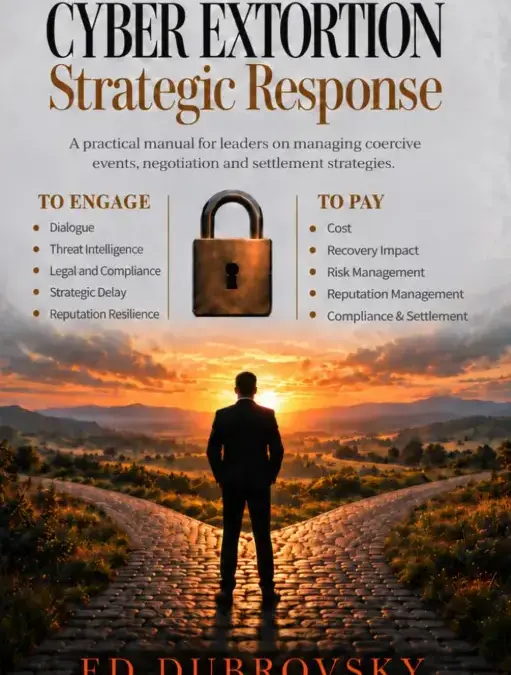
Dubrovsky’s professional background includes authoring a specialized textbook titled Cyber Extortion Strategic Response, a 252-page volume marketed as a guide to help organizations navigate the complex decision-making processes required during and after a ransomware incident. Promotional descriptions for the book highlight a core thesis regarding the operational dynamics of dealing with threat actors. The material stresses that maintaining communications with a digital criminal does not equate to agreeing to a ransom payout, and that entering into dialogue serves various strategic purposes, including verifying threat actor claims, gathering actionable intelligence, buying critical time, and preserving institutional options while leadership formulates a response.

Mr. Dubrovsky could not be reached immediately for legal statements following his apprehension. Inquiries directed to other executives at CyberSteward regarding the situation remained unanswered at the time of reporting. Available court documentation indicates that the defendant has not yet retained private legal representation, nor has the court formally appointed a public defender to manage his defense.
The ShinyHunters collective has established a reputation within the global cybersecurity community for utilizing sophisticated phishing campaigns and stolen credential sets to siphon vast amounts of proprietary data from corporate accounts hosted by software-as-a-service providers. The group typically leverages this stolen material to exert maximum pressure on victims, threatening public dissemination unless steep monetary extortion demands are met. Federal estimates suggest the group has successfully extorted more than $70 million from corporate targets globally throughout the year.
The current wave of arrests builds upon material seized by international law enforcement last month. Dutch police apprehended Pepijn van der Stap, a reformed cybercriminal linked to the syndicate, during raids executed as part of the broader ShinyHunters inquiry. Law enforcement agencies have spent the weeks since that operation sifting through seized hardware devices. Sources indicate that additional criminal charges targeting principals at other firms specializing in ransomware negotiation and incident response may be imminent as the investigation widens.
The pressure on investigators intensified immediately following Van der Stap’s apprehension, when an operative operating under the alias "Rey" assumed operational control of the ShinyHunters group. This new leadership figure began taunting federal authorities online by publicly revealing portions of the data stolen during the breach of the FBI’s online recruitment portal. The compromised records included sensitive internal details such as agent unit assignments, specialized training qualifications, and confidential medical and psychiatric evaluations.
Subsequent international reporting identified the individual operating as Rey as a teenager named Saif Al-din Khader. Authorities successfully detained the young hacker, who has since begun cooperating with federal investigators. The apprehension occurred as the cybercrime syndicate attempted to mount an extortion campaign against a prominent digital aviation and navigation unit that had recently been spun off by Boeing.



Leave a Reply