

The online community surrounding Opensource.com has been hard at work behind the scenes, signaling that a brand-new project is currently in the works. While specific details regarding the upcoming initiative remain under wraps for the time being, the quiet period on the platform has not gone unnoticed by its readership. Organizers and community members alike suggest that there is already plenty to discuss as the site approaches a significant milestone in its evolution—a transformation that promises to refocus the platform squarely on the human element that has driven open source software and culture for decades.
For regular visitors, the recent lull in publishing activity on Opensource.com has been palpable. However, rather than pointing toward a winding down of the platform, the quiet phase represents a period of intense preparation and transition. As the community looks toward the horizon, the conversation is expanding to encompass the very nature of how people connect across the digital landscape, starting with the architecture of the internet itself.
The Internet, and Top-Level Domains
To understand the scope of the changes ahead, it helps to examine the foundational layers of the internet. Most internet users recognize that the internet is, fundamentally, a network. By definition, a network is a structured group of physical and digital connections designed to facilitate communication and the exchange of data. In fact, the term "internet" is a well-known portmanteau derived from "interconnected" and "network."
Historically, the modern internet grew out of the merging and expansion of two primary early networks: a military network and an academic network. During its nascent stages, the user base was relatively small, highly specialized, and tightly controlled. However, once the internet began to catch on globally and exploded in popularity far beyond those initial military and academic enclaves, a pressing structural challenge emerged. It quickly became apparent that different organizational designations were urgently needed to categorize and differentiate entities operating online.

For instance, distinguishing a commercial enterprise from a charitable organization, or an educational institution from a governmental department, required a standardized naming convention. These essential designations became known as top-level domains, commonly abbreviated as TLDs. Today, a vast ecosystem of TLDs is available to register, ranging from geographic extensions to industry-specific suffixes.
For a long time, however, the domain name system operated with only a handful of original designations. These original TLDs remain remarkably popular and culturally embedded in the architecture of the web. Most internet users intuitively understand that visiting an address ending in .com typically leads to a commercial website, while navigating to a .org address generally points toward a non-profit organization, public institution, or community-driven initiative. These suffixes act as digital signposts, communicating the underlying intent and governance of the entity behind the screen.
Open Source Is a Network
Beyond the technical definition of wires, servers, and domain name extensions, open source itself represents a vastly different kind of network. Open source can take on many diverse forms and manifest across countless industries. It can be commercial, operating as a multi-billion-dollar enterprise model; it can be entirely non-profit, driven by public donations and volunteer labor; it can be deeply academic, fostering university-level research; and it can be profoundly cultural, shaping how creators, writers, and artists share their work with the world.
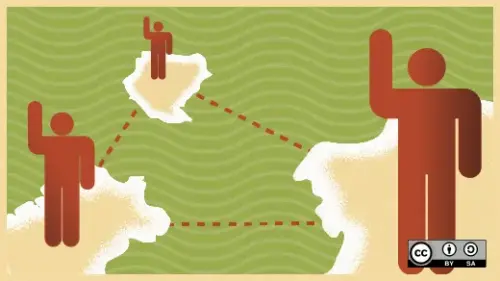
No matter what specific form open source takes, or which top-level domain hosts its digital home, it always functions fundamentally as a network. Sometimes, that network consists of interconnected computers sharing code repositories, continuous integration servers, and distributed databases. But most importantly, at its very core, it is a network of people.

Whether these individuals are gathering in person at a massive international technology conference, catching up informally at a local pub, or collaborating asynchronously in an online chat room, open source is, above all else, a vibrant community of human beings working toward shared goals.
For the past twelve years, the website Opensource.com has maintained its presence and output with the support of a commercial entity. Throughout that extensive history, the platform has published countless stories, case studies, and tutorials about creating, adopting, and sharing open source solutions, building a loyal readership that spans the globe. Yet, the people who truly constitute the beating heart of the Opensource.com community—the writers, editors, commenters, advocates, and everyday users—are not commercial entities. They are individuals.
As the website prepares to turn the page on this chapter of its history, organizers point out a fundamental misalignment between the corporate support structure and the human-centric reality of the community. In just one month, Opensource.com is set to resolve that long-standing structural dynamic, marking the beginning of its next major evolution. With the transition fast approaching, community members are encouraged to stay tuned for further announcements as the details of the new project come to light.


Leave a Reply