
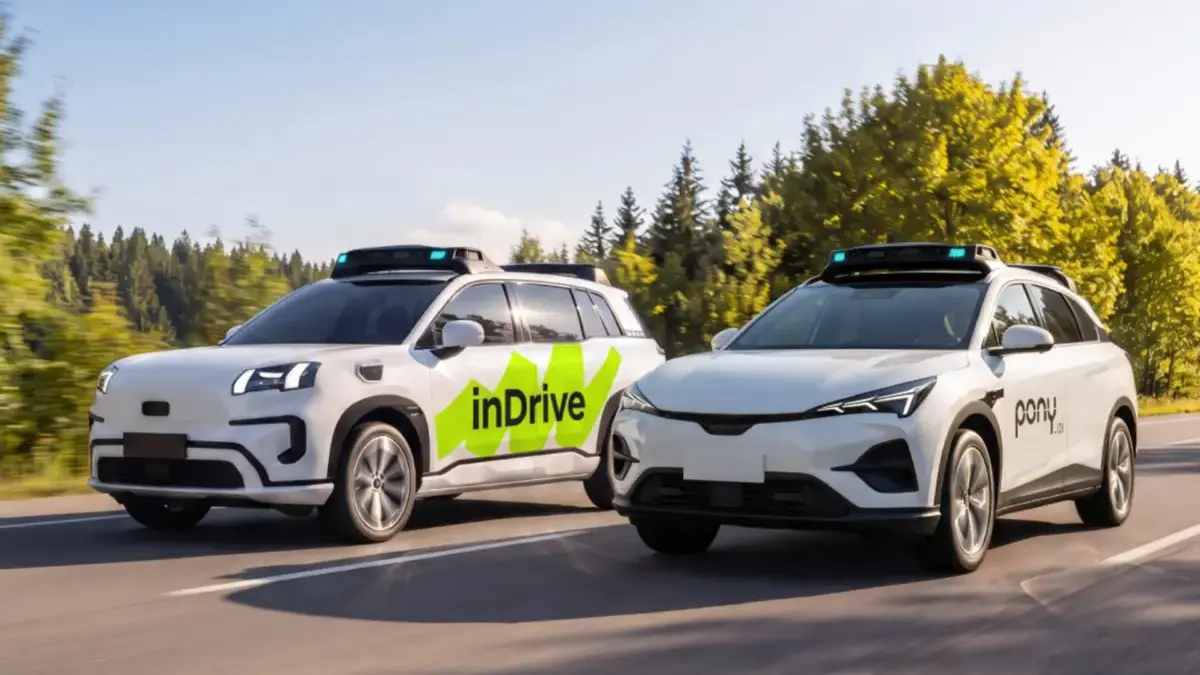
Ride-hailing platform inDrive, widely recognized for its unique model that allows passengers and drivers to directly negotiate fares, is taking a major step into the future of urban mobility. The company has announced a strategic collaboration with Chinese autonomous driving firm Pony.ai and technology giant Nvidia to begin testing robotaxis in Kazakhstan, with pilot programs slated to launch in early 2027.
The companies formalized their partnership on Friday by signing a memorandum of understanding to explore integrating Pony.ai’s advanced autonomous vehicles directly into inDrive’s established ride-hailing platform. This collaborative agreement highlights the rapidly accelerating global interest in self-driving technology, extending major autonomous trials far beyond their traditional epicenters in the United States and China into emerging international markets.
According to Yuri Misnik, Chief Technology Officer at inDrive, initial testing is scheduled to commence in Kazakhstan’s capital city, Astana, during the first half of 2027. True to standard safety protocols for emerging autonomous deployments, these initial phases will involve human safety operators stationed inside the vehicles, with the long-term objective of transitioning to fully driverless commercial rides as the technology matures and regulatory frameworks evolve.
Under the framework of the proposed deployment plan, Pony.ai will supply its seventh-generation robotaxis. inDrive will then seamlessly incorporate these vehicles into its consumer-facing ride-hailing application, managing local operations on the ground in Kazakhstan. Meanwhile, Nvidia will provide the critical artificial intelligence infrastructure, supplying its comprehensive Hyperion autonomous vehicle platform alongside the Halos safety system to ensure high levels of reliability and situational awareness.
This international initiative arrives as global ride-hailing and transportation networks aggressively expand their bets on autonomous vehicle integration. Earlier this month, ride-sharing giant Uber announced parallel plans to test Pony.ai’s robotaxis in London, supplementing its existing supervised autonomous services operated in partnership with British autonomous vehicle startup Wayve—a firm that counts Nvidia and Uber among its prominent financial backers. Uber is similarly collaborating with multiple autonomous driving developers across various international territories, including high-growth markets in the Middle East.
For inDrive, entering the autonomous space represents a logical evolution for a company that has built its immense global footprint around affordable, accessible transportation. By exploring the autonomous market in regions where competitors like Uber are also staking claims, inDrive aims to bring its trademark focus on cost efficiency and consumer accessibility to the self-driving sector.
Misnik emphasized that the company’s structural approach to this technological shift is deliberately flexible. The organization operates globally across more than 1,200 cities spanning 47 countries, scaling well beyond its foundational ride-hailing services into local delivery networks, intercity transportation, and broader financial services.
"Our approach is capital-light by design," Misnik said, explaining the company’s philosophy on technology integration. "We work with a range of partners in different markets, combining their expertise with ours to deliver a better customer experience."
From a technological standpoint, Nvidia’s hardware and software stack plays a pivotal role in making such deployments economically viable for platforms operating outside wealthy tech hubs. Nvidia highlights that its Hyperion platform significantly lowers the capital barriers associated with developing and deploying robotaxis. Instead of forcing individual mobility companies to custom-build, test, and integrate every single sensor and computing unit from scratch, Nvidia provides a pre-engineered, ready-made foundation of sensors and high-performance computing architecture. Additionally, Nvidia supplies its advanced Alpamayo model alongside sophisticated simulation tools capable of generating synthetic data, allowing developers to rigorously test autonomous driving systems across a vast spectrum of complex, real-world driving scenarios.
Ali Kani, Vice President of Automotive at Nvidia, noted that these structural cost savings are exceptionally crucial for emerging economies. In many developing and emerging markets, traditional human-driven ride-hailing services are already exceptionally affordable, meaning upcoming autonomous mobility solutions must compete aggressively on price from day one to win over everyday commuters. The timing of this multi-company announcement notably coincided with Nvidia CEO Jensen Huang’s official visit to Kazakhstan.
The agreement in Kazakhstan also represents another significant milestone in Pony.ai’s aggressive international expansion strategy outside of mainland China. The autonomous driving company has set ambitious growth targets, aiming to scale its operational fleet to more than 3,500 robotaxis deployed across upwards of 20 cities globally by the end of 2026, a substantial leap from its active fleet of 1,975 vehicles recorded at the close of June.
The broader local regulatory environment is proving exceptionally supportive of these technological ambitions. Last month, the government of Kazakhstan formally announced national plans to introduce driverless taxi services starting in 2027, outlining initial public trials targeted for Astana and two other major cities. The national government has simultaneously instituted progressive regulatory guidelines specifically designed to permit and govern the testing of autonomous vehicles on designated public roads.
Beyond regulatory readiness, Astana offers a uniquely demanding operational environment that could serve as an invaluable proving ground for autonomous driving software. With a population of approximately 1.7 million residents, the capital city experiences notoriously severe winters characterized by months of heavy snowfall, freezing temperatures, and persistent ice. These harsh seasonal elements present notoriously difficult technical hurdles for computer vision systems, radar, lidar, and overall vehicle handling.
Arsen Tomsky, founder and Chief Executive Officer of inDrive, pointed out that these environmental challenges are viewed as a strategic advantage for the upcoming trials. Launching in such a climate will provide an essential opportunity to rigorously evaluate how advanced autonomous driving software performs under punishing winter conditions. Success in Astana could ultimately generate critical operational insights and engineering data that will facilitate the future expansion of autonomous mobility into other global markets facing similar meteorological hurdles.
Kazakhstan is not the sole region where inDrive has been actively laying the groundwork for driverless transportation. Last December, the company entered into a separate formal agreement with Saudi Arabia’s AI Driver to explore the deployment of autonomous vehicles powered by another major Chinese self-driving pioneer, WeRide, with initial operational focus centered on the capital city of Riyadh. While the partnering companies had initially targeted a regional pilot project for the first half of 2026, the current status of those specific field tests remains under development.
As inDrive continues to evaluate its pipeline for future deployments, company leadership maintains that regulatory partnership remains the single most important catalyst for success. Misnik reiterated that finding jurisdictions with progressive, collaborative regulatory bodies is essential for ensuring that future testing phases can proceed safely, sustainably, and efficiently on public roadways.


Leave a Reply