
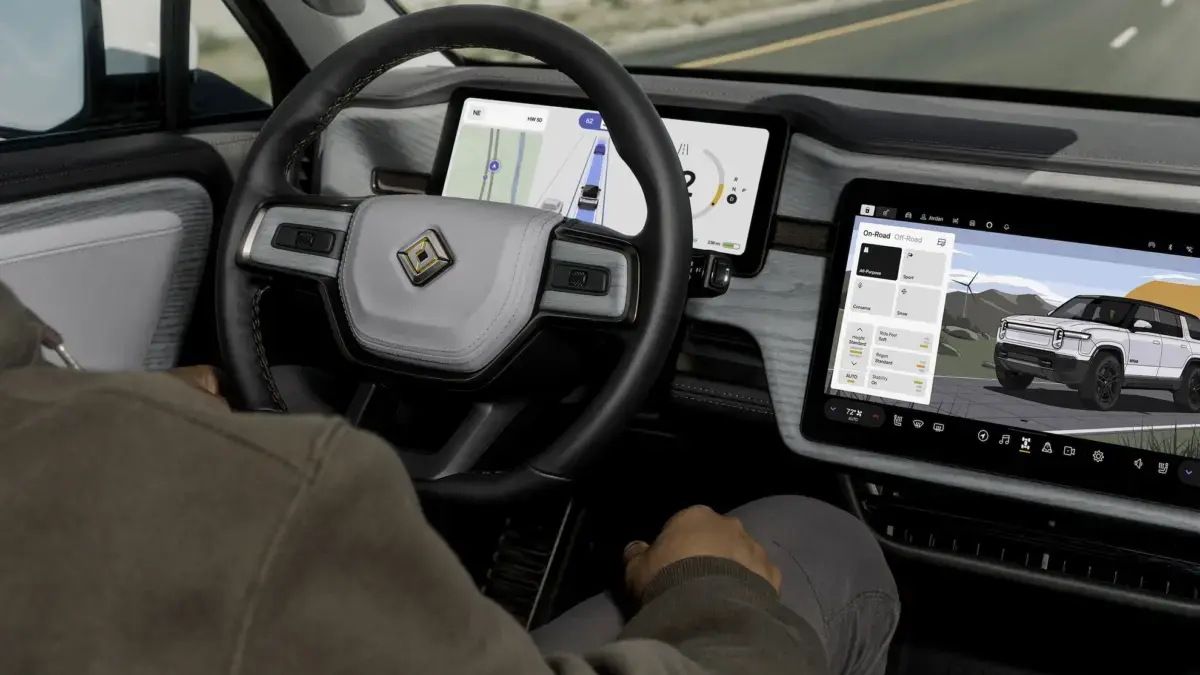
Electric vehicle manufacturer Rivian has completed the acquisition of Third Dimension, a promising U.K.-based startup founded by veterans of the gaming and autonomous vehicle industries. Third Dimension specializes in utilizing artificial intelligence to transform flat images and videos into hyper-realistic, lifelike three-dimensional worlds. While the strategic buyout does not signal a pivot into the video game industry for Rivian, the automaker intends to harness Third Dimension’s advanced technology to convert vast amounts of real-world driving data into highly accurate 3D simulations. This capability is expected to significantly accelerate the development of Rivian’s advanced driver-assistance systems, as well as the specialized autonomous driving software required for the robotaxis that Rivian plans to supply to ridesharing giant Uber.
Financial terms of the transaction were not officially disclosed by either company. However, structural details of the deal reveal that Third Dimension’s tightly knit, 15-person team—the vast majority of whom are based in the United Kingdom—will be fully integrated into Rivian’s growing autonomy and artificial intelligence division, which is spearheaded by James Philbin. According to an exclusive interview with Philbin, the acquisition also provides Rivian with a strategic opportunity to organically expand its existing AI engineering hub located in London, bolstering its international talent pool as the company scales its autonomous driving roadmap.
Third Dimension was originally established in 2024 by Chief Executive Officer Tolga Kart and co-founder Piotr Sokólski. Prior to the acquisition by Rivian, the startup had successfully raised $7 million in seed funding from a roster of prominent venture capital firms, including Abstract Ventures, MVP, Soma Capital, and Solari Capital. Although the underlying technology was initially engineered to streamline and accelerate the complex process of video game development, the founders quickly recognized broader commercial applications for their software, identifying high-value sectors such as defense and autonomous ground vehicles as prime candidates for disruption.
Now, operating under the corporate umbrella of Rivian, the entire founding and engineering team will narrow its collective focus entirely to the complex challenges of automated driving. In an interview, Kart expressed immense enthusiasm for the newfound singular focus that comes with joining a major automotive manufacturer. As he explained to reporters, operating as an independent startup required serving multiple different masters across various industries, which proved to be exceptionally difficult. By joining forces with Rivian, the team can direct its energy toward solving a single, massive problem at a scale where their proprietary technology can make a tangible, lasting difference.
Simulation has long served as an indispensable pillar for autonomous vehicle developers across the globe. Industry engineers rely heavily on virtual environments to train, test, and validate complex self-driving algorithms before deploying them to physical test vehicles or public roadways. Historically, these virtual simulators were constructed using traditional rendering software or commercial video game engines, and they frequently relied heavily on synthetic data generation. While these virtual environments could closely mimic the visual appearance of the real world, a persistent and troublesome gap has always remained between simulated scenarios and actual physical reality. Kart noted that the industry-standard workaround for this discrepancy typically involved feeding simulators ever-larger quantities of raw data in a continuous, often inefficient effort to close the quality gap and improve predictive accuracy.
Third Dimension’s proprietary technology leverages artificial intelligence to faithfully match the nuances of the physical world. When this cutting-edge software is combined with Rivian’s massive repositories of real-world driving data, it has the potential to transform into an exceptionally valuable and accurate simulator. Rivian is uniquely positioned to gather this data thanks to the tens of thousands of R1T pickup trucks, R1S SUVs, commercial delivery vans, and upcoming R2 SUVs currently traversing public roadways. This massive data collection network operates through customer vehicles whose owners have explicitly enabled external camera sharing.
Rivian aggregates and thoroughly anonymizes this incoming data, utilizing it to construct sophisticated machine learning training models for its driving software. According to Philbin, Rivian’s customer fleet currently uploads more than 400,000 distinct video and sensor sequences per day. By integrating Third Dimension’s software stack, Rivian will gain the technical capability to simulate intricate, highly complex driving conditions without having to patiently wait for rare, potentially dangerous real-world edge cases to occur naturally on public roads, thereby streamlining the safety validation process for its upcoming vehicle architectures.


Leave a Reply