
Veteran Linux developer Ikey Doherty is officially out of retirement, galvanized by what he views as the troubling convergence of massive corporate funding and inflammatory rhetoric within the open-source community. Best known as the creator of Solus and AerynOS, Doherty has fired back at David Heinemeier Hansson—better known as DHH—and the millions of dollars backing the controversial Omarchy project. Rather than releasing yet another standard Linux operating system, Doherty has answered with "Barney," a Rust-based tool designed to demonstrate how Linux distributions should be built from scratch.
The catalyst for Doherty’s return centers on the massive financial backing surrounding Omarchy and its governing body, the Omacom Foundation. Since its high-profile launch in August, the foundation has rapidly accumulated more than $13 million in financial pledges. This war chest was kickstarted when a coalition of eight prominent tech executives, including tech titan Michael Dell, each contributed one million dollars. The project’s financial momentum has continued unabated, recently bolstered by a $300,000 pledge from 13-year-old password management firm 1Password—a move that triggered internal friction and sharp objections from the company’s own employees. Furthermore, the Omacom Foundation announced it had secured $1.95 million worth of artificial intelligence tokens from major industry players like Meta, Anthropic, OpenAI, and Fireworks, compounding the project’s staggering resource advantage.
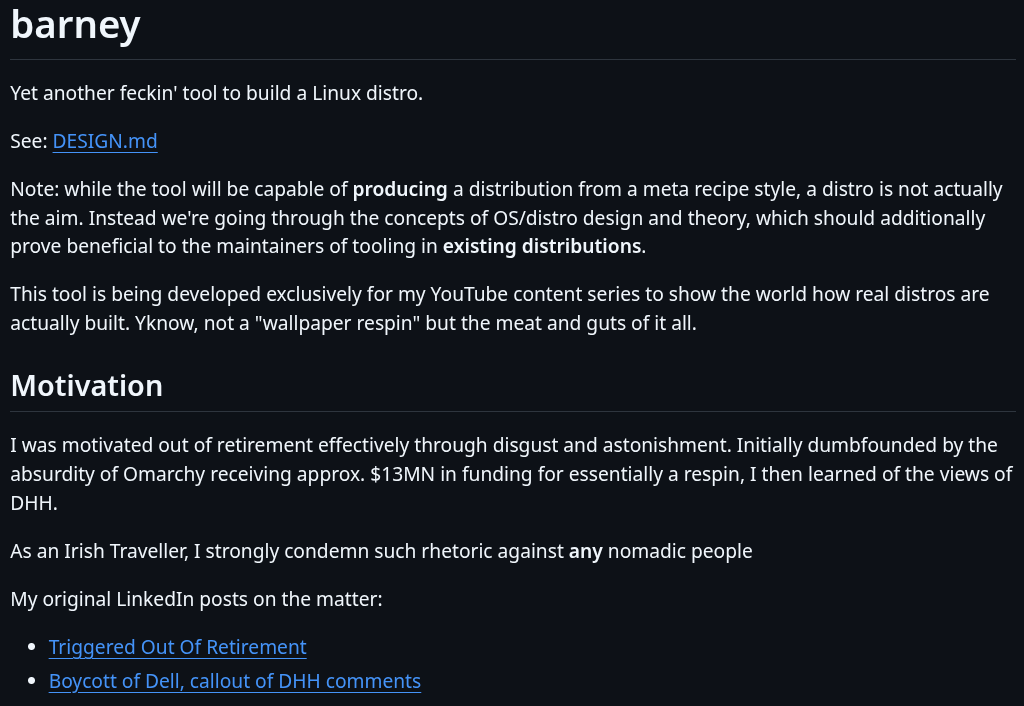
For Doherty, who is an Irish Traveller, the objections go far beyond the economics of the tech industry. The decision to re-enter the development sphere was heavily influenced by public commentary from DHH, who authored a controversial post comparing Denmark’s wolf population to Romani people camping in public parks in Copenhagen. As a member of the Irish Traveller community—an indigenous nomadic ethnic group that has faced systemic discrimination and prejudice for generations—Doherty felt compelled to respond. Taking to professional networks like LinkedIn, he shared his initial announcement video and condemned DHH’s rhetoric as horrific, asserting that the combination of such views and the absurd influx of capital dragged him back into the development game.
The backlash has already altered Doherty’s personal consumer choices. Following Michael Dell’s financial backing of Omarchy, Doherty publicly stated that he has placed Dell on his permanent avoid list, making it clear that he will not purchase another Dell laptop. In a scathing public evaluation of the entire enterprise, Doherty did not mince words regarding his stance on Omarchy and its leadership, stating that he would not touch the project’s software under any circumstances, while dismissing the distribution itself as yet another superficial "wallpaper-respin" that lacks genuine technical innovation.
Not a Distro, but a Stance
Rather than attempting to compete directly in the overcrowded consumer desktop operating system market, Doherty has positioned his new project as a deliberate statement of architectural integrity and transparency. Named personally after his son, Barney is not a consumer distribution ready for installation, but rather a specialized utility designed to help developers build Linux distributions from the ground up. The GitHub repository for the project sets a characteristically blunt tone, describing it as "yet another feckin’ tool to build a Linux distro" while explicitly emphasizing that delivering a packaged operating system is not the intended goal.
Instead of shipping a pre-packaged desktop environment, Doherty plans to pull back the curtain on how operating systems are actually engineered, utilizing a dedicated video series hosted on his YouTube channel titled "Episode 0: Getting Ready." To support the production of this behind-the-scenes engineering content, Doherty has established a Ko-fi page enabling direct community backing from supporters who prefer independent, grassroots open-source development over corporate-backed foundations.

Under the hood, Barney is written entirely in Rust and released under the permissive Mozilla Public License 2.0. The design philosophy behind the tool relies on compiling everything entirely from source, with outputs rigorously cached against the specific inputs that generated them. Under this architecture, modifying a single underlying dependency automatically triggers a targeted rebuild of anything built on top of it.
Furthermore, the system relies on stateless layouts—a conceptual approach Doherty helped pioneer during his time on Intel’s Clear Linux development team, which he later championed while working on Solus and AerynOS, previously known as Serpent OS. Builds are executed entirely within isolated containers, and the resulting build artifacts are stored strictly by content. This ensures that identical files across different packages are stored only once on the system. The ambitious engineering roadmap even extends to rebuilding the foundational toolchain completely from scratch.
Will It Do Well?
Whether Barney achieves mainstream adoption misses the underlying point of its creation, according to industry observers. Doherty has famously walked away from major open-source initiatives in the past, with both Solus and AerynOS continuing their development trajectories independently long after his departure. Barney could theoretically follow a similar path, but its immediate value lies in its transparency and educational impact rather than capturing market share.
The launch of Barney also arrives at a fascinating moment for independent Linux infrastructure. Auke Kok, another alumnus of Intel’s Clear Linux project, has concurrently begun building The Ur Project entirely from scratch. Neither developer is waiting for institutional backing or multimillion-dollar foundations to validate their work. Within the open-source community, there remains a persistent optimism that independent engineering efforts of this caliber can collectively remind the broader software ecosystem that pouring absurd amounts of venture capital into a project is not the sole requirement for building robust, high-performance technology.
Leave a Reply