A contentious legal battle between a self-described filmmaker and several high-profile private BitTorrent trackers has taken a bizarre new turn in a federal courtroom in Illinois. What began as a standard copyright infringement dispute involving platforms such as PassThePopcorn, BroadcasTheNet, Karagarga, HDBits, and Beyond-HD has evolved into a complex procedural chess match centered on questions of identity, potential civil contempt, and even the possible use of generative artificial intelligence in media creation.
The litigation traces back to last year when a filmmaker named Matthew Schneider initiated legal action by obtaining a DMCA subpoena through a California federal court. Schneider sought identifying information from Cloudflare regarding the administrators of several prominent private torrent trackers, alleging that these platforms unlawfully distributed his copyrighted works without permission.
Several months after the initial Cloudflare subpoenas, the same operators found themselves named as defendants in a lawsuit filed in an Illinois federal court. However, the dynamics of the litigation shifted dramatically when defense attorneys presented evidence suggesting that the individual litigating under the name Matthew Schneider might actually be an impostor. Faced with these mounting challenges, the person pursuing the lawsuit opted to drop the case last month.
Despite the voluntary dismissal, the legal saga is far from over. U.S. District Judge Andrea R. Wood retained jurisdiction over a pending request for sanctions against the plaintiff. Before the court can address or award any potential sanctions, the defense has insisted that the judiciary must first verify the true identity of the person behind the filings.

During a court hearing held in September, the man maintained that Matthew Schneider is his legal name and stated that he currently resides in London. In response to these assertions, the presiding judge ordered the plaintiff to provide official, verifiable documentation to substantiate his claims regarding his identity and his copyright assertions.
Passport, License, and Copyright Documentation
Judge Wood initially scheduled an October 2 status hearing to take place via videoconference. However, the plaintiff ultimately joined the proceedings by telephone, citing technical difficulties that prevented him from using video.
During that hearing, the judge directed the plaintiff to email copies of his driver’s license, passport, and official documentation regarding his application to the U.S. Copyright Office to the courtroom deputy by October 9. The court intended for these sensitive documents to be filed under seal and shared strictly among the parties involved under the protection of a strict protective order.
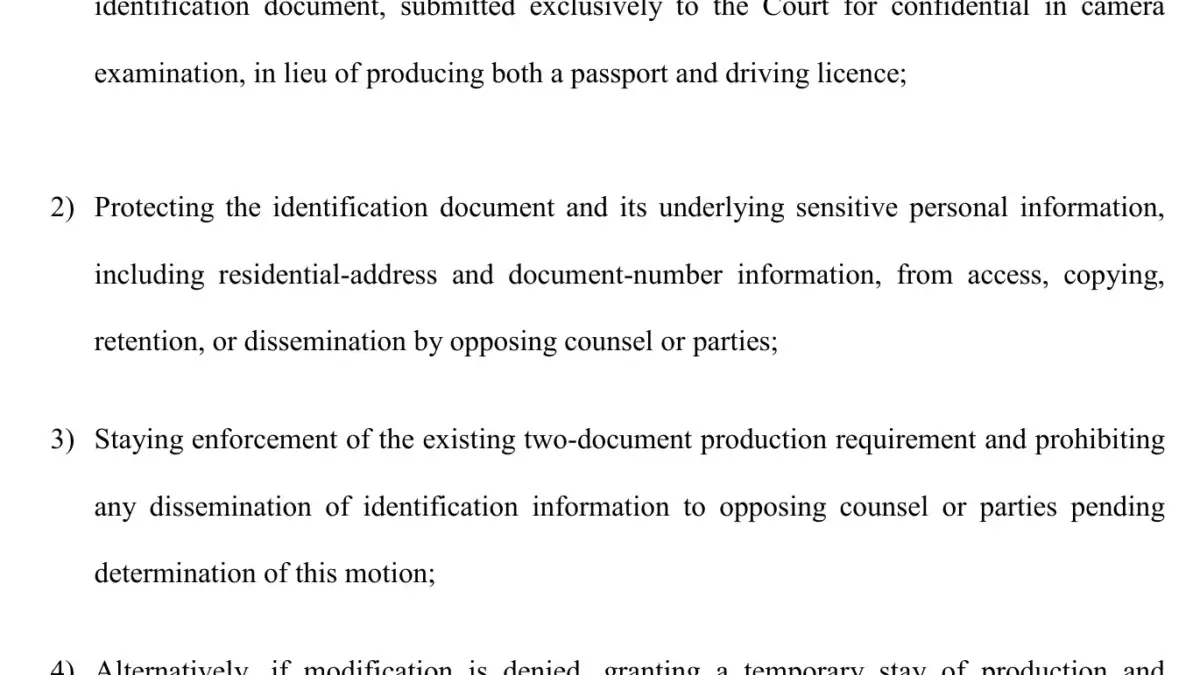
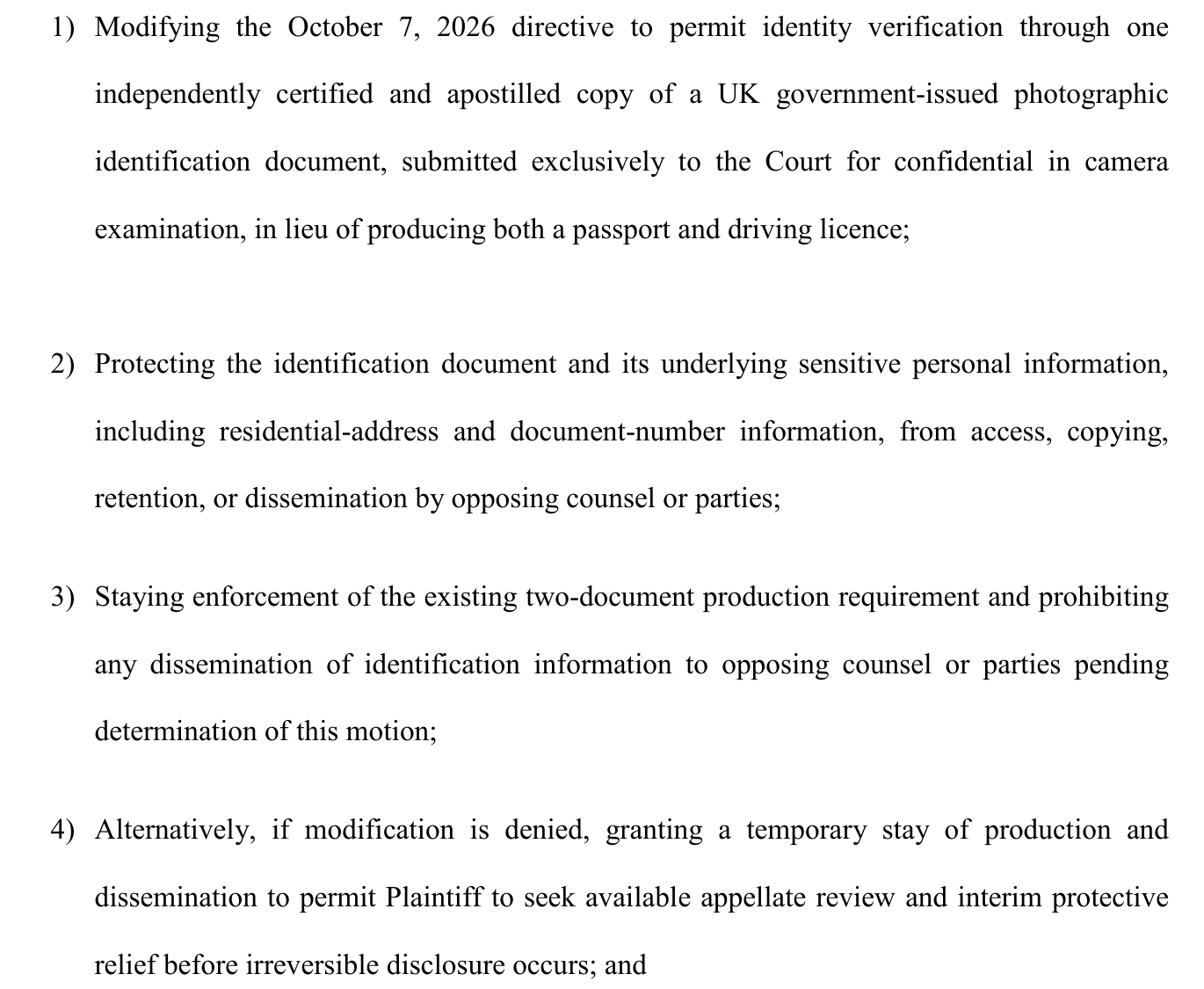
Nevertheless, the October 9 deadline passed without compliance from the plaintiff. Instead of submitting the requested materials, the plaintiff approached the court on October 14 with an alternative proposal. He asked permission to submit a single, independently certified and apostilled United Kingdom government photo identification card. Furthermore, he requested that this ID be examined exclusively by the judge herself, with no access granted to the opposing counsel.
The plaintiff justified this restrictive proposal by pointing to United Kingdom data protection laws, arguing that the exposure of his government-issued identification poses permanent privacy risks that cannot be undone. In his motion, he argued that once opposing counsel receives sensitive government identification and residential information, the loss of confidentiality is absolute and irreversible.
In the event that the court refused to institute these heightened privacy restrictions, the plaintiff formally requested a temporary stay of the order to allow him time to seek appellate review. Notably, the plaintiff’s motion omitted any mention of the required U.S. Copyright Office records, which—as far as the defense has been able to ascertain—have also not been produced.
"This Is Plaintiff’s Design"
The plaintiff’s ongoing reluctance to comply with document requests quickly drew a sharp response from the defense. Two days after the filing regarding the alternative ID proposal, Erin Russell, an attorney representing one of the anonymous defendants known as Doe 1, petitioned Judge Wood to order the plaintiff to show cause why he should not be held in civil contempt. According to Russell’s motion, the plaintiff had previously agreed on the court record to hand over the specified verification documents.
While Russell’s motion did not immediately press for harsh punitive measures, it requested a sworn statement detailing precisely what documents were sent and when, alongside a subsequent in-person hearing. Defense counsel emphasized that establishing the plaintiff’s true identity is not merely a procedural formality. As Russell previously pointed out to the court, any future sanctions award issued by the bench would be entirely uncollectible unless the court first definitively establishes who the plaintiff actually is.
In a subsequent legal filing submitted the following week, the defense team for Doe 1 argued that the plaintiff’s non-compliance extends beyond simple foot-dragging. The filing asserted that the plaintiff’s refusal to produce his passport and driver’s license actively sabotages the discovery schedule agreed upon by all participating parties during the October 2 conference, leaving the defendants completely in the dark regarding his actual identity.
Given the plaintiff’s explicit warnings that he intends to appeal any unfavorable rulings regarding his identification documents, the defense contends that these delays are entirely intentional. A filing submitted by Doe 1 characterized the situation bluntly, stating that this ongoing interference with the judicial schedule is not incidental, but rather part of the plaintiff’s deliberate design.
Blanks to Fill and Expanded Subpoenas
Because the core identity documents remain unverified and undisclosed, the legal teams for the defendants have been forced to adapt their discovery plans. In recent court submissions, Doe 1 and Doe #10—the latter identified in filings as the Usenet indexer omgwtfnzbs.org—outlined their proposed discovery requests and subpoenas while explicitly noting their reliance on placeholders.
With the plaintiff’s legal name unconfirmed, Doe #10’s proposed admissions included placeholder phrasing such as asking the plaintiff to admit that his legal name corresponds to the information found on his passport. Meanwhile, the broader discovery strategy aims to trace the plaintiff’s digital footprint and physical background. Proposed subpoenas target Google for records associated with the plaintiff’s Gmail account, telecommunication providers for phone number records, and mailbox providers or residential landlords tied to a residential address listed in Sanborn, New York.
From these entities, Doe 1 is seeking billing records, historical payment methods, and forwarding address details. Additionally, the defense has requested that the PACER Service Center turn over the specific Internet Protocol addresses utilized by the plaintiff to access the federal court’s electronic docketing website.
The defendants are also seeking a comprehensive accounting of the materials the plaintiff obtained from third-party companies through earlier subpoenas. Both Doe 1 and Doe #10 have requested all documents, data, and materials the plaintiff received from subpoenaed entities since August 2025. This sweep includes the confidential materials Cloudflare previously produced in response to the initial California DMCA subpoena, an exhibit that was previously filed under seal.
Attorneys for the defense have previously suggested that the person orchestrating the litigation may have a history of being banned from the targeted private torrent trackers, pointing to potential personal animosity and retaliatory motives behind the lawsuits.
Questions Surrounding Generative AI
Among the final sets of discovery inquiries are
detailed questions regarding "Do Us Part," one of three independent films the plaintiff claimed to have produced within the United Kingdom. After facing court orders to produce evidence, the plaintiff submitted his version of the film in September, arguing that his submission directly refuted claims that his work was actually an unrelated Canadian production.
However, the defense has expressed skepticism regarding the origin of the film, which the plaintiff alleges was created more than 14 years ago. Consequently, the defense has asked the plaintiff to formally admit whether the submitted film was generated, either in whole or in part, using generative artificial intelligence tools.
In conjunction with these admissions, the defense is demanding the original digital video file, all raw unedited footage, and comprehensive technical records. Their requests specifically encompass all prompts, outputs, project files, account activity records, and system logs associated with any utilization of AI during the creation process.
All participating legal teams retain the opportunity to file formal objections to these sweeping discovery requests. The parties are scheduled to reconvene for another video status hearing on November 17, during which the court has explicitly instructed the plaintiff to test his video conferencing capabilities prior to the start of the proceedings.