Google has announced a major shift in how generative artificial intelligence and core digital tools are integrated within educational environments. Beginning soon, the tech giant will switch off Gemini, Gemini Notebook, Gemini in Classroom, and Google Search tools for K-12 student accounts by default. These services will remain disabled across school accounts until a designated school administrator explicitly chooses to turn them on, with each service requiring individual, manual activation.
While the default restriction of dedicated AI products aligns with growing institutional caution regarding automated learning assistants, the policy surrounding Google Search presents a more complex challenge for educators. Because Google has increasingly woven artificial intelligence directly into its core web search infrastructure, the policy forces institutions into a difficult position regarding digital access.
According to company statements, features such as AI Mode and AI Overviews will be active within Google Search for school accounts, designed to guide students through academic problems step by step. Consequently, schools that wish to maintain a strict policy against artificial intelligence tools will find themselves unable to utilize Google Search altogether for their students. Google’s Vice President for Education, Chris Phillips, confirmed in an interview with The New York Times that students attending a school that opts out of these AI-driven features will instead be presented with a formal notice from the administration stating that Google Search is currently unavailable.
Upcoming Options and the Evolution of Classroom AI
Starting in 2027, educational institutions whose administrators choose to enable artificial intelligence will be presented with two distinct Search configurations. The first option closely mirrors the standard consumer version of the search engine, featuring automated AI overviews and interactive chat capabilities. The second configuration is structured around Guided Learning, which serves as the designated student version of the Gemini platform.

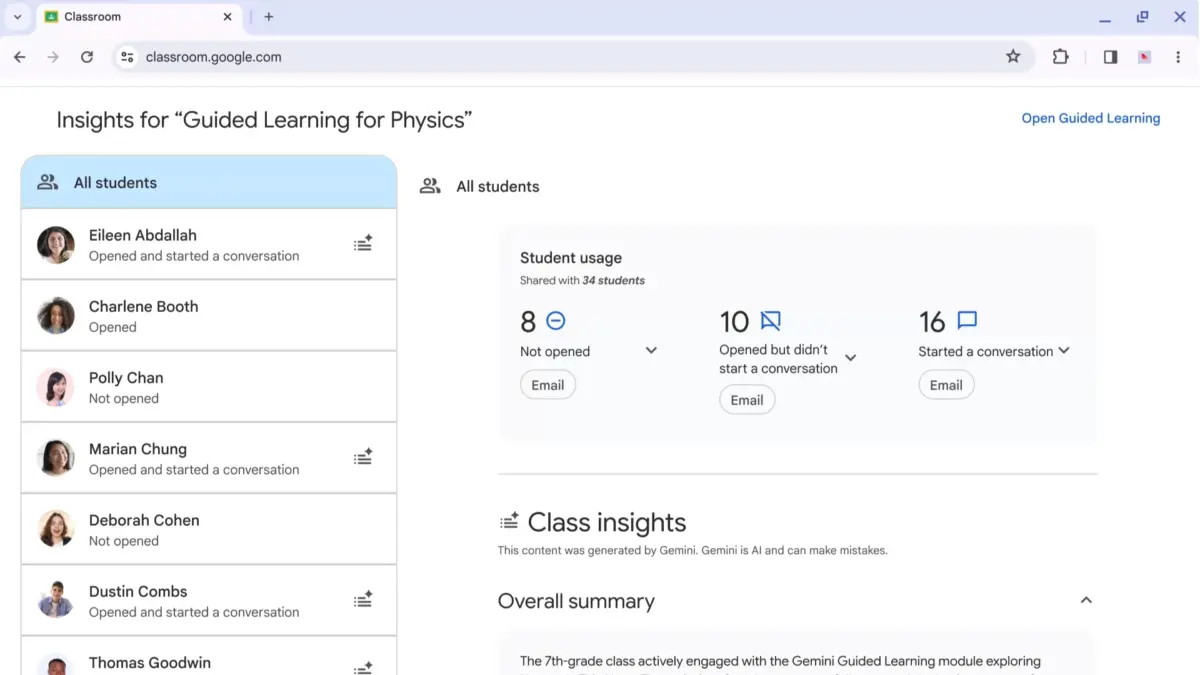
This alternative mode is engineered to function as an interactive study coach rather than a direct answer generator. Instead of simply handing solutions over to the student, the system is designed to ask probing questions and break down complex academic problems into manageable, sequential steps. Google has indicated that further specifics regarding these implementations will be released over the coming months ahead of the official rollout.
The latest policy announcement represents a notable pivot from Google’s strategy earlier in the year. In August, Gemini in Classroom was expanded to accommodate students of all age groups. During that rollout, the Gemini tab was enabled by default across educational institutions that already permitted student access to the chatbot, while schools that previously disabled the feature for students maintained their restricted status.
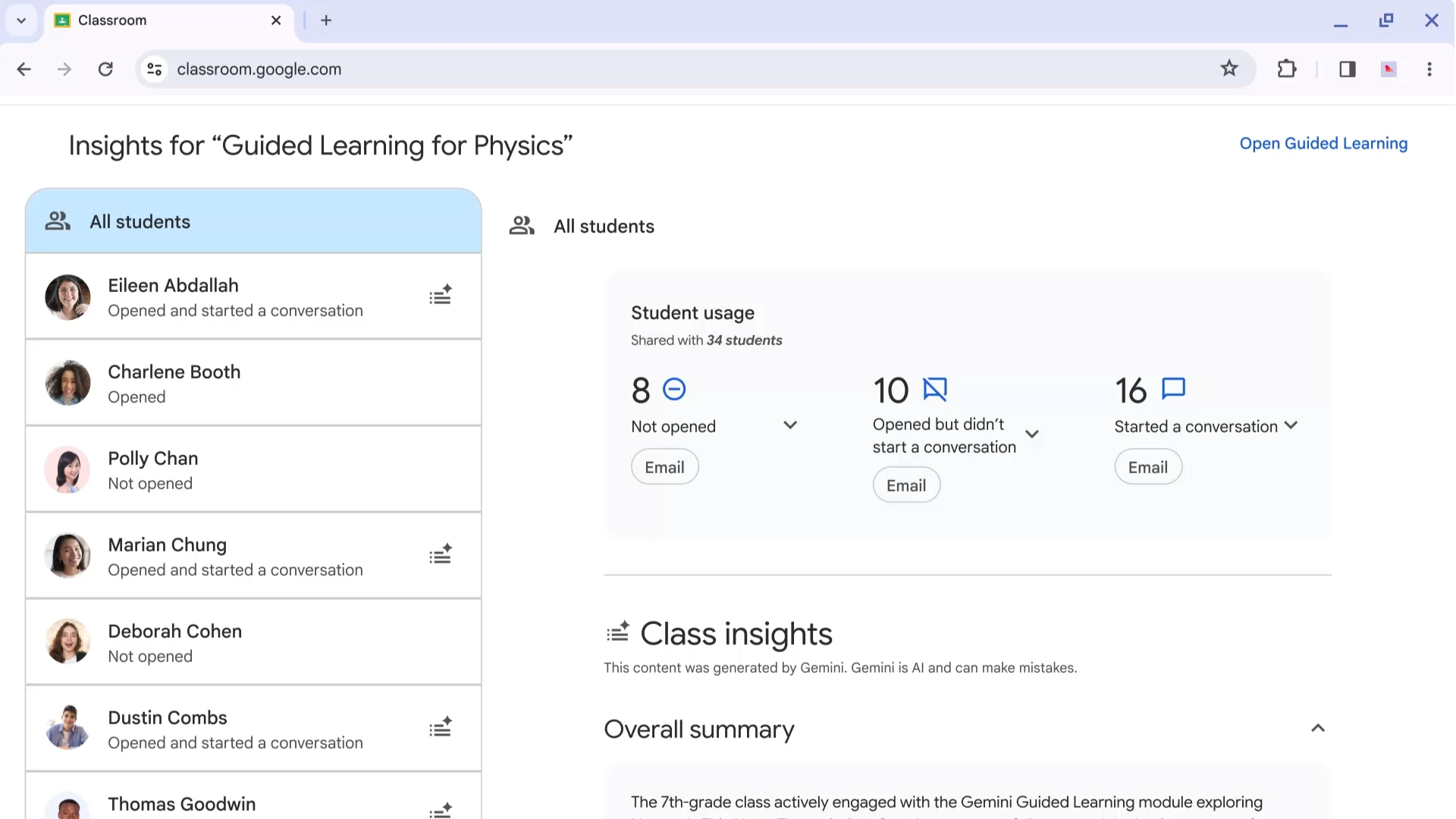
Prior to that summer expansion, the Gemini chatbot had been restricted exclusively to students aged 18 and older. Administrators who wished to prevent underage users from accessing the tool were required to manually isolate them into separate organizational units and disable access within those specific parameters. The upcoming changes effectively reverse that default framework, placing the burden of activation entirely on school leadership.
Mounting Pressure and Institutional Resistance
The tightening of default controls arrives amid a backdrop of growing regulatory and administrative pushback against generative artificial intelligence in public education. Several major school districts in the United States have already enacted restrictive measures independently of Google’s policy shifts.

For instance, New York City public schools announced a comprehensive ban on student-facing generative artificial intelligence tools spanning preschool through the eighth grade, while also implementing broader limitations on screen time. Similarly, the Los Angeles Unified School District moved to bar artificial intelligence tools entirely on district-issued student devices, highlighting the friction between rapid technological deployment by major corporations and the cautious approach favored by local educational authorities.
The tension between digital utility and AI integration stands in contrast to approaches developing in other regions, such as Europe. A four-year framework contract recently awarded to IONOS following a public procurement process allows schools across several German federal states, including Berlin, Hamburg, Hesse, Bremen, North Rhine-Westphalia, and Rhineland-Palatinate, to voluntarily opt into a collaborative cloud infrastructure built upon open-source software from Nextcloud.

Participation in the German framework remains entirely optional for individual schools and regional educational authorities. The public tender specifically required software released under an Open Source Initiative-approved license, emphasizing principles of digital sovereignty and the institutional freedom to change technology providers without vendor lock-in.
This structural difference underscores a central dilemma for modern educational administration. While European institutions are increasingly exploring frameworks that prioritize open-source modularity and opt-in flexibility, schools operating within ecosystems dependent on major commercial providers face tighter integration hurdles. Under Google’s upcoming system, an educational institution wishing to provide standard web search capabilities to its student body will ultimately have to accept the integration of artificial intelligence tools alongside it, once the new rollout takes full effect.