
As the global Internet community approaches a major cryptographic milestone, technical operators and network administrators are closely monitoring the upcoming rotation of the Domain Name System (DNS) root key. Scheduled for October 11, 2026, the rolling of the root key represents a rare and critical operational event for the infrastructure underpinning the entire web. Unlike standard cryptographic keys within the DNS Security Extensions (DNSSEC) hierarchy, the root key occupies a unique position because it operates entirely without a parent key.
The complexity of changing the root key stems from its absolute authority at the apex of the DNS trust tree. In normal circumstances, subordinate keys rely on a parent key to validate their authenticity. For a Zone-Signing Key, validation is provided by the zone’s Key-Signing Key, while a Key-Signing Key is validated by entries signed in the parent domain. Because the root zone has no parent, the transition mechanism relies on an "old signs new" protocol, where the outgoing key cryptographically signs the incoming key. Validating resolvers then require an extended grace period to recognize and trust the new credential.

According to RFC 5011, titled "Trust Anchor Update," this transition relies on a mandatory hold-down time. The specification dictates that the add hold-down time must be 30 days or the expiration time of the original Time to Live (TTL) of the first trust point resource record set containing the new key, whichever is greater. This safety measure ensures that resolvers observe at least two validated resource record sets containing the incoming key before accepting it into their local trust anchor stores. When recursive resolvers observe the new key for this duration, the automated trust anchor update process is designed to handle the transition smoothly.
The 2026 key roll does not involve a shift in cryptographic algorithms; rather, it is a routine rotation of the public and private key pair. The incoming Key-Signing Key, designated as KSK-2024, was published by the Internet Assigned Numbers Authority on their website in July 2024. It was subsequently added to the root zone’s resource record set in January 2025. With the operational date set for October 11, 2026, the key will officially begin generating the root zone’s digital signatures.
Evaluating the global readiness for KSK-2024 has required sophisticated measurement techniques to determine which recursive resolvers have successfully incorporated the new key into their local trust anchor sets. Industry observers and researchers have utilized two primary methods to peer into the infrastructure and track adoption rates prior to the transition.

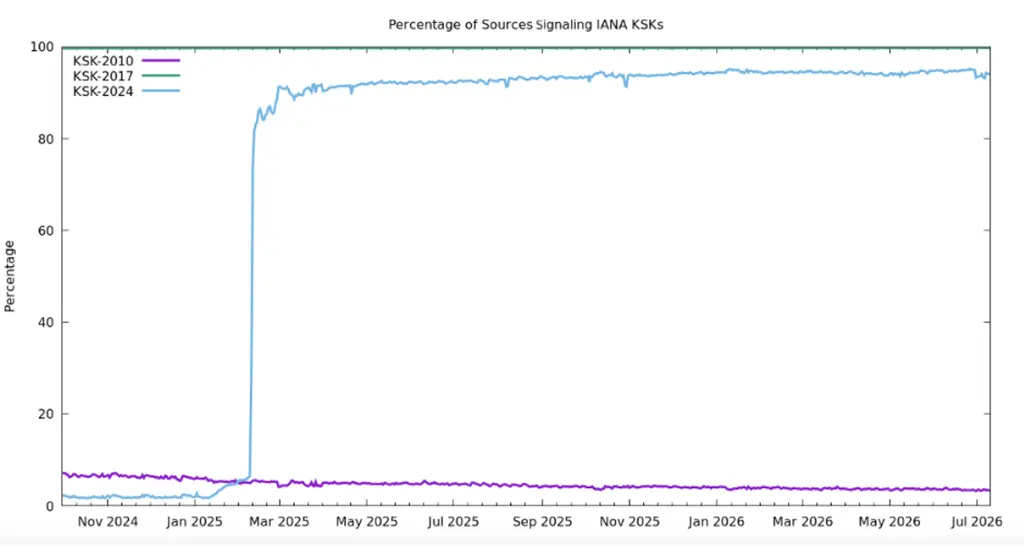
The first measurement technique relies on RFC 8145, "Signaling Trust Anchor Knowledge in DNS Security Extensions." Under this framework, recursive resolvers embed the key tags of their trusted keys directly into queries directed toward authoritative root servers. This is accomplished either by formatting query names to include specific trust anchor tags—such as queries containing indicator strings like "_ta-4f66-9728"—or by utilizing the EDNS key tag option within the query packet. Root server operators, including Verisign, have captured and analyzed these telemetry signals to map global resolver behavior. Data collected by mid-2026 indicated that approximately 90% of reporting resolvers had successfully added KSK-2024 to their local trust anchors. However, researchers note that raw resolver percentages do not necessarily reflect the true volume of end users behind those systems, as some validating resolvers serve millions of clients while others support only a single device.
To gain a more granular understanding of end-user exposure, researchers turned to a second methodology outlined in RFC 8509, "A Root Key Trust Anchor Sentinel for DNSSEC." This approach utilizes a sentinel mechanism where a resolver evaluates a specially formatted query and returns specific error codes based on whether it trusts a given key tag. For example, if a validating resolver recognizes the sentinel label and trusts the specified key, it returns a standard response, whereas an untrusted key triggers a SERVFAIL response. Cloudflare operates a dedicated web page enabling network administrators to test their local infrastructure against these criteria.
Using APNIC’s advertisement-based measurement platform, researchers have conducted extensive daily sampling, averaging roughly 16 million tests per day between May and July 2026, and resuming observations in October. Out of these daily tests, roughly six million originated from end systems sitting behind DNSSEC-validating recursive resolvers, with about 1.8 million providing a clear signal supporting the RFC 8509 sentinel mechanism. Among the resolvers explicitly reporting via this sentinel framework, approximately 70% indicated that KSK-2024 had been successfully loaded as a trusted key.
Despite positive global averages, detailed telemetry reveals significant disparities across individual networks and geographic regions. Small-scale testing conducted via RIPE Atlas probes across nearly 2,900 distinct Autonomous Systems in early October demonstrated that while a vast majority of probes reflected proper key loading, a notable subset still exhibited behavior consistent with missing trust anchor updates.
An examination of specific networks with low adoption rates highlights potential vulnerabilities that could impact users once the rollover takes place. Telemetry data compiled from recent ad-based measurements points to dozens of Internet Service Providers across Latin America, Africa, Asia, Eastern Europe, and the Middle East where a substantial portion of reporting tests show low acceptance rates for KSK-2024. Networks such as Telefonica de Costa Rica, Swazi Mobile in Eswatini, Hutchison Telecoms in Sri Lanka, Teletalk in Bangladesh, Mauritanian Telecommunication, and Djibouti Telecom registered KSK-2024 trust signals hovering around 46% to 49%. Even larger telecommunications providers in various other regions recorded lower figures, indicating that thousands of validating resolvers across these autonomous systems had yet to fully adopt the incoming key prior to the scheduled transition.
If an Internet Service Provider fails to update its recursive DNS resolvers before the key rollover takes effect, users relying on those networks may encounter widespread resolution failures, as validating resolvers reject root zone responses signed by the new key. Network operators whose systems appear among those with lagging trust signals are encouraged to review their DNS configurations immediately and perform diagnostic checks using available verification tools to ensure seamless continuity for their end users.


Leave a Reply