
As the Internet infrastructure approaches a major operational milestone, the Domain Name System (DNS) community is closely monitoring the transition of its most critical security component. Scheduled for October 11, 2026, the rolling of the root key of the Domain Name System marks a rare and delicate procedure for the global network. Unlike subordinate keys within the DNS Security Extensions (DNSSEC) hierarchy, the root key lacks a parent authority to validate its authenticity, making its routine replacement a focal point of careful observation and measurement by network operators worldwide.
The significance of rolling the root key stems from its unique position in the cryptographic hierarchy of the Internet. Every other key within DNSSEC relies on a parent key to verify its legitimacy. A Zone-Signing Key is validated by its zone’s Key-Signing Key, while a Key-Signing Key is authenticated through entries signed in the parent domain. Because subordinate keys simply require the parent key to sign a hash of the public key component published as a signed Delegation Signer resource record, their updates follow a well-established path.
The root key, however, has no parent. To authenticate a new root key, the legacy Key-Signing Key must sign across the incoming key. Validating clients then require an extended grace period to observe, pick up, and ultimately trust the incoming cryptographic material. Guidance for this transition is codified in RFC 5011, titled "Trust Anchor Update." The standard establishes a mandatory hold-down time of 30 days or the original Time to Live expiration of the first trust point resource record set containing the new key, whichever is longer. This safeguard ensures that resolvers encounter multiple validated resource record sets containing the new key before accepting it into their local trust anchor stores.

When the new Key-Signing Key is added to the root zone’s resource record set, validating resolvers discover the key automatically during routine record retrieval. Once the mandatory hold-down interval elapses, resolvers incorporate the key value into their local caches. If these minimum hold periods are strictly respected across all operational stages, the entire rollover process is designed to proceed smoothly and automatically.
The upcoming event does not involve a cryptographic algorithm change; rather, it represents a standard transition of the public and private key pair. The incoming Key-Signing Key, designated as KSK-2024, was published on the Internet Assigned Numbers Authority website in July 2024 and subsequently integrated into the root zone’s resource record set in January 2025. Following the necessary observation and hold-down phases, the scheduled transition on October 11, 2026, will see this key officially used to generate the root zone’s digital signature.
To evaluate readiness across the global Internet, researchers and infrastructure operators rely on specialized telemetry to determine whether recursive resolvers have successfully incorporated KSK-2024 into their trust anchor sets. Measuring this behavior across millions of distributed systems requires indirect observation techniques, as direct access to every resolver is impossible.
Trust Signal and Measurement Methodologies

Two primary techniques offer visibility into how the global DNS infrastructure is adopting the new root key. The first approach is outlined in RFC 8145, titled "Signaling Trust Anchor Knowledge in DNS Security Extensions." Under this method, a recursive resolver embeds the key tags of its trusted keys directly into queries sent toward the authoritative servers of the root zone. Resolvers can append tag values within the query name—such as a query containing a specific string indicating the trusted key identifiers—or include them within an EDNS key tag option.
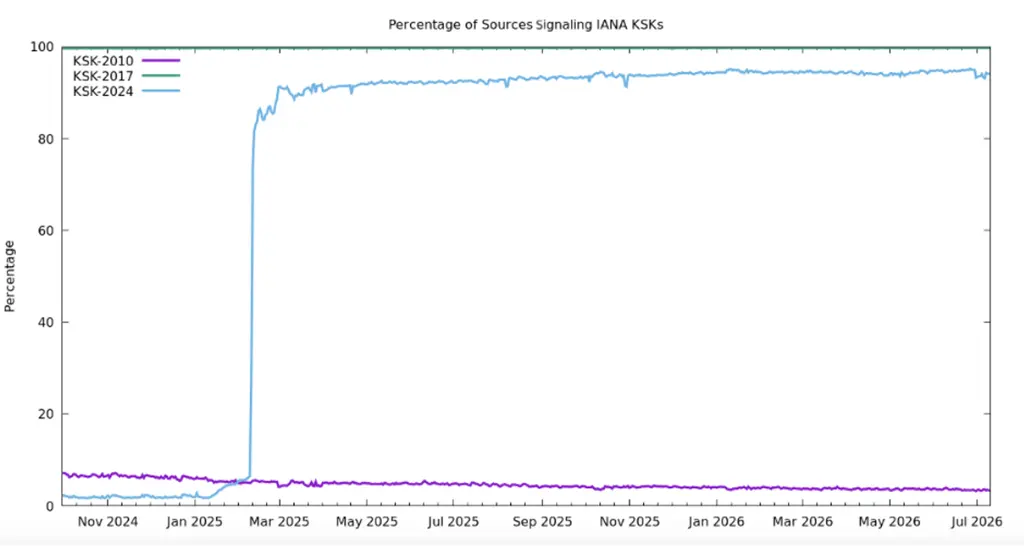
Analysis of these signals by root server operators, including Verisign, provides valuable insights into global adoption trends. Historical sampling data indicates that a significant majority of reporting resolvers have successfully added KSK-2024 to their local trust anchor collections. However, aggregate resolver statistics do not always reflect the true scale of end-user populations. While some validating recursive resolvers serve millions of active users, others handle traffic for only a handful of devices, meaning raw resolver counts do not directly translate to user impact estimates.
An alternative measurement approach is defined in RFC 8509, "A Root Key Trust Anchor Sentinel for DNSSEC." Instead of passing trust signals onward to root zone servers, this mechanism folds the inquiry back to the querier. By utilizing specific labels within the leftmost section of a DNS query name, the system prompts compliant recursive resolvers to evaluate their own trusted key sets and respond accordingly. If a resolver trusts a specific key tag, it returns the expected answer; if it does not, it responds with a SERVFAIL message. Network administrators and engineers can test their own infrastructure using diagnostic web pages provided by organizations like Cloudflare.
Researchers at APNIC leverage an advertisement-based measurement system to issue these queries to a large population of end users daily. Instead of tracking individual recursive resolvers, this methodology quantifies the proportion of end users situated behind validating resolvers that have failed to adopt KSK-2024. The diagnostic testing sequence involves multiple queries designed first to verify whether a resolver supports the Root Key Trust Anchor Sentinel mechanism by checking trust in the legacy KSK-2017 key, and subsequently to determine whether KSK-2024 has been loaded into local storage.
Adoption Metrics and Regional Observations
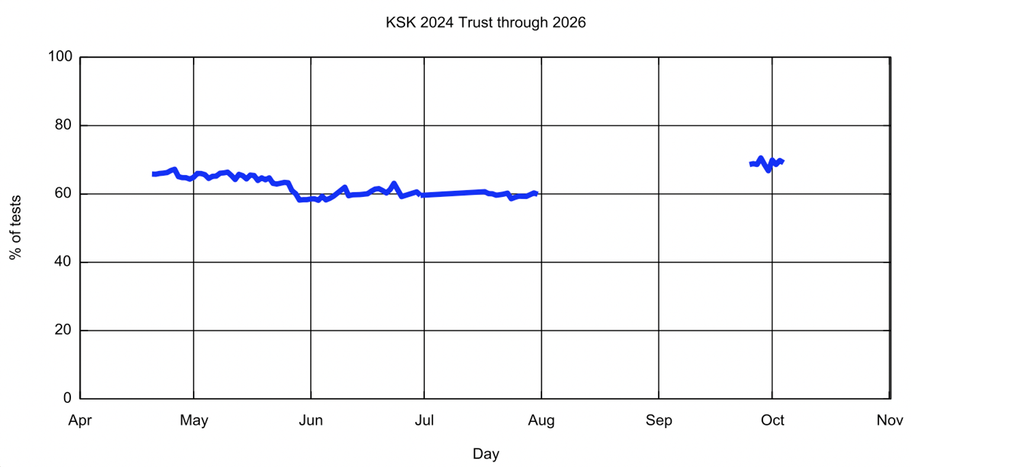
Small-scale pilot tests conducted with RIPE Atlas probes across thousands of autonomous systems revealed that the vast majority of tested probes exhibited behavior consistent with having loaded the new key, while a small fraction lagged behind. Broader ad-based measurements conducted throughout the year, averaging roughly 16 million tests daily, provide a more comprehensive picture of global adoption.
Data from these extensive campaigns indicates that approximately 70 percent of tests demonstrating support for the sentinel mechanism report that KSK-2024 has been successfully loaded as a trusted key. Out of the millions of daily tests, a substantial portion originates from networks utilizing DNSSEC-validating recursive resolvers, with a distinct subset providing clear telemetry regarding their key sentinel support.
Despite positive global averages, significant variations exist across different regions and network operators. Monitoring efforts have identified specific autonomous systems and Internet Service Providers where the adoption rate of KSK-2024 remains notably low among supporting resolvers. Networks spanning various countries, including parts of Central America, Africa, South Asia, Eastern Europe, and the Middle East, feature prominently among those with lower rates of incoming key acceptance.
For instance, measurement data highlights several telecommunications providers and regional operators where a substantial portion of testing samples indicate that local recursive resolvers have yet to incorporate the 2024 key into their trusted collections. In some networks, measured acceptance rates hover well below the global average, pointing to potential configuration delays or outdated software versions running on resolver infrastructure.
Because an unconfigured or outdated trust anchor can lead to resolution failures for end users once the root key rollover is complete, identifying these lagging networks is a critical step in preventing service disruptions. Operators of listed networks and system administrators whose recursive DNS setups show reluctance in adopting the new key are encouraged to review their configurations, verify software compatibility, and perform diagnostic checks using publicly available testing tools. As the transition date arrives, continued monitoring will ensure that any remaining adoption gaps are swiftly addressed to maintain a secure and stable Domain Name System.
Leave a Reply