
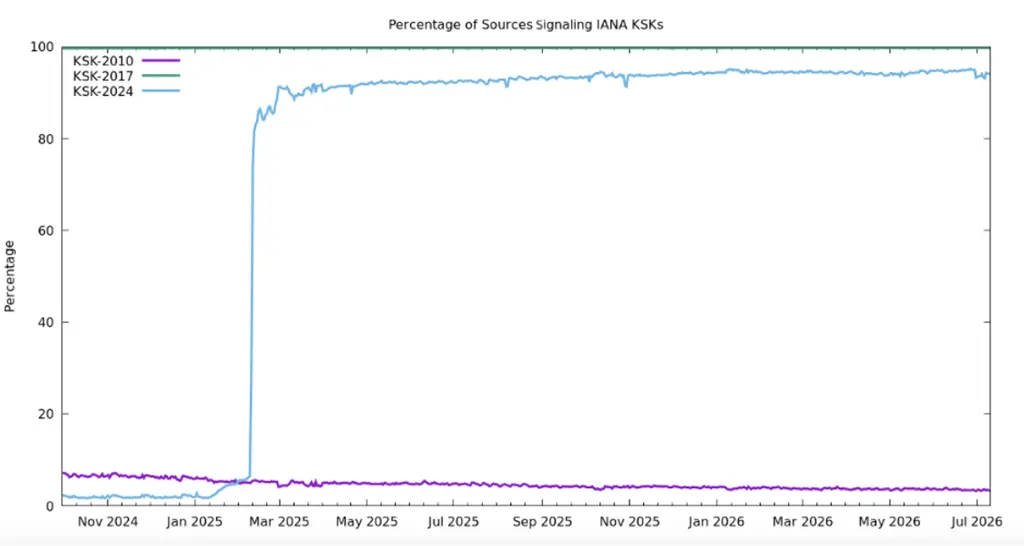
As network operators and Internet service providers around the world prepare for a major transition in core Internet infrastructure, the Domain Name System (DNS) community is tracking the final countdown to the scheduled roll of the DNS root key. Unlike everyday certificate updates or routine domain administration, altering the root key of the global Domain Name System represents a uniquely delicate operation. Every other cryptographic key within the architecture of DNS Security Extensions relies on a clearly defined parent-child relationship to validate its authenticity, but the root key stands entirely alone at the apex of the hierarchy.
The mechanics of this transition require careful coordination across the global ecosystem of validating recursive resolvers. For subordinate keys such as Zone-Signing Keys or Key-Signing Keys, authentication is achieved when a parent zone signs across a new key value, creating a Delegation Signer resource record. The root zone, however, has no parent domain to perform this function. Instead, authentication depends on an "old signs new" methodology, where the legacy key signs across the incoming key. Following this, an extended operational period must elapse to give DNSSEC-validating clients sufficient time to discover and trust the incoming cryptographic asset.
Guidance outlined in RFC 5011, which governs trust anchor updates, specifies that the add hold-down time must be at least 30 days or match the original Time to Live expiration of the first trust point DNSKEY resource record set containing the new key. This safeguard ensures that validating resolvers observe at least two validated resource record sets containing the new key before officially accepting it into their local trust stores. When these hold periods are strictly observed across every stage of the rollout, the entire replacement process is designed to proceed automatically as resolvers retrieve updated resource records from the root zone.

The upcoming transition focuses purely on refreshing the public and private key pair rather than executing an underlying cryptographic algorithm change. The incoming key, designated as KSK-2024, was formally published on the Internet Assigned Numbers Authority website in July 2024 and subsequently integrated into the root zone resource record in January 2025. With the operational phase culminating on October 11, 2026, the designated key is slated to generate the digital signatures for the root zone’s DNSKEY resource record set, marking a significant milestone in routine cryptographic hygiene for the global Internet.
To evaluate readiness across the broader Internet, engineers rely on sophisticated telemetry to determine which recursive resolvers have successfully incorporated KSK-2024 into their local trust anchor sets. Gaining visibility into this decentralized infrastructure requires specific measurement techniques designed to peer into recursive resolver behavior without compromising network stability or user privacy.
Trust Signal and Measurement Techniques
Two primary methodologies allow network researchers to inspect the DNS infrastructure and measure the adoption status of the incoming root key among recursive resolvers. The first technique, defined in RFC 8145 under the title "Signaling Trust Anchor Knowledge in DNS Security Extensions," involves resolvers embedding the key tags of their trusted keys directly into queries directed toward authoritative root zone servers. This can be accomplished either by encoding tag values into specialized query names—such as utilizing a query string that reveals specific trust anchor identifiers—or by incorporating the information into an edns-key-tag option within the query itself.

Analysis of these telemetry signals, managed by root server operators such as Verisign, provides valuable insight into the global deployment landscape. Data collected prior to the rollover indicates that a significant majority of reporting resolvers have successfully added KSK-2024 to their local trust configurations. However, aggregate metrics derived from resolver reporting logs do not directly translate into an exact census of the end-user populations sitting behind those resolvers, as some recursive operators serve millions of active clients while others handle traffic for only a single household.
A complementary approach, outlined in RFC 8509 and titled "A Root Key Trust Anchor Sentinel for DNSSEC," folds the measurement signal back toward the original querier rather than forwarding it onward to root servers. This mechanism utilizes the leftmost label of a DNS query name, requiring capable resolvers to recognize specific label patterns and alter their response behavior based entirely on whether they trust a given key tag. Under this framework, testing a specific key tag can yield a normal answer if the key is trusted, or return a server failure response if the key remains absent from the local trust anchor set.
Researchers can leverage these measurement protocols to gauge real-world adoption on a massive scale. Operators utilize advertisement-based measurement systems, such as APNIC’s distributed platform, to issue millions of test queries daily across diverse geographic regions. Rather than identifying individual recursive resolvers, this approach quantifies the exact proportion of end users situated behind DNSSEC-validating infrastructure that has failed to incorporate the new key into its trusted collections. Small-scale testing using global probe networks similarly reveals varying degrees of preparedness, underscoring the fragmented nature of operational updates across disparate autonomous systems.
Global Adoption Insights and Network Disparities
While broad statistical averages suggest that a substantial portion of reporting recursive resolvers have embraced the new key, global deployment remains unevenly distributed. Large-scale daily measurements yield millions of test interactions, yet only a fraction of those tests originate from end systems operating behind fully validating recursive resolvers that support advanced sentinel mechanisms. Looking past global averages highlights stark variations across individual network operators and regional infrastructure providers.
An examination of network-specific telemetry reveals a subset of autonomous systems exhibiting notably low adoption rates for KSK-2024. Analyzing networks where thousands of validation-capable tests confirm support for key sentinel measurements exposes significant disparities across international telecommunications providers. Prominent operators spanning multiple continents show varying degrees of readiness, with certain regional Internet service providers recording low percentages of trust anchor integration.
For instance, major telecommunications providers and regional network operators in countries across Central America, Africa, South Asia, the Middle East, and parts of Europe appear prominently among networks lagging in KSK-2024 adoption. Entities such as Telefonica de Costa Rica, Swazi Mobile, Hutchison Telecoms in Sri Lanka, Teletalk in Bangladesh, Mauritanian Telecommunication, and various regional operators in Iraq, the Philippines, and India demonstrate adoption rates that fall well below the global average. In some cases, major national broadband providers and mobile network operators record adoption metrics where only a small minority of verified validating tests indicate successful loading of the new trust anchor.
Such disparities carry practical implications for end users residing within those networks. When the root key rollover proceeds without comprehensive upstream preparation, recursive resolvers that have failed to adopt the incoming trust anchor may treat validated DNS responses as insecure or untrusted, resulting in widespread resolution failures and severed connectivity for clients attempting to access modern web services. Network operators identified with low trust signal percentages face an urgent need to review their DNS configurations, update local validator software packages, and ensure their infrastructure aligns with current cryptographic standards before unmitigated resolution errors impact their subscriber base.
Leave a Reply