The global domain name system has successfully weathered a major administrative transition following the recent root Key Signing Key (KSK) rollover. Advanced measurement networks tracking the event have revealed that the critical security update concluded smoothly, resulting in a net global increase in DNSSEC-validating users despite isolated regional drops and early warning signs that had caught researchers off guard.
This latest update follows previous assessments published ahead of the scheduled DNS root KSK rollover on October 11, 2026. Network analysts utilized the Key Signing Key (KSK) Sentinel signal to monitor which autonomous systems and networks successfully tracked the rolling of the root key in real time. Because prior reports thoroughly detailed the mechanics of the KSK Sentinel signal, recent analyses focused strictly on the empirical data collected during the operation and its immediate aftermath.

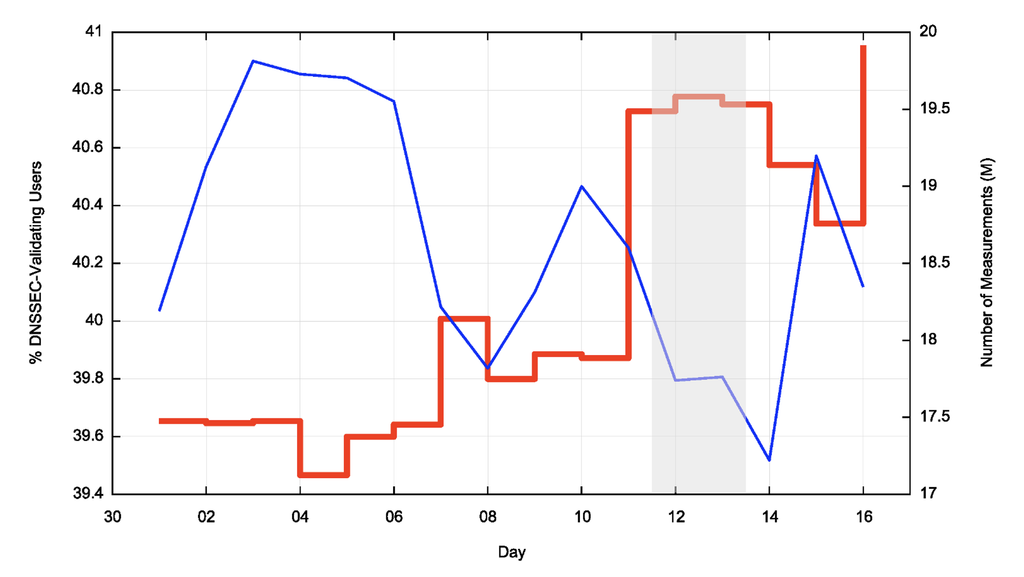
Evaluating the big picture requires looking at the comprehensive data collected by advertisement-based measurement networks during the first sixteen days of October. The observation period accounts for the critical window starting at the exact moment of the KSK roll at 14:00 UTC on October 11, extending through the subsequent forty-eight-hour period. This timeframe specifically covers the standard cached lifetime of root zone DNSKEY records within validating resolvers worldwide, during which local caches are refreshed and resolvers are forced to transition from trusting the outgoing key to trusting the incoming key.
Throughout the observation window, daily measurement ad presentation rates remained entirely within normal levels of statistical variation, indicating steady traffic patterns. Pre-roll measurements tracked whether users relied on resolvers that trusted the outgoing KSK. Once local DNSKEY records were refreshed—a process completed across compliant infrastructure before 14:00 UTC on October 13—validating resolvers officially required trust in the incoming KSK to successfully perform validation operations.
Global telemetry indicates that the overall average DNSSEC validation rate rose from a pre-roll baseline of 39.7 percent to a post-roll value of 40.6 percent. In global terms, this positive shift confirms that the KSK was rolled successfully without triggering any major international DNS outages. Industry observers view this outcome as a resounding endorsement of the collaborative work by the numerous organizations, software developers, and network administrators who invented, standardized, implemented, and deployed robust DNSSEC validation software capable of tracking the root key transition.

However, global averages can easily conceal individual behavioral variances that deviate from broader trends. A closer examination of specific national economies with large populations of DNSSEC-validating users reveals distinct regional experiences during the rollover window. Brazil and India provide instructive case studies, as both economies typically feature high reliance on ISP-provisioned recursive resolvers that implement DNSSEC validation.
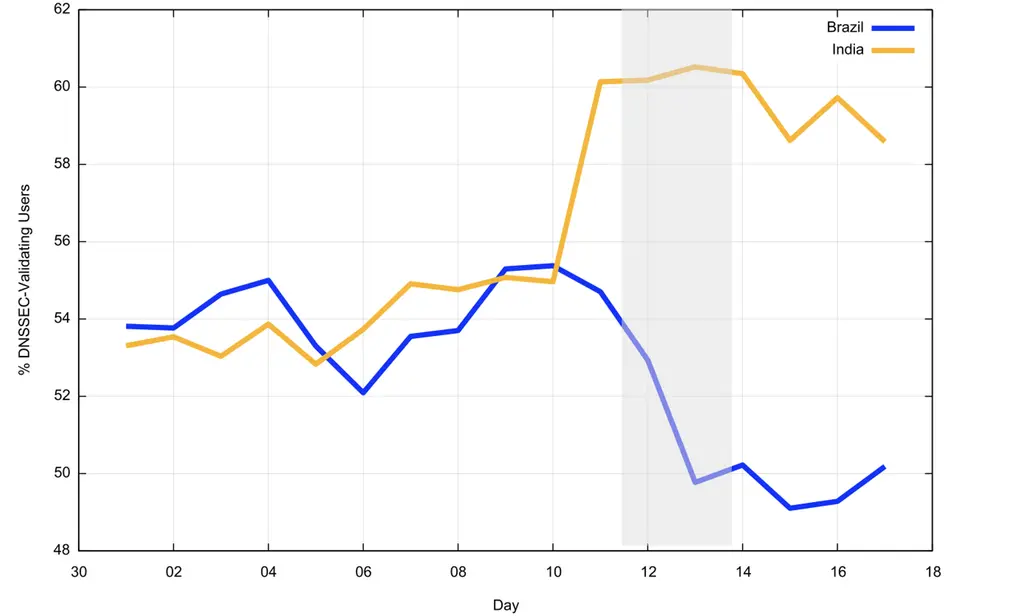
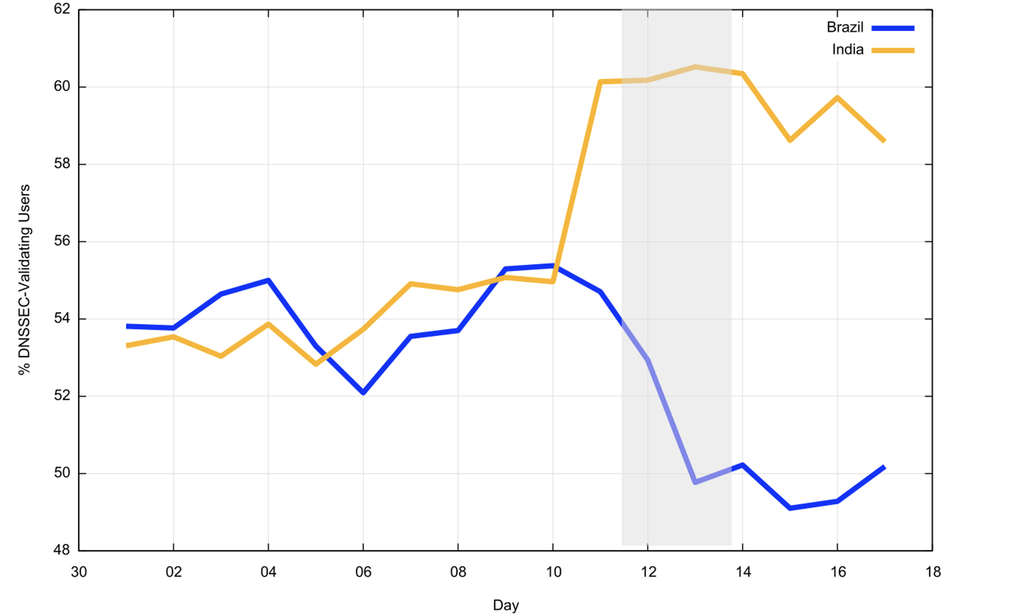
Ahead of the transition, proactive intervention played a vital role in preventing regional failures. Network analysts successfully contacted a major Indian internet service provider on October 9 after spotting KSK Sentinel signals indicating that the provider’s resolvers had failed to acquire local trust in the incoming KSK. Without intervention, these systems would have failed validation checks once the key rolled. Alerted in time, the ISP reacted swiftly, enabling the country to increase its DNSSEC validation rate among measured users from 55 percent to 59 percent across the KSK roll.
A similar proactive outreach was attempted in Brazil for networks exhibiting identical warning signs, but administrators could not be reached in time. Consequently, the national DNSSEC validation rate in Brazil dropped from 54 percent to 50 percent following the completion of the key rollover.
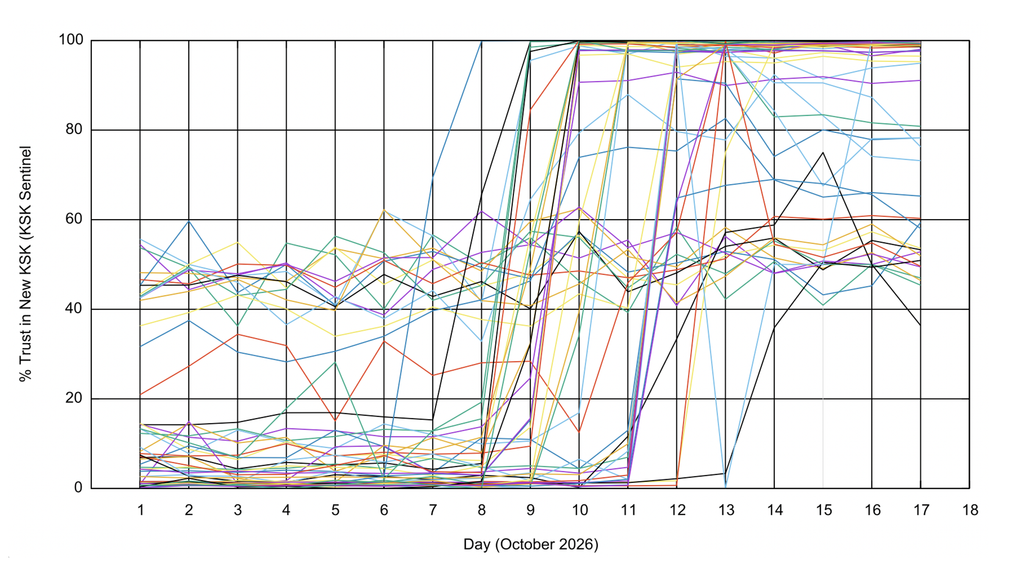
Further analysis targeted a specific group of fifty networks identified earlier in the month as having the lowest rate of acceptance for the incoming key, despite showing support for the Key Sentinel mechanism in preliminary tests. Observers tracked the acceptance rates for these fifty networks up until October 18. Surprisingly, none of these historically lagging networks were stranded when the root key rolled. Every single one of these networks successfully added the new KSK to their trusted key sets during the narrow window between October 7 and October 13.
This uniform behavior pattern proved unexpected, as observing an entire group of previously non-compliant networks abruptly cross the 50 percent acceptance threshold after the roll is a rare occurrence within the notoriously decentralized architecture of the Domain Name System.
To gauge broader operational stability, researchers analyzed the distribution of DNSSEC validation changes across individual networks. The dataset encompassed 13,538 networks that yielded an average of twenty samples per day both before and after the rollover event. Among these, thirty-five networks recorded a dramatic positive change in validation exceeding 50 percent, likely reflecting configurations that natively trusted the incoming KSK while ignoring the incumbent key. Widening the criteria, 594 networks registered a positive increase of 10 percent or more in their DNSSEC validation rates.
Conversely, negative impacts were also documented. Fifty-eight networks suffered a drop in DNSSEC validation of 50 percent or more, while 660 networks experienced a decline of 10 percent or more.
Estimating the human impact of the transition relies on comprehensive population models of internet users. Out of a total estimated global user population of over 4.3 billion, the number of users situated behind DNSSEC-validating resolvers stood at approximately 1.65 billion prior to the roll. Following the transition, that figure climbed to over 1.70 billion, representing a net global increase of roughly 45.8 million DNSSEC-validating users.
Economy-level data highlights the specific regions driving this growth. India led all nations with a net increase of more than 45.4 million validating users, moving from a pre-roll total of approximately 321.6 million to over 367.1 million post-roll. Viet Nam followed with a net gain of roughly 9.1 million validating users, while Algeria added over 3.2 million. Other economies experiencing notable net growth included Morocco, Kazakhstan, Slovakia, Iran, Thailand, Sri Lanka, and Lithuania.
On the other hand, several nations recorded substantial declines in their validating user populations. Brazil experienced the largest drop, losing approximately 7.7 million validating users as its national rate dipped from roughly 80.5 million down to 72.7 million. The Russian Federation saw a decrease of over 3 million validating users, while China, the United States, Bulgaria, Bangladesh, Japan, Uganda, Pakistan, and Egypt also recorded notable net reductions in their validating user counts.
Assessing the overall outcome requires recognizing the fundamental nature of the Domain Name System. As a highly distributed yet loosely coupled system, the DNS does not permit the precise central coordination of actions, meaning that any large-scale administrative effort will inevitably encounter localized variations. Evaluating whether such an operation succeeded requires a tolerance for these variances. Based on comprehensive telemetry and broad stability indicators, data confirms that the October 2026 KSK roll was a definitive success.
Detailed datasets and technical logs associated with this measurement effort have been made publicly available through specialized research repositories, offering long-term tracking metrics for ongoing DNSSEC deployment studies.