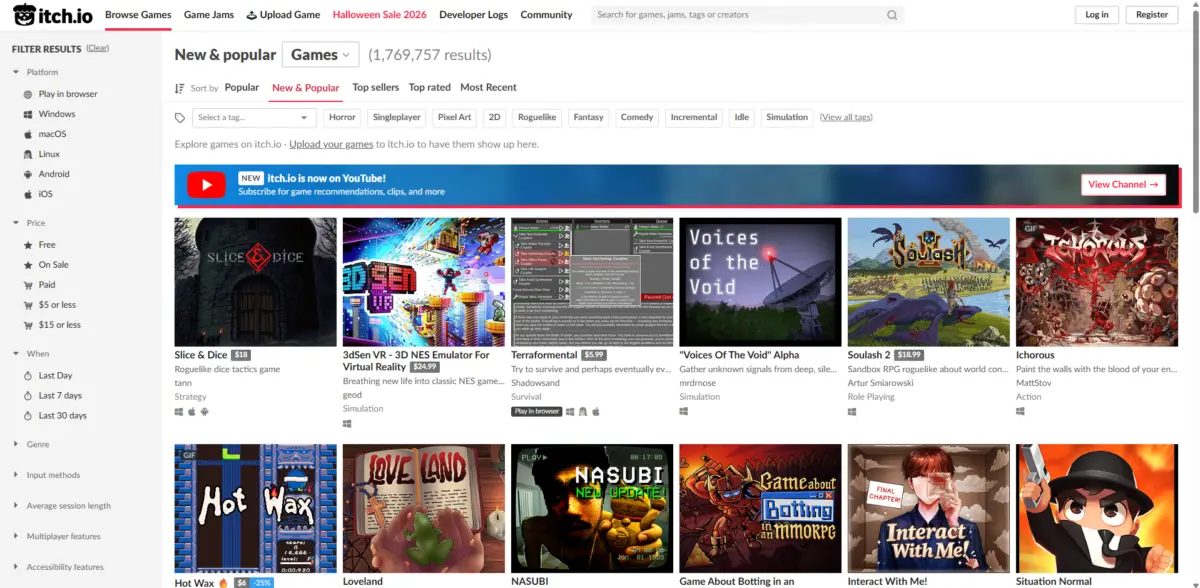
The digital landscape for independent video game developers is facing an unprecedented transformation, and not necessarily for the better. According to recent data disclosed by the popular indie-friendly storefront and community platform itch.io, the number of new game pages being created on a daily basis has doubled over the course of just two months. While platforms like itch.io have historically prided themselves on being accessible, open environments where anyone from university students to veteran developers can share their creative projects, the sudden and dramatic influx of new listings has raised serious alarms regarding discoverability, content saturation, and the broader implications of generative artificial intelligence within the gaming industry.
The startling statistics came to light late on October 31, when representatives for itch.io took to the social media platform Bluesky to share internal metrics tracking platform growth. The data revealed a stark upward trajectory beginning in August 2026. At that time, the platform was already seeing a substantial volume of activity, with approximately 3,000 new game pages being established each day. However, by the end of October, that daily figure had skyrocketed past the 6,000 mark. Subsequent clarifications and replies from the platform’s official channels confirmed what many industry observers had long suspected: generative AI projects account for the vast majority of this sudden and exponential growth in new submissions.
For years, itch.io has occupied a unique and vital niche within the gaming ecosystem. Unlike heavily curated storefronts such as Valve’s Steam or the console marketplaces managed by Sony, Microsoft, and Nintendo, itch.io has maintained a philosophy of radical openness. It has functioned as a digital incubator for experimental prototypes, student assignments, game jam submissions, and niche artistic works that might never find a commercial home elsewhere. At the same time, the platform has frequently hosted high-profile indie hits and organized massive charity fundraising bundles that draw millions of visitors. This open-door policy has made itch.io a beloved home for indie creators, but it also leaves the platform uniquely vulnerable to automated mass-publishing methods.
The consequences of this content boom extend far beyond simple database statistics, raising critical questions about what this means for indie game developers who rely on organic visibility to sustain their livelihoods. A superficial glance at the numbers might initially suggest a thriving, expanding marketplace where creative output is at an all-time high. Optimistic observers might assume that a doubling of new game listings would naturally translate to a corresponding surge in consumer engagement, sales, and downloads.
However, reality paints a starkly different picture. Although itch.io confirmed that the rate of page creation has doubled since August, the platform explicitly noted that the number of actual downloads and purchases has failed to follow suit. The consumer audience has not expanded proportionally to match the tidal wave of new software. Instead, the same pool of prospective players is now being asked to navigate a marketplace that is twice as crowded as it was just sixty days prior, with a massive percentage of that new inventory consisting of low-effort or automated content.
This phenomenon is not isolated to itch.io. Across the broader PC gaming landscape, storefronts are grappling with similar pressures. Steam, the industry’s dominant digital marketplace, has faced continuous scrutiny over the influx of low-quality releases and automated clones. Developers participating in recent events, such as the digital-only Steam Next Fest demonstrations, have frequently voiced concerns that their hand-crafted projects are being drowned out, overlooked, or even directly mimicked by AI-generated competition flooding the system.
The core issue facing independent creators is the traditional struggle for visibility. Hand-crafted games require months or years of dedicated programming, writing, art design, and audio production. In contrast, generative AI tools allow individuals or automated operations to churn out numerous mock-games, superficial clones, and derivative projects in a fraction of the time. When these automated releases flood digital storefronts en masse, they occupy the same promotional spaces, search results, and newly-listed feeds that human developers depend on to find an audience.
What does this mean for indie game developers?
For developers currently building or planning to distribute games through platforms like itch.io in the near future, the current climate is undeniably concerning. An influx of new releases that fail to bring any corresponding growth in user acquisition means that the competition for player attention has intensified dramatically. Creators must work harder than ever just to ensure their projects are seen by prospective players, let alone purchased or downloaded.
While platforms are beginning to take initial steps toward addressing the shift—such as itch.io’s existing policy requiring developers to disclose the use of generative AI in their projects—industry stakeholders are increasingly questioning whether disclosure alone is enough. Without stricter monitoring, active curation, or targeted platform restrictions regarding the volume and nature of generative AI-made content, the sustainability of open indie marketplaces faces a severe test. Unless major digital storefronts implement more robust measures to protect human-crafted works from being buried beneath waves of automated material, the challenge of standing out in a crowded digital marketplace will remain one of the most pressing hurdles for independent game developers worldwide.