
The global Domain Name System (DNS) has successfully navigated a major technical milestone following the rolling of its primary cryptographic anchor. According to new measurement data collected across October 2026, the critical operation to transition the DNS root zone’s Key Signing Key (KSK) proceeded without causing widespread outages, validating the collaborative work of network operators, software developers, and technical standards bodies worldwide.
The transition, which officially took place on October 11, 2026, marks the latest update in a series of evaluations led by internet measurement networks to track how internet service providers and recursive resolvers handled the shifting cryptographic landscape. Utilizing the Key Signing Key (KSK) Sentinel signal, researchers have been able to observe firsthand which autonomous systems successfully incorporated the incoming key and which lagged behind during the mandatory transition window.

Tracking the Big Picture Across the Global Internet
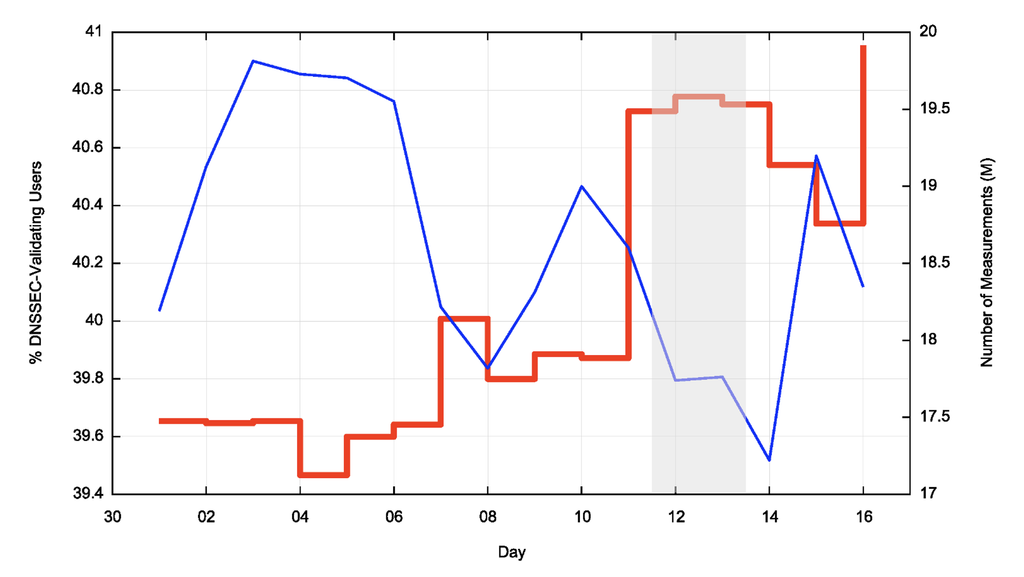
To gauge the overarching impact of the root key roll, researchers analyzed data captured by advertisement-based measurement networks during the first sixteen days of October. The observation period placed special emphasis on the critical 48-hour window immediately following the start of the KSK roll at 14:00 UTC on October 11, covering the standard cached lifetime of root zone DNSKEY records within validating resolvers.
Daily measurement ad presentation rates remained consistent with normal baseline variations throughout the observation window. More importantly, metrics tracking the percentage of end-users relying strictly on DNSSEC-validating resolvers demonstrated remarkable stability. Before the October 11 transition, successful validation required resolvers to trust the outgoing KSK. Once the locally cached resource records refreshed—a process completed by October 13—validating resolvers had to successfully rely upon the incoming KSK to maintain cryptographic validation.
Global telemetry figures revealed that the worldwide average DNSSEC validation rate experienced a slight upward tick, moving from a pre-roll value of 39.7% to a post-roll value of 40.6%. This macroscopic data confirms that the root key roll was executed smoothly on a global scale, averting any major catastrophic network failures. The seamless transition stands as a testament to decades of protocol development, software implementation, and diligent deployment practices by recursive resolver operators across the globe.

Regional Variations: The Diverging Experiences of Brazil and India
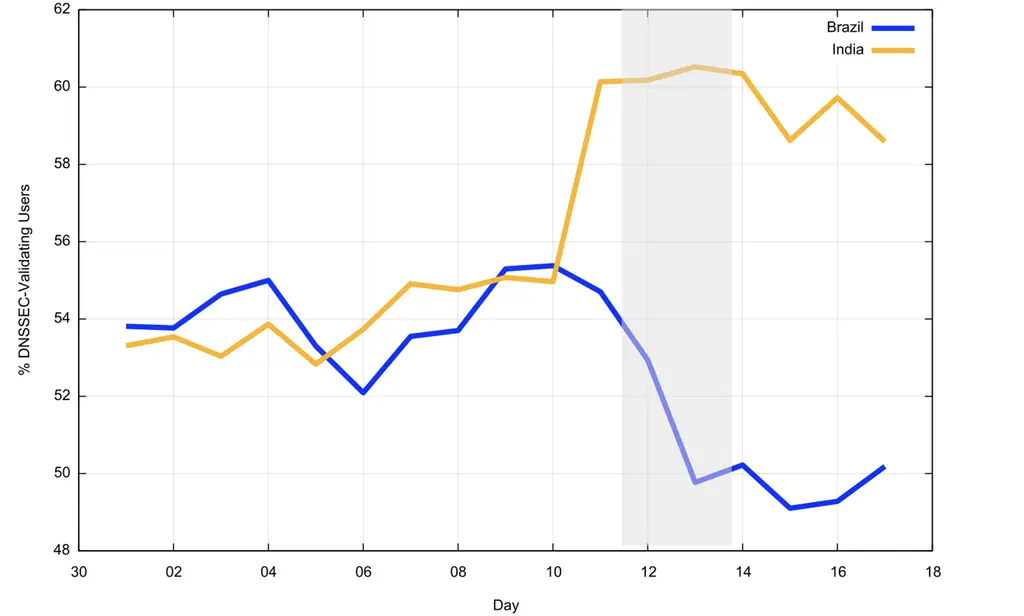
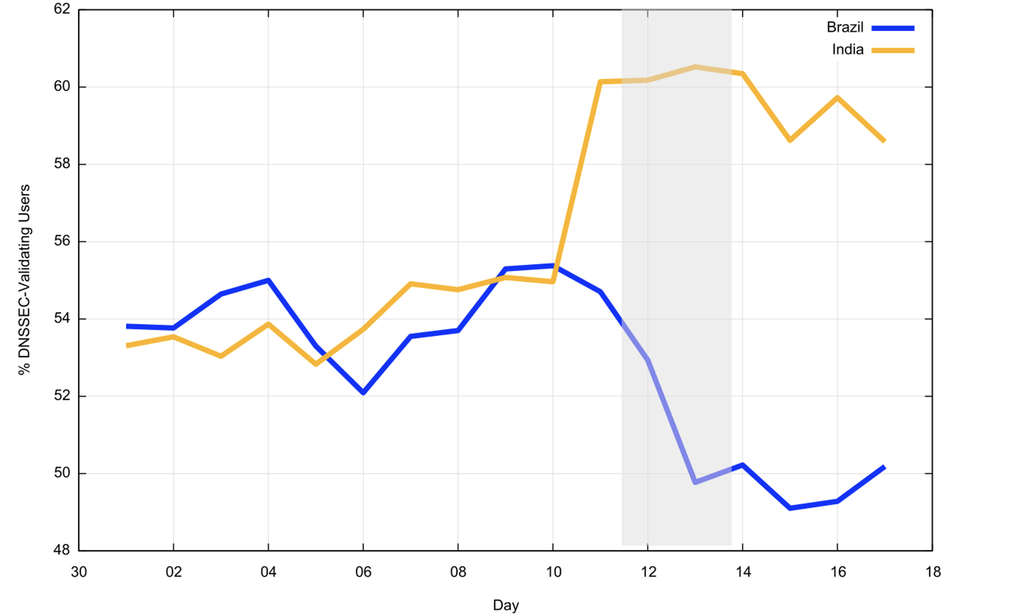
While global averages point toward a smooth transition, macroeconomic performance indicators often mask localized behavioral nuances. A closer examination of two specific economies with substantial populations of DNSSEC-validating users—Brazil and India—highlights how proactive communication can alter technical outcomes. Both nations typically benefit from widespread ISP-provisioned recursive resolvers that enforce DNSSEC validation by default.
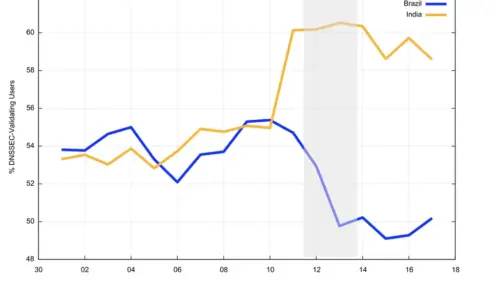
Prior to the rollout, technical signals flagged a major Indian internet service provider whose resolvers had failed to register local trust in the incoming KSK, putting them at high risk of validation failures once the root key rolled. Thanks to timely intervention and direct outreach on October 9, engineers at the ISP were alerted to the KSK Sentinel warning and successfully remediated the configuration. Consequently, the measured DNSSEC validation rate among users in India actually rose from 55% to 59% across the duration of the key roll.
A similar proactive intervention was attempted in Brazil for networks exhibiting identical warning signs, but outreach efforts within the same timeframe were unsuccessful. Without last-minute configuration adjustments by the affected regional operators, the DNSSEC validation rate among measured users in Brazil declined from 54% to 50% following the completion of the root key transition.
Unexpected Resilience Among Flagged Networks
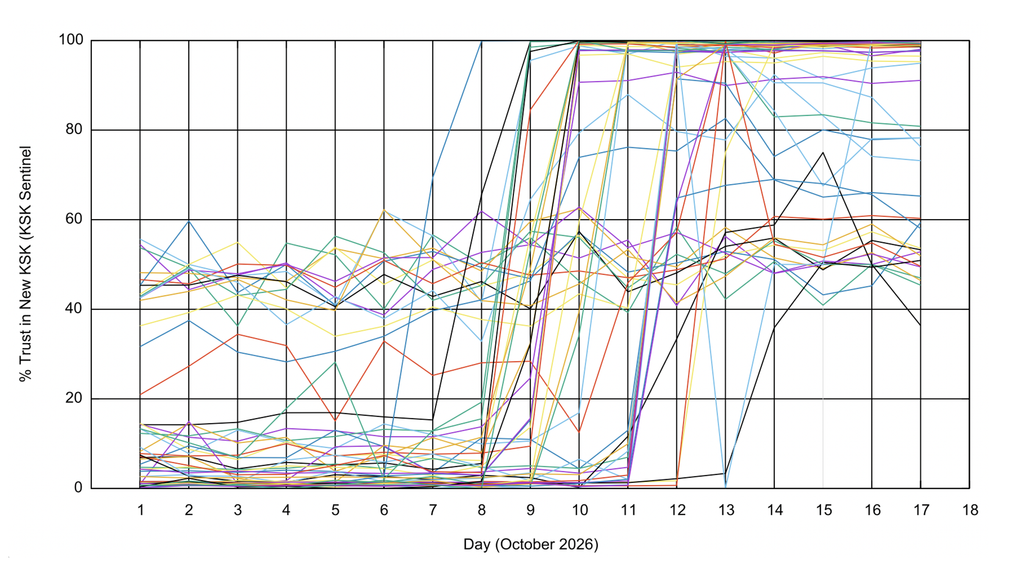
Earlier evaluations published at the beginning of October highlighted a cohort of fifty individual networks exhibiting the lowest rates of acceptance for the incoming KSK, despite having sufficient Key Sentinel measurement support. Monitoring these specific fifty autonomous systems through October 18 revealed a surprising pattern of behavior.
Against initial expectations, none of the flagged networks became stranded or suffered catastrophic validation failures when the root key rolled. Every single one of these previously lagging networks successfully incorporated the new KSK into their trusted key sets during the critical convergence window between October 7 and October 13. While such uniform compliance is historically rare within the highly decentralized and loosely coupled architecture of the DNS, it underscores a heightened awareness among network administrators charged with maintaining cryptographic trust anchors.
Quantifying User Impact and Net Growth
To understand the human and network scale of the transition, researchers utilized population estimates to calculate shifts in the total number of users behind active DNSSEC-validating resolvers. Across the global internet population of more than 4.3 billion users, the estimated number of individuals protected by DNSSEC validation stood at approximately 1.7 billion following the event.
Prior to the root key roll, the baseline population of validated users sat at roughly 1.65 billion. Post-roll measurements captured a net global increase of approximately 45.8 million DNSSEC-validating users.
An analysis of economy-wide data highlights the regions experiencing the largest net gains in validating users. India led the expansion with a net addition of over 45.4 million validating users, moving from roughly 321.6 million to 367.1 million. Other economies witnessing notable positive growth included Viet Nam, which added over 9.1 million validating users, Algeria with an increase of nearly 3.3 million, and Morocco with a gain of over 2.3 million users. Additional positive adjustments were recorded in Kazakhstan, Slovakia, Iran, Thailand, Sri Lanka, and Lithuania.
Conversely, certain regions recorded net reductions in their validating user populations due to local configuration drops or resolver adjustments following the transition. Brazil experienced the most significant contraction, registering a decrease of nearly 7.8 million validating users as its overall rate slipped from 80.5 million down to 72.7 million. Other economies observing notable downward adjustments in validating user counts included the Russian Federation, China, the United States, Bulgaria, Bangladesh, Japan, Uganda, Pakistan, and Egypt.
Was the KSK Roll a Success?
The Domain Name System functions as an extraordinarily distributed yet loosely coupled infrastructure. Because rigid, centralized coordination of operational actions is fundamentally impossible within the global internet topology, any large-scale operational transition will inevitably encounter minor operational variances. Assessments of success or failure must naturally account for this decentralization.
In light of the empirical data gathered throughout October 2026, the transition of the root Key Signing Key has been characterized as a definitive operational success. The resilience demonstrated by previously flagged networks, combined with a net global expansion of validating users and the absence of widespread outages, validates the coordinated efforts of the global technical community.
Detailed datasets and long-term measurement statistics regarding global DNSSEC validation trends continue to be maintained and published through open technical resources by APNIC Labs and related research initiatives.


Leave a Reply