As the global internet infrastructure braces for a critical administrative milestone, the countdown is underway for the scheduled rollover of the Domain Name System (DNS) root key. Unlike standard security keys deployed throughout the internet’s hierarchy, updating the root key presents a unique architectural challenge. Because the root of the DNS holds no parent authority, the transition requires meticulous coordination, automated trust updates, and rigorous global measurement to ensure that validating resolvers worldwide seamlessly adopt the incoming cryptographic pair without disrupting user connectivity.
The root key rollover process stands apart from everyday cryptographic updates because every other key within the DNS Security Extensions (DNSSEC) framework relies on a distinct chain of authenticity. For a Zone-Signing Key, validation is handled by the zone’s Key-Signing Key. For a Key-Signing Key, validation relies on entries signed within the parent domain. In subordinate scenarios, the process simply requires the parent key to cryptographically sign across the new key value or its corresponding hash, which is published in the parent zone as a signed Delegation Signer resource record.
The root zone, however, operates without a parent domain. To authenticate a new root key, the legacy Key-Signing Key must sign across the incoming Key-Signing Key in a delicate process known colloquially as "old signs new." Following this, an extended operational window is required to grant DNSSEC-validating clients sufficient time to discover and implicitly trust the incoming cryptographic material.
Guidance for this delicate trust transition is formally outlined in RFC 5011, titled "Trust Anchor Update." The standard establishes a mandatory hold-down period designed to prevent premature trust assignments. According to the specification, the add hold-down time must span at least 30 days or match the original Time-To-Live expiration period of the initial trust point DNSKEY resource record set containing the new key, whichever duration is greater. This safeguard ensures that resolvers encounter at least two separate, validated DNSKEY resource record sets containing the new key before it is formally accepted into local trust stores.

When the new Key-Signing Key is integrated into the root zone’s resource record set, validating resolvers automatically encounter the updated data during routine zone retrievals. Once the new key has been continuously observed throughout the prescribed 30-day hold-down interval, compliant resolvers automatically incorporate the key value into their local caches of trusted authorities. When these minimum observation periods are strictly observed across every stage of the transition, the entire key roll mechanism is engineered to proceed automatically across the global recursive resolver ecosystem.
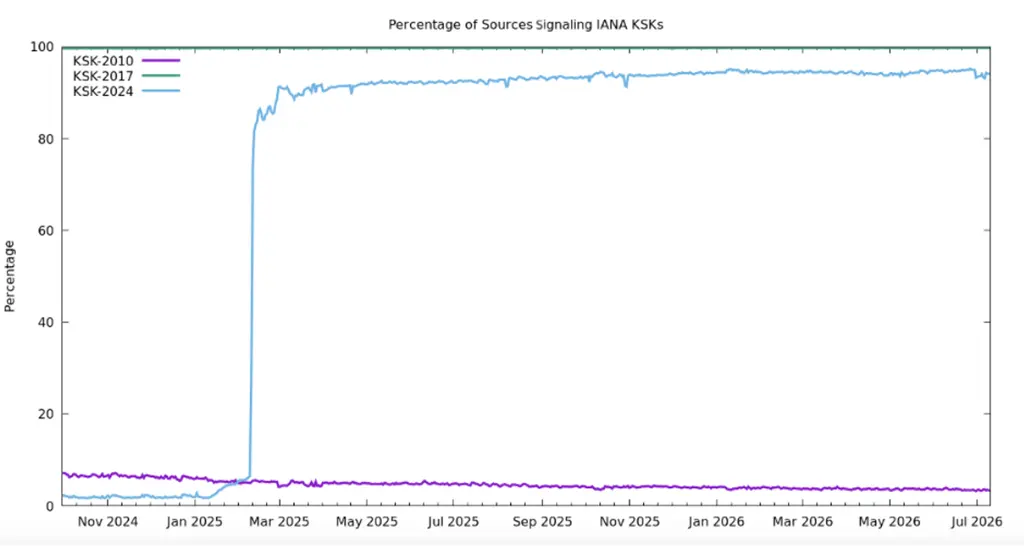
The forthcoming rollover does not involve an algorithm transition; rather, it represents a standard operational rotation of the public and private key pair. The incoming Key-Signing Key, designated as KSK-2024, was published by the Internet Assigned Numbers Authority on its designated repository in July 2024 and subsequently integrated into the root zone’s DNSKEY resource record set in January 2025. Following the necessary observation and hold-down phases, the scheduled transition dictates that the key will actively generate digital signatures for the root zone’s DNSKEY resource records.
To understand the operational readiness of the global internet, network administrators must answer a critical operational question: Have all DNSSEC-validating recursive resolvers successfully discovered KSK-2024 and incorporated the cryptographic material into their trust anchor sets? Assessing this deployment status requires specialized telemetry to peer deep into the foundational architecture of the internet’s recursive infrastructure.
Trust Signals and Measurement Methodologies
Network engineers rely on two primary techniques to evaluate whether recursive resolvers have successfully updated their local trust anchor collections to include KSK-2024.

The first approach stems from RFC 8145, titled "Signaling Trust Anchor Knowledge in DNS Security Extensions." Under this mechanism, individual resolvers embed the cryptographic key tags of their currently trusted keys directly into routine queries dispatched toward the authoritative servers governing the root zone. One deployment method appends the tag values of all trusted keys directly into the query name itself, allowing root server operators to examine incoming traffic patterns and gauge global trust anchor adoption rates. Alternatively, resolvers can encode the trusted key tag values directly within an EDNS key tag option embedded within the query packet.
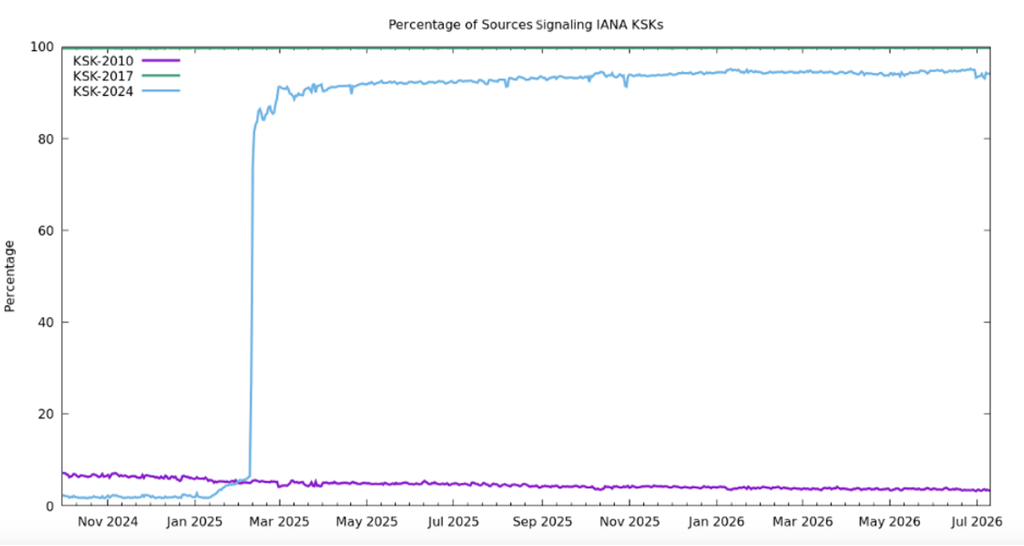
Telemetry gathered from root server logs—such as data compiled by root operator Verisign—provides valuable insight into infrastructural adoption. While these telemetry streams indicate that a vast majority of reporting resolvers have successfully added KSK-2024 to their local trust anchor configurations, raw resolver counts do not directly translate to the actual end-user populations sitting behind them. Certain validating resolvers manage traffic for millions of daily active users, while others serve only a single machine, highlighting the complexity of translating resolver-side metrics into user-impact assessments.
To address the limitations of passive log analysis, RFC 8509—"A Root Key Trust Anchor Sentinel for DNSSEC"—introduces an active measurement approach. This technique folds the telemetry signal back toward the querier rather than forwarding it onward to root zone servers. By utilizing specialized DNS labels, the method forces a validating resolver to evaluate its own internal trust anchor set and construct a specific response based on whether a designated key tag is actively trusted. If the resolver trusts the queried key, it returns a standard response; if it does not, it responds with a server failure status.
Researchers leverage large-scale measurement frameworks, such as APNIC’s ad-based measurement system, to pose these specialized queries to millions of end users daily. Rather than isolating individual recursive resolvers, this methodology quantifies the exact proportion of internet users situated behind DNSSEC-validating resolvers that have failed to adopt KSK-2024.
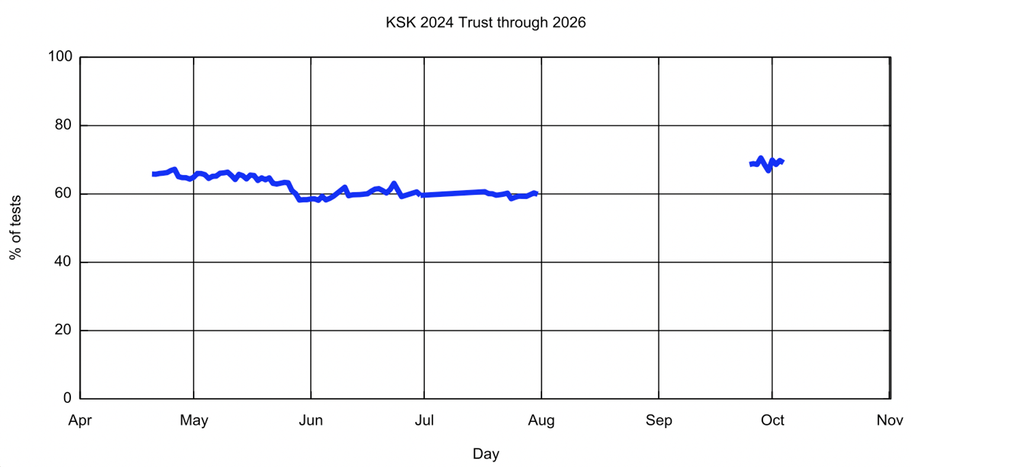
The evaluation relies on a multi-part testing structure. Initial queries determine whether a given resolver supports the Root Key Trust Anchor Sentinel mechanism by checking its trust status regarding legacy infrastructure. Once a resolver’s support is verified, subsequent queries determine whether KSK-2024 has been successfully loaded into its local trust store.
Examining Global Adoption Metrics
Initial small-scale evaluations conducted via RIPE Atlas probes across thousands of distinct autonomous systems demonstrated that a significant portion of tested networks exhibited resolver behavior consistent with successful KSK-2024 integration. However, a small percentage of evaluated probes continued to display behavioral patterns indicating that the incoming key had not been loaded into local trusted key collections.
Broader ad-based measurement campaigns capturing millions of daily tests reveal that a substantial majority of resolvers supporting the sentinel mechanism have successfully incorporated KSK-2024 into their trust anchors. However, aggregate global averages obscure critical regional variations and localized operational lag. A granular examination of the data highlights specific network operators and autonomous systems where trust signal adoption rates remain notably low.
Network telemetry collected from global service providers indicates varying degrees of readiness. Operators spanning diverse geographical regions—ranging from telecommunications providers in Central America and Africa to major broadband networks in South Asia, Europe, and the Middle East—appear prominently among networks with lower rates of KSK-2024 integration. In these specific environments, a substantial share of evaluated test samples demonstrate that recursive resolvers have yet to finalize their trust anchor updates, despite the approaching transition deadline.
Resolvers operating within these lagging networks risk encountering operational friction when the root key rollover takes full effect. Because unready resolvers will fail to recognize the authenticity of signatures generated by the new key, validation failures will inevitably manifest as widespread SERVFAIL responses for end users attempting to resolve domain names across the modern secure web.
Network operators identified with low trust signal adoption are strongly encouraged to review their recursive DNS configurations immediately. Administrators can leverage publicly available diagnostic tools, such as Cloudflare’s dedicated testing interfaces, to evaluate their local infrastructure’s readiness and take corrective action before un-updated trust stores trigger cascading resolution failures for their user base.