

The open-source software community is facing an unprecedented transformation as generative artificial intelligence reshapes how code is written, reviewed, and maintained. According to a comprehensive new research report published by LF Research, the research arm of the Linux Foundation, the rapid proliferation of AI-assisted development tools has introduced significant friction into the ecosystem. While code authoring has become markedly faster for many developers, project maintainers are increasingly overwhelmed by a rising tide of low-quality submissions, often referred to colloquially as AI slop.
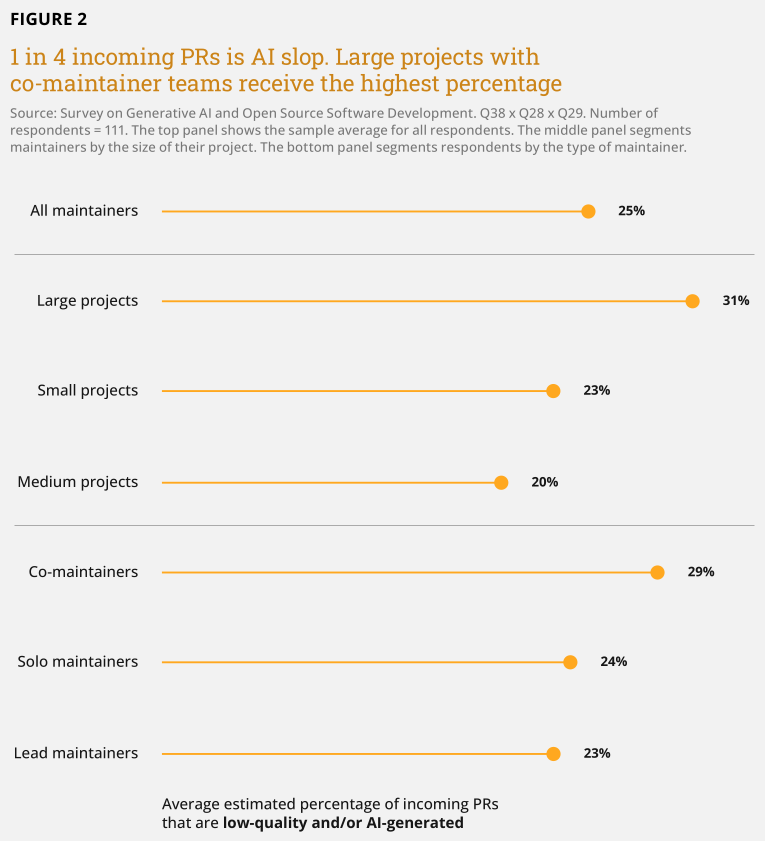
The report, titled Navigating Open Source Software Development in the Generative AI Era, draws on survey data from 234 open-source contributors and maintainers to examine the tangible impacts of generative AI on collaborative software development. Sponsored by Red Hat with additional contributions from OpenSSF, LF AI & Data, and Futurewei, the study attempts to quantify the hidden costs of the AI boom on the global developer community. Among its most striking findings is the estimation that roughly 25 percent of incoming pull requests across surveyed projects consist of low-quality AI-generated code. For larger, more prominent projects, that estimate climbs even higher, reaching an alarming 31 percent.

The Findings
The burden of this automated influx is not distributed evenly across the open-source landscape. According to the research, large projects—defined as those boasting more than 50 active contributors—bear the brunt of the generative AI wave. Among maintainers of these larger repositories, 69 percent report experiencing an increase in incoming contributions, compared to 59 percent across all surveyed projects.
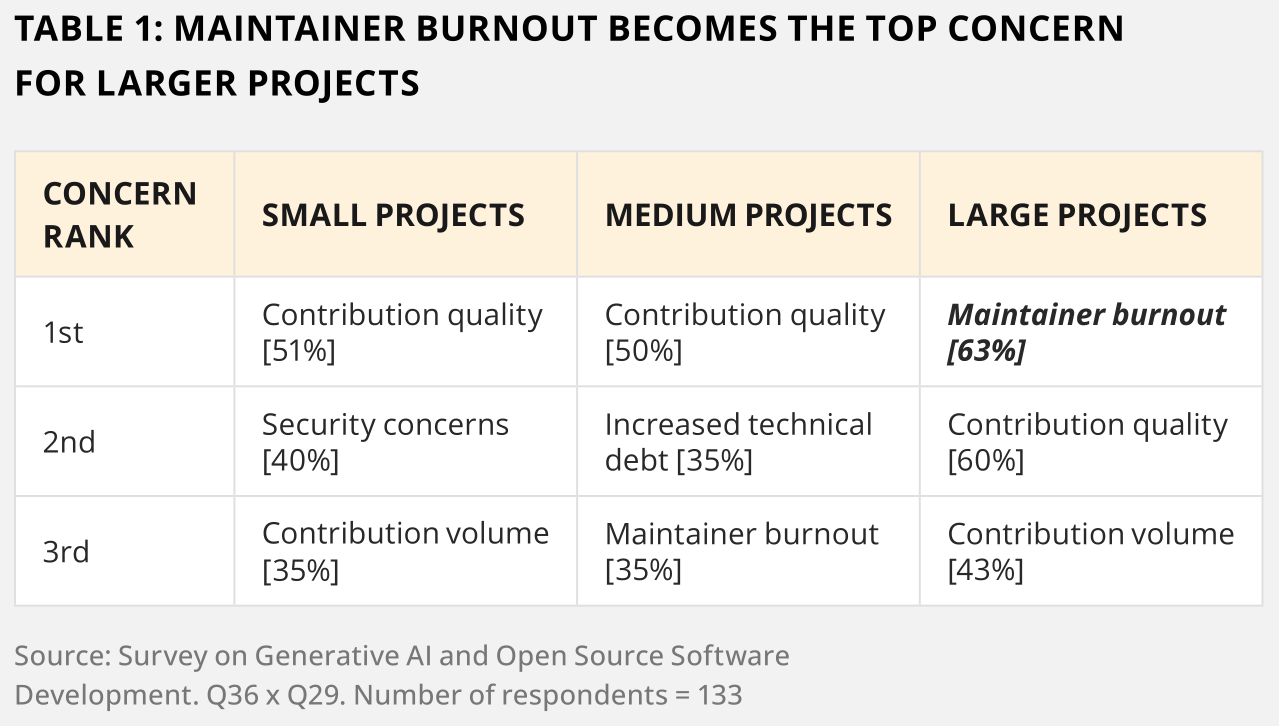
This surge in volume has not translated to increased productivity for project gatekeepers. On the contrary, 64 percent of maintainers managing large projects state that code reviews now take significantly longer than they did previously. Consequently, maintainer burnout has emerged as the single greatest concern for these critical projects, cited by 63 percent of respondents, narrowly edging out contribution quality, which was flagged by 60 percent.

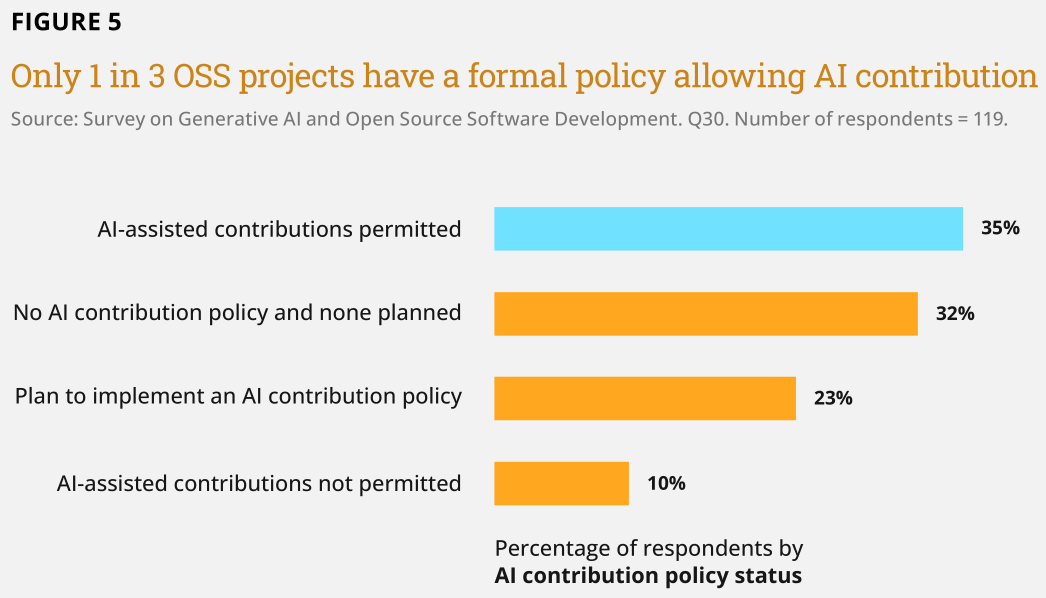
Beyond the immediate administrative burden, the study highlights a profound lag in project governance and policy. Formal guidelines surrounding the use of artificial intelligence and vulnerability reporting have failed to keep pace with rapid technological adoption. Out of the 119 respondents who answered specific questions regarding project governance, only 35 percent stated that their project maintains a formal policy permitting the use of AI. Conversely, 32 percent operate with no policy whatsoever and have no plans to draft one, 23 percent are in the process of drafting guidelines, and 10 percent have chosen to ban AI-generated contributions outright.
This regulatory vacuum leaves projects vulnerable to technical debt and security oversights. Notably, the report reveals that 26 percent of projects possess no mechanism or methodology whatsoever to verify whether incoming contributions were assisted by artificial intelligence. While prominent projects like LLVM have established conditional frameworks allowing AI-generated code under strict parameters, many smaller or mid-sized repositories lack the resources to police incoming submissions effectively.
In response to these challenges, the report urges the open-source community to invest greater effort into establishing clear written policies, mandatory disclosure of AI tools during the contribution process, and rigorous testing and documentation standards.
The Dual Nature of AI Adoption
Despite the administrative headaches and review bottlenecks, the study underscores why developers continue to embrace generative AI tools. For individual contributors, the technology offers undeniable efficiency gains. Respondents estimated that the code authoring phase of development takes 52 percent less time on average when leveraging AI assistants. However, this initial speed comes with caveats; when dealing with more complex architectural tasks, 21 percent of respondents noted that the work actually took longer when AI was involved, likely due to the time required to debug, refactor, or discard flawed suggestions.
The democratization of entry is another prominent theme in the data. A decisive 71 percent of maintainers acknowledge that artificial intelligence makes it easier for newcomers to take their first steps and begin contributing to open-source codebases. By lowering the barrier to entry for syntax and boilerplate code, AI tools can help onboard novice developers more quickly.
Yet, this influx of newcomers has not fostered a deeper sense of community trust. Just over half of the respondents—53 percent—stated that AI has done nothing to improve community trust within their projects, while a meager 13 percent felt that the technology had a positive impact on interpersonal trust and collaboration.
Methodology and Caveats
The findings of the LF Research report are contextualized by specific methodological boundaries. Respondents for the survey were recruited through Linux Foundation newsletters, social media channels, and partner networks, including Red Hat. Furthermore, the widely cited figure that 25 percent of incoming pull requests constitute low-quality AI slop is based on estimates provided by 111 respondents rather than a measured empirical count.
Because disclosure policies remain largely voluntary and a quarter of repositories lack any verification tools, quantifying the exact scope of AI-generated code remains a persistent challenge. The current system relies heavily on the good faith of contributors to disclose their use of AI tools. Experience across various open-source communities—such as recent high-profile security incidents and administrative burdens faced by projects like curl—suggests that bad actors or careless contributors rarely take the extra step to transparently flag low-effort submissions. As the open-source ecosystem navigates this new frontier, maintainers, foundations, and contributors will need to forge new standards to balance the undeniable efficiency of generative AI with the enduring necessity of code quality and community sustainability.


Leave a Reply