India’s digital entertainment landscape is undergoing a massive transformation, driven largely by the explosive popularity of snackable, vertical video content. More than 118 million users now watch microdramas every month across the country, turning serialized vertical storytelling into one of the fastest-growing sectors in digital media. Capitalizing on this sweeping trend, EloElo, the company behind the popular Story TV app, has successfully raised $80 million in a Series C funding round.
Co-led by Hornbill Capital and NBCUniversal, with participation from MIT Investment Co. and existing backers including Play Ventures, Kalaari Capital, Waterbridge Ventures, and Griffin Gaming Partners, the latest financing brings EloElo’s total fundraising to $130 million. The company is now valued at an impressive $500 million, cementing its status as a heavyweight in the rapidly evolving mobile content market.
The fresh capital arrives as serialized, vertical video content enjoys unprecedented global momentum. Platforms hosting bite-sized dramas have taken off across multiple geographies, including the United States, China, and India. The format has even caught the attention of Hollywood heavyweights, with celebrities like Issa Rae, James Franco, and Kim Kardashian investing in and starring in microdramas.
India, boasting a massive internet population exceeding one billion users and an insatiable appetite for entertainment, represents a particularly lucrative battleground. Analysts project that the country’s interactive media and microdrama industry will cross $3 to $4 billion in annual revenue by 2030. Reflecting this shift, dedicated microdrama platforms like Story TV, Kuku TV, and Quick TV ranked among the most downloaded video streaming apps in India over the past year.
Story TV itself has emerged as a dominant force in the ecosystem. Founded in 2020 by former Flipkart executive Saurabh Pandey, the platform has scaled rapidly, boasting a catalog of over 5,000 titles across six languages. According to industry analysts, Story TV commands more than 33 million active users. Pandey notes that the snackable nature of the format keeps users deeply engaged, with the average person logging 95 minutes on the app daily through multiple sessions.
"I fundamentally believe that the next billion users will probably not grow up on a diet of watching television; they will grow up on a diet of watching content on their phones, right? And this content has to be, and this entertainment, designed very differently. It’s not going to be appointment viewing. It’s going to be within certain slots throughout the day. And a lot of this was earlier solved for short clips, but serialized storytelling was never solved," Pandey explained regarding the rise of the microdrama format. While he believes traditional big-screen viewing with family and friends will retain its place, the vast majority of daily entertainment consumption is shifting definitively to mobile devices.
Despite the booming user numbers, operating in the microdrama space comes with distinct hurdles. EloElo and its peers compete directly against tech giants like YouTube, Instagram, and TikTok, where creators post free content, and platforms are actively experimenting with episodic vertical reels. To stand out, Story TV relies on high-production-value storytelling, bolstered by strategic partnerships with major traditional production houses such as Balaji Telefilms to produce original series.
Monetization remains another complex challenge in the Indian market. While audiences readily consume free content supported by advertisements, converting them into paying subscribers is notoriously difficult. According to reports, ad-supported models (AVOD) generate lower yields compared to direct subscriptions. Data from analyst firm Redseer indicates that while more than 40 million people in India have paid for a microdrama at least once, only 15 to 17 million users maintain monthly paid subscriptions. Furthermore, a survey by Ormax Media revealed that 72% of consumers have never paid for microdramas.

To tackle these dynamics, Story TV offers a mix of ad-supported content and flexible subscription plans spanning monthly, quarterly, and yearly intervals to unlock premium episodes.
AI and Other Bets
To maintain a steady supply of fresh content and engage diverse audiences, microdrama platforms are increasingly turning to artificial intelligence. Competitors like Google-backed Kuku are leveraging AI to streamline workflows and boost output, while other players like Dashverse’s Shortfree utilize advanced video AI models to generate serialized clips.
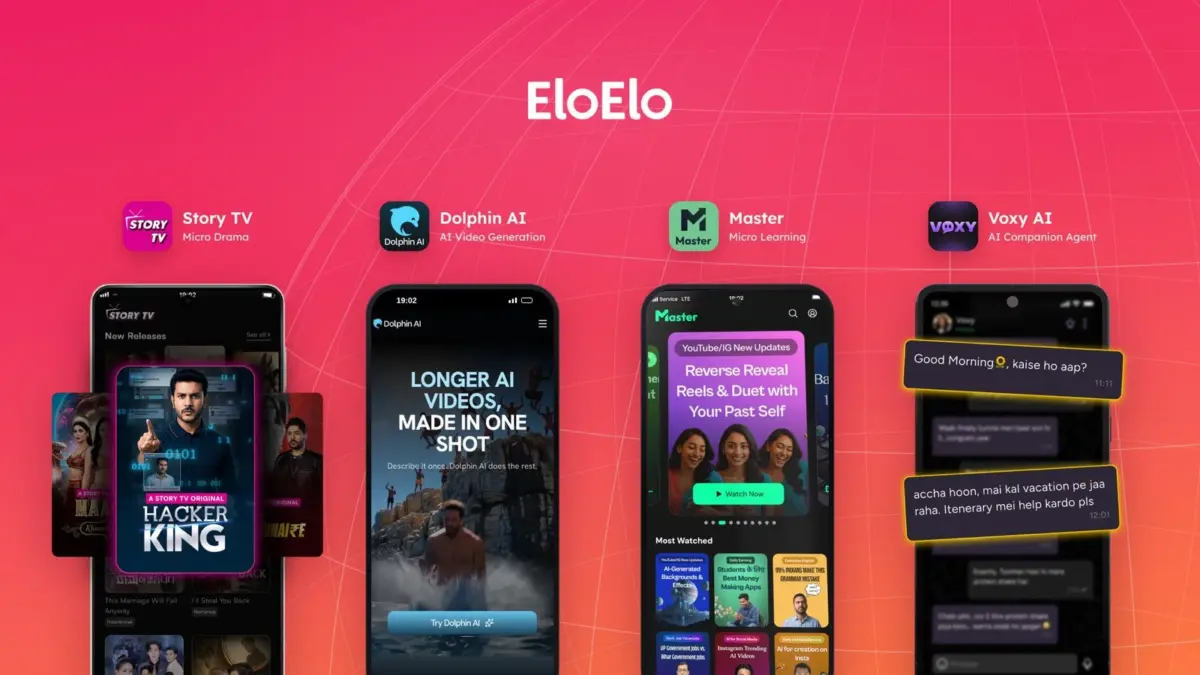
EloElo is approaching the technology through its proprietary Dolphin AI platform. Initially developed as an internal tool to optimize video creation, the company is now preparing to make the platform widely available. Dolphin AI functions as a sophisticated assistant equipped with templates and diverse generative models capable of producing images, audio, and video content. Looking ahead, EloElo envisions brands and marketers utilizing the tool for commercial campaigns and digital advertisements.
Despite the efficiency gains promised by automation, Pandey maintains that human creativity remains irreplaceable in the storytelling process. He views artificial intelligence not as a replacement for human creators, but as a high-performance engine that requires an expert driver.
"My belief in involving AI is that AI is a really fast race car where AI is the engine, but you need an extremely capable Formula One driver to be on the steering wheel. That, for me, is the creative director or the showrunner. AI is supposed to work with them, augmenting their skill set. AI can help write stories, but so far the best stories I have loved have all had a very high human-by-AI element to it," Pandey said.
Beyond its flagship microdrama platform, EloElo’s ecosystem includes Master, a vertical video learning app competing with the likes of Seekho and Kuku’s Guru, as well as an AI companion app called Voxy AI. Combined, the company’s suite of applications attracts more than 40 million monthly active users, with the vast majority concentrated on Story TV.
With a current headcount of 240 employees, EloElo plans to utilize its newly acquired capital to expand its artificial intelligence and machine learning research teams. A significant portion of the Series C funds will also be funneled directly into producing a broader slate of original titles, strengthening the company’s competitive edge as the Indian mobile entertainment market continues its rapid expansion.