The landscape of online copyright enforcement and dynamic site-blocking measures faced a fresh wave of scrutiny following a high-stakes legal battle in Paris. On October 22, prominent DNS resolver Quad9 announced that it would officially halt its services for users located in France. The decision came directly in the wake of a strict Paris court order that compelled the non-profit organization to block a designated list of pirate tennis streaming domains or else face severe daily financial penalties.
The underlying legal mandate, which sports broadcaster beIN Sports successfully obtained in May, began as a targeted directive aimed at just six specific domains. However, in the months that followed, the scope of the order expanded dramatically. By late October, the tally of targeted web addresses had ballooned to 118 domains, exposing systemic challenges regarding transparency, the efficacy of automated enforcement, and the unexpected collateral damage inflicted on unrelated internet infrastructure.
From a Handful of Domains to a Sweeping Blocklist
To understand the rapid growth of the blocklist, researchers turned to public transparency logs, specifically tracking the notices that major technology firms file with the Lumen database upon receiving judicial blocking instructions. The data reveals that the pirate site blocklist—one of many currently active under French jurisdiction—expanded in distinct, rolling batches throughout the year.
The initial May court order introduced six domains. The first major update, reported by Google in mid-June, tacked on an additional 22 domains. Subsequent updates arrived on September 21, October 16, and October 26, each injecting precisely 30 new web addresses into the enforcement pipeline.

A meticulous review of these records indicates that items are rarely, if ever, removed from the active blocklist. Domains that cease to function entirely or become inactive remain trapped under the judicial injunction. According to the timeline established by the courts, these sweeping blocking measures are slated to remain in effect until November 14, coinciding with the official conclusion of the Women’s Tennis Association (WTA) tennis season.
Transparency surrounding these actions remains severely limited, making it difficult for the public, independent researchers, and digital rights advocates to evaluate the exact scope and legal justifications behind individual blocks. Regulatory bodies such as Arcom do not regularly publish granular blocking updates. Consequently, Google’s Lumen notices serve as one of the few publicly accessible records, though they require significant investigative effort to uncover. Later filings frequently omit direct case numbers, forcing researchers to rely on targeted keyword searches and formal requests to view complete domain inventories.
Before the Paris court ruled on the looming financial penalties on October 21, Quad9 had reportedly refrained from implementing the blocks on the disputed domains. This reluctance formed a central component of the foundation’s public statements during the legal proceedings, though it was met with fierce opposition from beIN Sports attorneys.
Expired Domains and Seized Infrastructure Remain Blocked
While internet service providers, online intermediaries, lawmakers, and rightsholders often clash over the overall proportionality and effectiveness of dynamic site-blocking regimes, common sense dictates that blocking a domain no longer associated with infringing material serves little practical purpose. Yet, real-world observations demonstrate that automated blocking mechanisms frequently fail to account for the fluid nature of the internet.

A comprehensive check of all 118 domains on the blocklist conducted from Dutch and French server environments revealed intriguing anomalies. While the vast majority of the listed web addresses continued to resolve to active Internet Protocol (IP) addresses, several notable exceptions stood out.
Four domain names failed to resolve entirely. Among them, predb.click and line.golden-iptv.in had lapsed and were no longer registered, with the latter originally appearing as one of the core six domains in the foundational May court order. Additionally, another domain, 4kib.xyz, had been explicitly suspended by its registrar, while fermin37.com went dark shortly after initial observations in late October.
Other domains revealed the global nature of modern law enforcement actions intersecting with local blocking orders. The domain fr4.sportplus.live began loading a prominent seizure banner indicating that U.S. authorities had targeted the infrastructure in a broader July sweep against illicit sports streaming networks. Another domain on the French list, mgntv-nexon.xyz, pointed directly toward an IP address operated by Sedo, a well-known commercial domain marketplace.
Despite these changes in ownership, status, or active infrastructure, the French blocking apparatus treats them uniformly. Google’s DNS resolver in France blocked 91 of the 118 domains, while NordVPN’s DNS configuration blocked 89, encompassing dead names, expired registrations, and seized properties alike. Domains from the most recent October batch saw slightly lower immediate restriction rates, with only three of those thirty domains blocked within two days of reporting.

Cloudflare presented a notable contrast during the testing period. The company’s widely used 1.1.1.1 public resolver blocked none of the listed domains directly. Instead, Cloudflare complies with French blocking mandates at the Content Delivery Network (CDN) level, an approach that a Paris court formally accepted as a reasonable compliance effort in September.
Standard end-users attempting to navigate to these addresses via conventional web browsers receive generic, opaque error messages indicating that the site cannot be reached, obscuring the underlying mechanism of DNS-level censorship.
Unwitting Ownership and Censored Research Domains
The rigid nature of automated blocklists became even more apparent when researchers acquired control over expired domains previously flagged by the courts. On October 23, two domain names featured on the official French blocklist—rktv.top and ap-live.top—were found to have expired and were freely available for public registration.
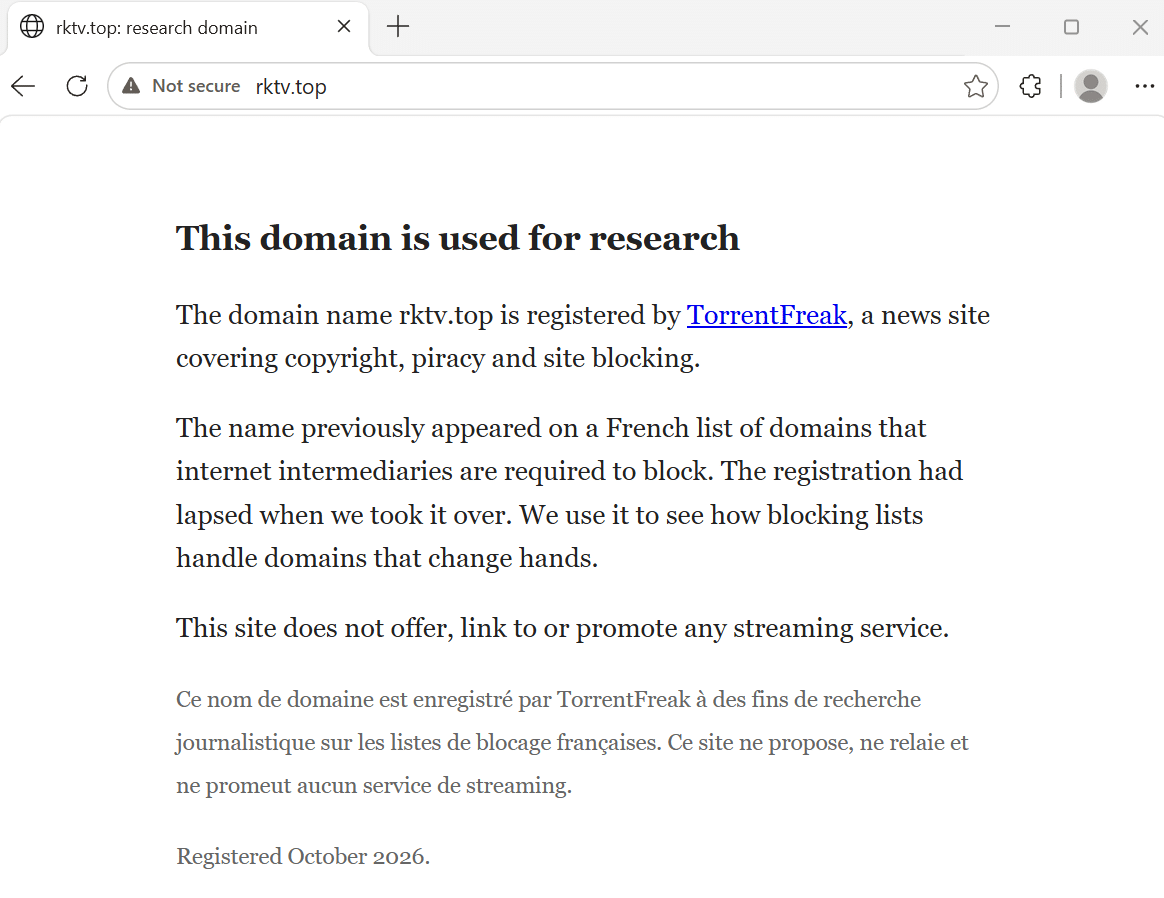
To test the system’s adaptability, TorrentFreak registered both domains, establishing simple, static landing pages that explicitly clarified the new ownership. The notices stated that the domains were held strictly for research purposes and did not host, link to, or promote any streaming services whatsoever.
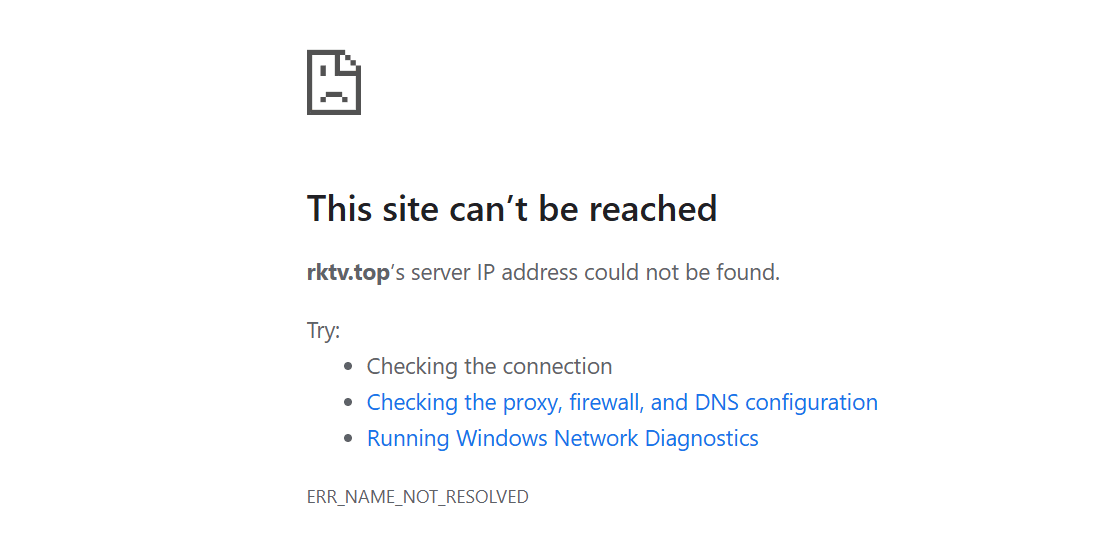
When accessed from the Netherlands, the research pages loaded precisely as expected. Inside France, however, the digital reality was entirely different. Google’s DNS service refused to resolve rktv.top, returning a response explicitly stating that the requested domain was subject to a judicial injunction or governmental blocking order. Crucially, the response carried extended error code 16, categorized within DNS standards as "Censored."
French telecommunications providers utilizing alternative ISP resolvers took the intervention a step further. Queries directed through Bouygues Telecom and Free did not simply result in a DNS refusal; instead, they returned a completely redirected IP address routing visitors to an official government-backed portal designed to promote licensed sports broadcasts. A business provider under SFR echoed the behavior, while Orange resolvers either pointed to the user’s local loopback address or reported that the domain did not exist.
Consequently, individuals typing a domain under independent ownership that hosted a benign research notice were forcibly redirected to anti-piracy messaging without any formal administrative recourse or transparent appeals process for domain holders.
Infrastructure Clues and Future Outlook
An analysis of the underlying network infrastructure hosting the remaining domains on the blocklist provides further insight into the targets of the legal campaign. A substantial majority of the 118 entries point toward a concentrated set of IP addresses located within a single Hong Kong network range. Specifically, 74 domains resolve to addresses that consistently return an unauthorized access error, while an additional 19 domains resolve to a secondary Hong Kong range displaying a standardized premium online service placeholder.
Together, these figures indicate that the vast majority of the judicial blocklist targets a remarkably consolidated backend infrastructure managed by one or two primary streaming operations. Despite the scale of the legal intervention, these operators have routinely demonstrated the ability to spin up alternative domains, maintaining operations with minimal permanent disruption.
Meanwhile, French legislators continue to streamline and expand the national enforcement framework. Recent legislative changes approved by the French Parliament provide a pathway for automated, real-time blocking of unauthorized sports streams during live broadcasts, with regulatory review occurring after the fact, largely devoid of integrated public transparency layers.
As the current court-mandated blocking order approaches its expiration date, questions remain regarding whether the active domains—including the independently held research properties—will be restored to standard routing status or if the enforcement cycle will simply reset with a new generation of domains.