Pay-TV giant DISH Network is pressing forward aggressively in its ongoing legal battle against the operators of the unauthorized Internet Protocol Television (IPTV) service known as DMTN. In recent filings submitted to a New York federal court, the broadcasting corporation has requested a massive $21.15 million default judgment alongside a sweeping permanent injunction designed to dismantle the piracy operation from top to bottom.
The legal proceedings target two primary individuals believed to be the masterminds behind DMTN IPTV: Moroccan resident Idriss Elkasmi and Tunisian resident Makrem Salem. Despite being fully aware of the copyright infringement lawsuit filed against them in the United States, neither man has made a formal appearance in court or mounted a legal defense. Meanwhile, the illicit service continues to operate in plain sight, offering annual subscriptions to customers around the globe and brazenly adapting its infrastructure to evade American copyright enforcement.
The legal crusade began earlier this year in February when DISH Network initiated a copyright infringement lawsuit in New York against the individuals allegedly orchestrating DMTN. In the initial complaint, the pay-TV provider squarely accused Idriss Elkasmi of running the operation, which has also been marketed under alternative aliases such as Idriss Premium TV and Manx TV. Investigators uncovered peculiar details during the preliminary probes, noting that customer payments for the pirate service were processed through a seemingly unrelated online retail storefront named "Genuine Leather." Furthermore, investigators discovered that Elkasmi had briefly swapped his personal Facebook profile picture for a photograph of Vince Gilligan, the acclaimed creator of the hit television drama Breaking Bad.

As the investigation deepened, DISH amended its complaint just a month later to include a second alleged operator, Tunisian resident Makrem Salem. Subsequent filings submitted by the pay-TV provider revealed that a company which previously hosted the service’s server had officially identified Salem as the owner of the account utilized to manage the hosting infrastructure. While the evidence mounted, Elkasmi attempted to push back informally. In an email communication directed to DISH’s legal counsel, Elkasmi argued that he was merely a "freelance website designer," attempting to distance himself from the day-to-day operations of the widespread commercial streaming service.
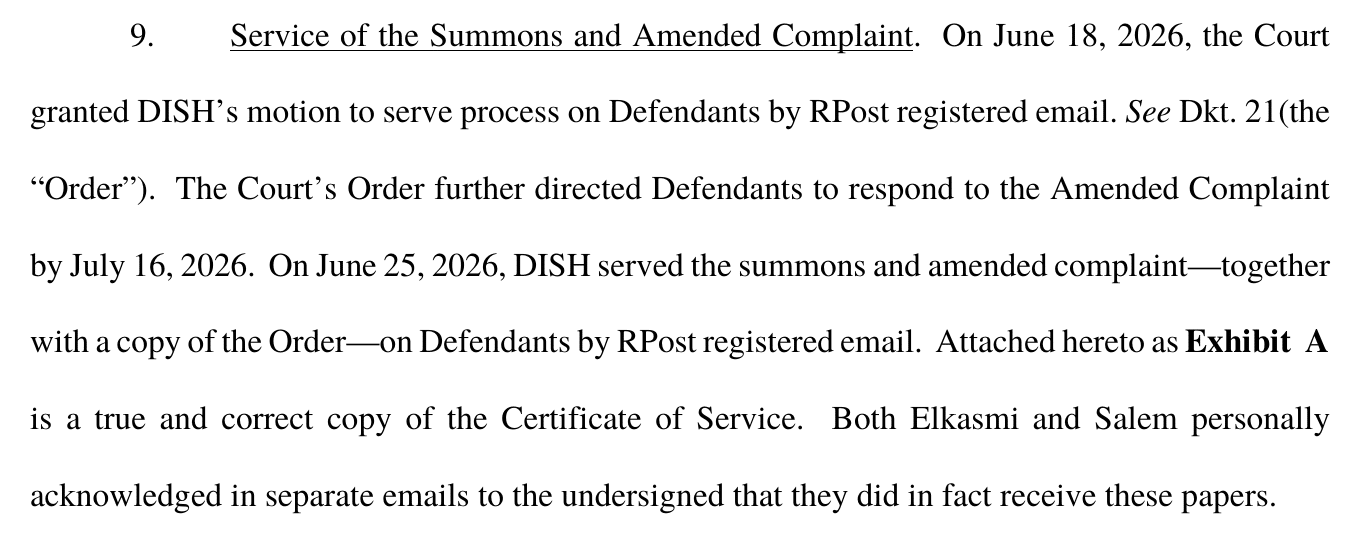
The legal battle entered a new phase in June when the presiding federal court granted DISH permission to serve the summons and the amended complaint upon the defendants via registered email. The court order established a strict deadline of July 16 for Elkasmi and Salem to file a formal response. On June 25, DISH successfully transmitted the required legal documents to the defendants. Both Elkasmi and Salem subsequently confirmed their receipt of the paperwork in separate email messages sent directly to DISH’s lawyer, removing any doubt regarding whether they were properly informed of the pending litigation.
Despite acknowledging receipt of the lawsuit, the defendants completely failed to file any formal responses with the U.S. court. Consequently, the Clerk of Court officially certified their default status in August, paving the way for DISH to seek severe financial penalties. Capitalizing on this procedural milestone, DISH submitted a motion asking the court to translate the default into a binding default judgment. In its legal memoranda, the corporation emphasized that the defendants had shown blatant disregard for American jurisdiction, noting that the infringement continued unabated even after the operators personally acknowledged that they had received the amended complaint.
The operators of the IPTV service did not simply ignore the lawsuit; they actively adapted their digital footprint to survive. According to DISH’s motion, the defendants temporarily disabled their primary website immediately following the initial filing, only to launch a brand-new website equipped with updated features shortly thereafter. Alongside the new web portal, the operators also rolled out a brand-new Android application to maintain uninterrupted delivery to their subscriber base.

Gregory Duval, the CEO of NagraStar—the security firm that investigated the rogue service on behalf of DISH—corroborated the ongoing violations, confirming that the service was still actively streaming the copyrighted channels in question within the United States. In the legal motion, Duval and DISH’s attorneys highlighted the lengths to which the operators go to shield themselves from liability. The motion states that the defendants actively seek to evade the enforcement of U.S. copyright laws by operating from secret locations in Morocco and Tunisia, rotating through an ever-changing network of servers, and utilizing fictitious shell companies with deceptive names such as "Genuine Leather" and "VPS Designs."
Despite the multi-million-dollar lawsuit hanging over their heads, the pirate service remains fully operational and openly accessible online. Recent checks of the DMTN IPTV website revealed that the platform continues to market its unauthorized programming aggressively. The site offered a 12-month subscription package for 70 euros—down from a standard price of 85 euros—while prominently promising prospective buyers "Instant WhatsApp activation."
To put an end to the operation once and for all, DISH is asking the federal court to award the absolute maximum statutory damages permitted under the law. The corporation has requested $150,000 for each of the 141 registered works specifically listed in the complaint, culminating in a staggering total of 21.15 million dollars. Under the proposed judgment, both Elkasmi and Salem would be held jointly and severally liable for the full financial penalty.
In addition to the monetary award, DISH is pursuing a permanent and extraordinarily broad injunction. If approved, the order would legally bar the defendants from offering DMTN IPTV, or any comparable service that retransmits DISH’s proprietary programming, anywhere they may be found. Crucially, the restrictions would also extend to any third parties who receive formal notice of the judicial order, creating a comprehensive legal net intended to cut off the service’s vital infrastructural support systems.
To ensure the technical dismantling of the network, DISH’s proposed injunction explicitly names a wide array of third-party companies, demanding that they take specific actions to sever ties with the pirates. The targeted entities include upstream network providers, web hosts, domain registrars, and customer communication platforms that facilitate the day-to-day business of DMTN.
Among the infrastructure providers listed are Hong Kong-based IPv4 Superhub and ISTQSERVERS, which have been tied to server IP registrations utilized by the network. Major domain registrars and web hosting firms such as GoDaddy, OVH, Hostinger, Key-Systems, Veeble Hosting, and PDR Ltd. are also targeted for their roles in hosting websites and managing domains including dmtn-tv.com, one-x.best, smart-tv.cc, dmtn8k.com, iptv-subscription.com, and smart-iptv.info. Under the terms of the proposed injunction, these registrars would be mandated to immediately disable the listed domains and transfer ownership directly to DISH, while also capturing any future domain names deployed by the operators.
Furthermore, the injunction seeks to disrupt the communication channels that DMTN relies on to interact with its paying customers. This includes targeting Meta-owned WhatsApp for two phone numbers used by the service, Google’s Gmail service for the primary contact email address tied to the operation, and live chat provider tawk.to, which is embedded into the streaming network’s subscription portals.
For the time being, DMTN IPTV continues to conduct business as usual, processing payments, onboarding new users, and streaming copyrighted television content across the internet. Whether the web hosts, domain registrars, and communication giants named in DISH’s sweeping injunction will ultimately be forced to pull the plug depends entirely on the final decision of the New York federal court.