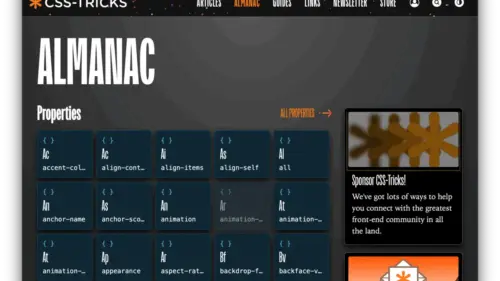
The popular web development resource CSS-Tricks has officially returned under new ownership, bringing with it a comprehensive roundup of front-end developments, design techniques, and platform updates that accumulated during its hiatus. Marking the comeback, the latest edition of the platform’s community update highlights a wide array of advanced capabilities in CSS, HTML, and browser engineering, signaling a dynamic period of innovation for web developers.
Alongside the return of the platform, the organization announced a major shift for its recurring updates. After a four-year hiatus, the CSS-Tricks newsletter is officially making a comeback. Beginning November 10th, these bi-weekly developer roundups will transition directly into the newsletter format, delivering front-end news and web platform updates straight to subscribers’ inboxes.
The revival also arrives with community highlights, including special discounts on prominent educational resources like Mat Marquis’s JavaScript for Everyone course, before diving into a technical landscape that showcases how modern CSS and HTML continue to push the boundaries of what is possible in the browser without relying heavily on JavaScript.
Exploring Background Image Refraction and Custom Borders
Visual styling on the web has taken a significant leap forward, as demonstrated by Preethi Sam, who showcased how to create complex background image refraction effects using pure CSS. The technique produces stunning, animatable visuals that require minimal code and eliminate the need for JavaScript or image duplication. Building on the theme of advanced visual effects, Temani Afif shared a demonstration on custom borders. By utilizing transparent borders alongside the border-shape property and combining background clips restricted to the border area, developers can achieve intricate styling that currently highlights the rapid evolution of layout capabilities in browsers like Chrome.
Layout architecture is similarly undergoing a transformation. Brecht De Ruyte demonstrated the practical application of customizable components using container style queries combined with advanced attr() functions. These interactive demonstrations illustrate how developers can rethink component wiring. Meanwhile, container queries continue to be a focal point for discussion regarding adoption. Victor Ayomipo examined why container queries have experienced slower integration into production environments despite topping developer wishlists for years, arguing that developers often misapply them by treating them like traditional media queries. To bridge this gap, Cory LaViska demonstrated the use of @custom-media alongside container style queries as a robust fallback mechanism.
Advanced Queries and Overlap Detection
The evolution of layout logic is further supported by new query mechanisms entering the web ecosystem. Dan Holloran explored the practical application of scroll-state() queries, covering states such as scrollable, scrolled, snapped, and stuck. This addition allows developers to apply conditional styles based on real-time scrolling behavior with concise syntax.
Addressing complex spatial relationships, Ahmad Shadeed tackled the challenge of detecting overlapping elements purely through CSS. By leveraging anchor positioning, scroll-driven animations, and container style queries, developers can now dynamically adapt elements—such as hiding decorative page graphics the moment they intersect with a section boundary—without relying on rigid media queries or JavaScript listeners.
Animation capabilities are also expanding into unconventional territories. Bramus demonstrated how to animate CSS grid layouts using anchor positioning by anchoring content directly to its corresponding grid cells. As the grid reflows, the content animates fluidly with it, though current implementations face minor rendering bugs in specific browser environments like Firefox.
In an unexpected display of creative problem-solving, Leon Arnott shared a technique for animating the background color of the ::selection pseudo-element. By passing a custom property made animatable via @property from a parent element down into ::selection, developers can bypass traditional limitations that previously prevented smooth color transitions on selected text.
HTML Proposals and Browser Ecosystem Updates
Beyond CSS, the broader web platform is seeing proposals and updates aimed at improving performance and user experience. Patrick Brosset introduced a proposal for the previewsrc HTML attribute, which would allow developers to natively supply lightweight preview images—such as blurry placeholders—for assets that have not yet fully loaded. While the proposal aims to streamline initial page rendering, it has sparked developer discussions regarding whether pseudo-classes like :loaded might offer a more flexible CSS-based solution.
Chris Coyier highlighted a range of lesser-known HTML features emerging in the web ecosystem, while also demonstrating how to use mathematical functions like random() to animate elements along the edges of other components. On the user interaction front, Andy Bell reminded developers of the utility of touch-action: manipulation, a property that disables double-tap-to-zoom behavior on specific interactive targets. Although not entirely new, incorporating this into standard CSS resets helps eliminate accidental zooming issues when users interact rapidly with buttons and controls.
The underlying infrastructure supporting these features continues to accelerate. Major browser engines, including Chrome and Firefox, maintain rapid release cycles, while Safari has introduced alignment with competing engines by shipping overlapping baseline features within matching release windows. As these capabilities standardize across the web platform, developers have a robust set of tools at their disposal to build more responsive, dynamic, and visually sophisticated applications.