The world of PC chassis design has long oscillated between minimalist elegance and aggressive, gamer-centric aesthetics. Recently, manufacturers have begun exploring more adventurous niches, blending industrial design with high-end hardware support. In a market where trends shift rapidly, companies are constantly looking for ways to make their mid-tower offerings stand out on crowded retail shelves and in enthusiast showcases.
Corsair, a veteran in the PC component space, is no stranger to bold enclosure designs. The company’s latest mid-tower offering, the Warthog, brings a distinct military-inspired aesthetic back to the forefront of modern system building. According to expert evaluations by Tom’s Hardware reviewer Joe Shields, the chassis’s rugged, utilitarian looks serve as its primary standout feature, though its overall market position is complicated by pricing and thermal performance trade-offs.
Aesthetic Inspiration and Design Evolution
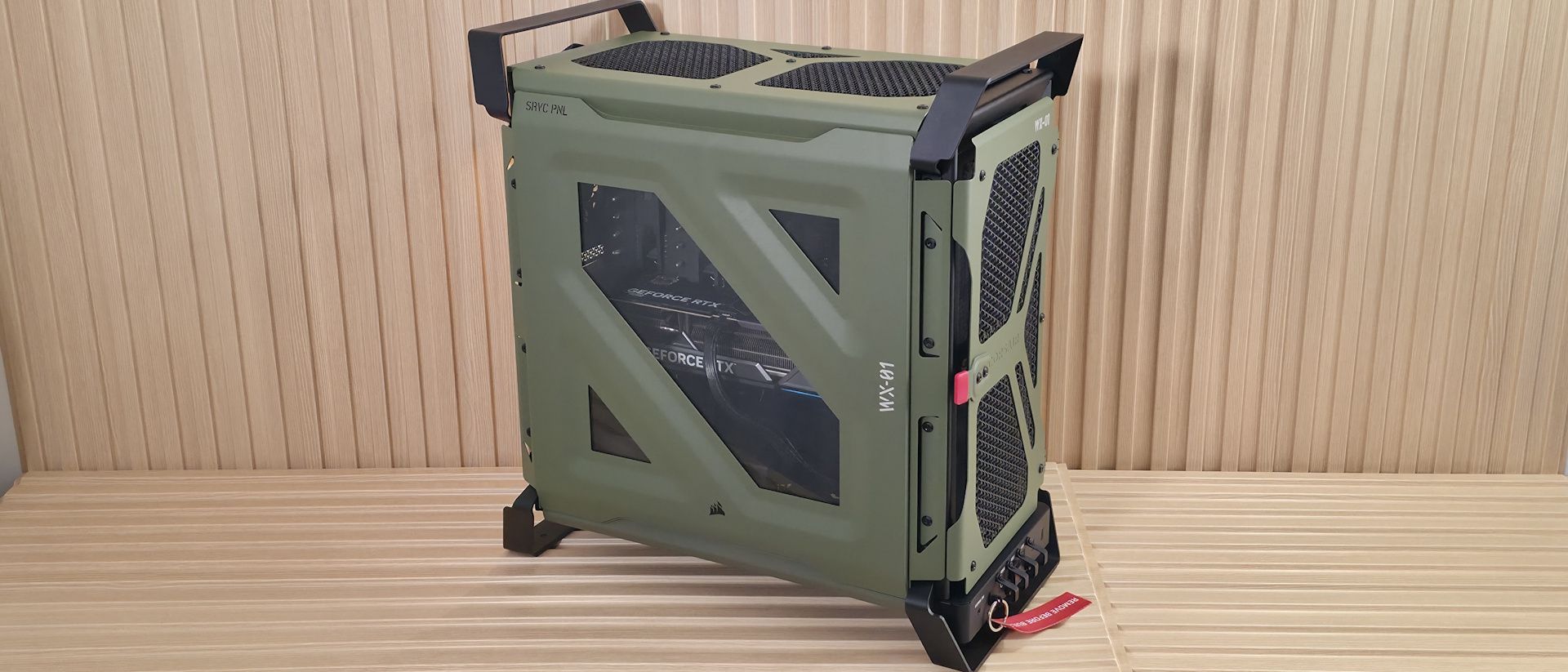
The design philosophy behind the Corsair Warthog draws heavy inspiration from military hardware, specifically bearing a striking resemblance to the fuel canisters, commonly known as jerry cans, frequently mounted on tactical and military vehicles. This utilitarian motif is not entirely new for the brand. The Warthog is based loosely on Corsair’s classic Vengeance C70 case, which originally launched back in 2012.
While the older Vengeance C70 leaned heavily into an ammunition container aesthetic—complete with industrial latches and robust carrying handles—the new Warthog has evolved significantly. It refines those heavy-handed military cues into a much better-looking, highly functional chassis tailored explicitly for today’s oversized, power-hungry components. Available in multiple colorways, the Warthog adapts its tactical theme to fit modern desktop environments without losing the rugged charm that defined its spiritual predecessor.
The appeal of military and industrial aesthetics in PC building often relies on textures, exposed fasteners, and heavy-duty structural elements. Corsair has managed to capture this vibe while ensuring that internal layout clearances, cable management routing channels, and modern front-panel connectivity remain up to date. Enthusiasts looking to build a themed rig featuring camouflage paint jobs, military-grade green or tan color palettes, or custom liquid cooling loops will find that the Warthog provides a striking visual foundation.
The Broader Chassis Market: Wood Accents and Alternative Trends
The launch of the Corsair Warthog arrives at a time when chassis manufacturers are heavily diversifying their visual approaches. While Corsair leans into tactical industrialism, other industry leaders are exploring organic materials and refined architectural styles. Fractal, for instance, arguably kicked off the massive wood accent PC trend with the critically acclaimed North line of desktop cases.
Fractal’s design ethos focuses heavily on blending Scandinavian minimalism with natural elements, a concept the company expanded upon with its new Summit case. According to Fractal, the Summit chassis is explicitly built for expressive, high-performance systems that successfully combine distinctive Scandinavian design aesthetics with advanced cooling potential. To achieve this look, the chassis incorporates FSC-certified wood—timber that has been independently verified to come from responsibly managed, socially beneficial, and economically viable forests—for prominent details such as the front surround and solid wood feet.
However, design trends often come with practical caveats regarding visibility. While cases utilizing natural timber or specialized industrial metals look undeniably striking in promotional imagery, everyday usability depends heavily on the chosen color SKU. For example, while light-colored variants allow wood accents to pop dramatically against contrasting panels, those same details can easily blend into darker finishes, such as the Blackout SKU tested by hardware reviewers. Similarly, the Warthog’s military styling demands careful consideration of workspace aesthetics, as its aggressive profile will either dominate a room or fit seamlessly into a dedicated gaming den depending on the chosen colorway.
Performance, Pricing, and the Tom’s Hardware Verdict
When it comes to putting high-end hardware inside a mid-tower enclosure, looks can only carry a product so far. Thermal efficiency, acoustic profiles, and value for money ultimately determine whether a case earns a recommendation from hardware critics.
In the case of the Corsair Warthog, rigorous testing reveals a nuanced picture. Tom’s Hardware reviewers spent hours testing and comparing the chassis against competing mid-towers to evaluate how well it handles modern components. The verdict highlights that while the Warthog’s rugged military looks are undeniably the standout feature of the mid-tower, a couple of significant factors keep it from soaring effortlessly above the rest of the market.
Specifically, reviewers noted that the chassis comes with a higher price point compared to some direct competitors, forcing buyers to pay a premium for its unique aesthetic. Furthermore, when evaluating noise-normalized cooling performance—particularly regarding how well the case handles heat dissipation from powerful modern video cards without ramping up fan noise to distracting levels—the Warthog delivers mixed results. While it is fully capable of housing high-end graphics cards and multi-fan cooling arrays, users chasing the absolute lowest temperatures or quietest operation may find themselves wishing for optimized airflow paths or more competitive pricing.
Ultimately, prospective builders must weigh these performance and financial trade-offs against their desire for a military-themed enclosure. For enthusiasts who prioritize a rugged, fuel-canister-inspired aesthetic over pure thermal dominance or budget optimization, the Corsair Warthog offers a compelling throwback design modernized for contemporary gaming rigs. As testing standards continue to evolve at publications like Tom’s Hardware, chassis evaluations ensure that consumers have access to transparent, rigorous data to help them choose the absolute best hardware environment for their personal setups.