

Canonical continues its methodical modernization of the Ubuntu operating system, turning its attention toward core cryptographic tooling. In the newly released Ubuntu 26.10, codenamed "Stonking Stingray," the distribution has quietly integrated Sequoia PGP directly into its main software archive. This development marks the preliminary step in a broader long-term ambition by Canonical to eventually supplant the aging, C-based GnuPG utility with a modern, memory-safe alternative written entirely in the Rust programming language.
While the new implementation is preinstalled on development builds of Ubuntu 26.10, the traditional GnuPG toolchain remains firmly in place as the active default for users. Canonical has emphasized that transitioning foundational components of a major Linux distribution requires extensive evaluation, testing, and multi-release integration phases to ensure absolute stability and security for millions of global users.
Understanding OpenPGP and Its Traditional Linux Implementation
To understand the significance of introducing Sequoia PGP, it is necessary to examine the foundational standards governing secure communications on modern operating systems. OpenPGP is not a software application in its own right, but rather a widely recognized and globally adopted open standard for encryption. The genesis of Pretty Good Privacy traces back to 1991 when Phil Zimmermann introduced the original architecture. Today, the Internet Engineering Task Force maintains the open specifications that dictate how independent software solutions must handle data encryption, decryption, digital signing, and signature verification.

For decades across the Linux ecosystem, GnuPG has served as the dominant implementation of the OpenPGP standard. Authored in the C programming language and adhering to the RFC 4880 specifications, GnuPG provides the familiar command-line utilities gpg and gpgv. These tools have long managed everything from complex public key infrastructures and encrypted local storage to standalone digital signature verification for software repositories and developer communications. However, as software engineering paradigms shift toward memory safety to mitigate vulnerabilities inherent in legacy codebases, distributions like Ubuntu are increasingly exploring alternatives.
Sequoia PGP: A Modern Rust-Based Alternative
Sequoia PGP represents a fundamental departure from the monolithic C architecture of older cryptographic tools. Initiated in 2017 by a team of former GnuPG developers, the project was conceived to build a modern OpenPGP implementation from the ground up using Rust. Rather than attempting to patch or refactor decades-old C codebases to address modern security requirements, the creators designed Sequoia PGP as a modular library that other applications can integrate directly.
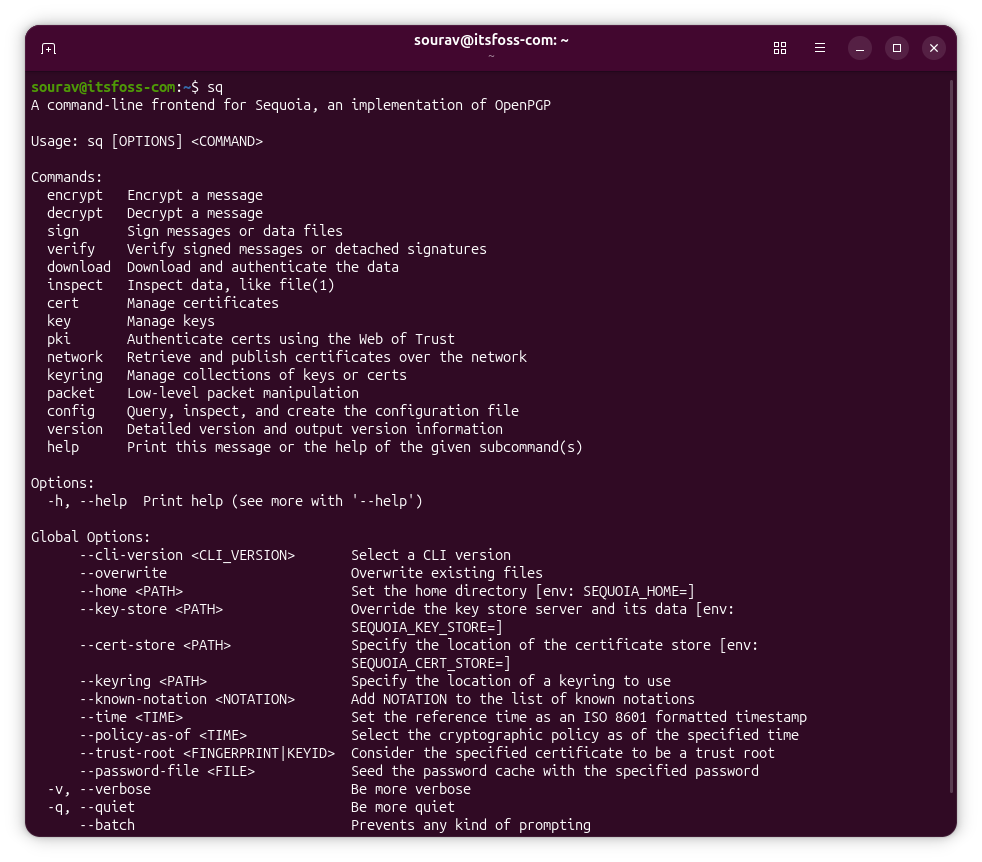
To replicate the capabilities of traditional command-line interfaces, Sequoia PGP provides specific tools. The sq utility acts as the primary interface for encryption, decryption, signing, and comprehensive key management, while sqv is dedicated exclusively to high-performance signature verification. These utilities serve as the functional equivalents of GnuPG’s gpg and gpgv commands. Furthermore, Sequoia PGP implements RFC 9580, the modern 2024 revision of the OpenPGP standard. In contrast, GnuPG has continued its development along the RFC 4880 branch, pursuing independent extensions and the LibrePGP specification rather than fully adopting RFC 9580 as its primary baseline standard.

Current Integration Status in Ubuntu 26.10
With the arrival of Ubuntu 26.10, Sequoia PGP has officially transitioned into the mainstream infrastructure of the operating system. Users examining the default package pools within the main archive will find the software preinstalled, categorized under the rust-sequoia namespace. Testing on current development builds confirms that both the sq and sqv commands are fully functional out of the box, allowing developers and administrators to experiment with the new toolset immediately.
Despite this inclusion, the daily user experience remains unchanged. When a user executes commands like gpg or gpgv in the terminal, the system continues to route those requests directly to GnuPG. Both OpenPGP implementations currently coexist peacefully within the operating system environment. Canonical has not yet flipped the switch to make Sequoia PGP the default backend for these standard commands. Should Canonical eventually decide to promote Sequoia PGP to the default status, the underlying system aliases and command routing tables would be modified to point to the Rust equivalents, mirroring the careful approach previously observed with other foundational system components.
A Measured Approach to Rust Integration
The path toward making Sequoia PGP the default OpenPGP toolchain for Ubuntu is expected to be gradual. Canonical’s official release notes for Ubuntu 26.10, alongside accompanying platform announcements, explicitly frame this inclusion as a long-term goal rather than an immediate operational change. Transitioning core system architecture is a meticulous process that Canonical handles with extreme caution, ensuring that new utilities mature over multiple release cycles before assuming primary responsibilities.
This deliberate pacing is consistent with Canonical’s broader Rust migration strategy across the Ubuntu ecosystem. The migration of coreutils components began in 2025 and only reached complete implementation with the release of Ubuntu 26.10. Similarly, the transition involving sudo-rs was previewed, tested, and vetted well in advance before it became the default behavior for system administrators.
Landing within the main archive represents the crucial first milestone for Sequoia PGP on Ubuntu. Whether this modern Rust implementation ultimately supersedes GnuPG as the default cryptographic standard across the entire distribution will depend on ongoing performance evaluations, community feedback, and rigorous stability testing in the cycles ahead.



Leave a Reply