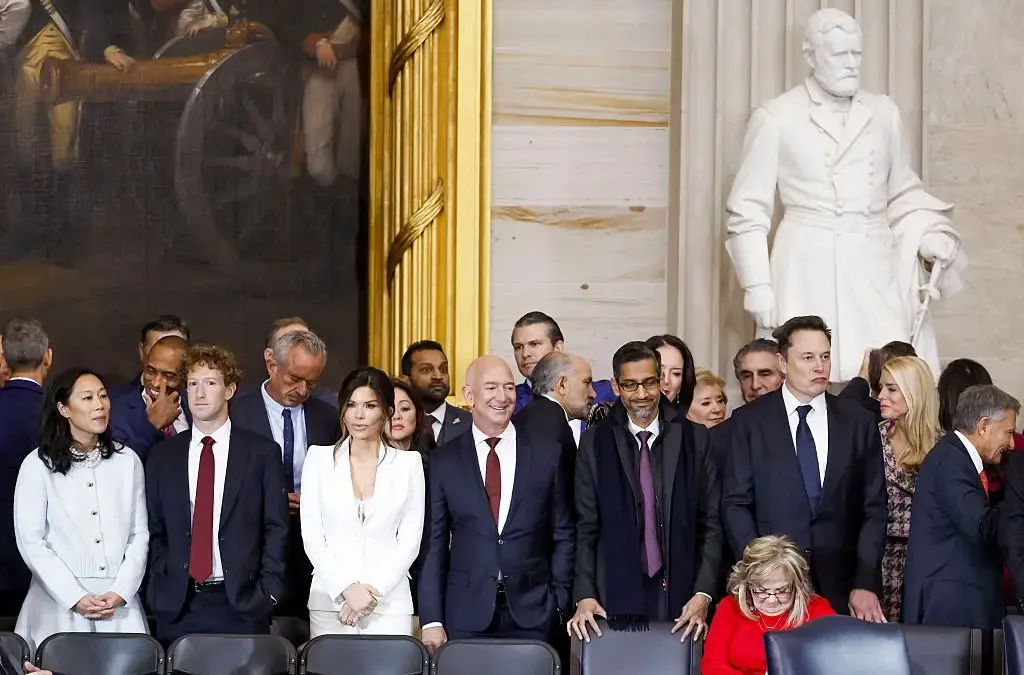
In the shadow of a shifting political landscape following the midterm elections, Silicon Valley’s tech giants are scrambling to recalibrate their relationships in Washington. For the past two years, the industry’s most prominent leaders enjoyed a largely accommodating federal environment under President Donald Trump, marked by favorable tax breaks, the pausing of select federal investigations, and significantly looser artificial intelligence regulations. During that period, many prominent executives aligned themselves closely with the administration, attending White House events, scaling back internal diversity, equity, and inclusion initiatives, and funneling millions of dollars into super PACs backing the president and his allies.
Yet, as the midterm elections alter the balance of power in the nation’s capital, major technology companies are actively working to mend fences with Democrats, who have pledged to institute rigorous oversight of artificial intelligence and hold Big Tech accountable.
The strategic shift has already manifested in subtle yet telling corporate maneuvers. Right before the midterm elections, OpenAI hired Jessica Schumer—the daughter of Democratic Senator Chuck Schumer—signaling a renewed push to build bridges with influential congressional Democrats. Simultaneously, OpenAI announced plans to rebrand its massive data centers as "compute campuses," a pivot aimed at softening the industrial image of facilities that have increasingly sparked local pushback.
Industry critics, however, view these moves with deep skepticism. J.B. Branch, director of federal AI governance and technology policy at Public Citizen, a nonpartisan nonprofit advocacy group, argued that the tech sector is grappling with a severe reputation crisis. He characterized recent corporate actions, such as the Schumer hire and facility rebranding, as nothing more than "PR washing."
Branch noted that these cosmetic changes are part of a broader, calculated trend of private-public partnerships designed to buy goodwill. He pointed to OpenAI’s previous partnership with the American Federation of Teachers, alongside Anthropic’s newly launched Claude Corps and Meta’s America’s Workforce Academy, as prime examples of corporations attempting to embed themselves within labor and workforce development initiatives. "I would imagine more of that sort of investment in these corporate, private-public partnerships," Branch said.
These strategic overtures did not materialize overnight. According to reports, Meta and other major tech firms began exploring ways to reinforce their ties to the Democratic party as early as polling data indicated likely Democratic gains in the midterms. When reached for comment regarding the impact of the midterm elections on Meta, a company spokesperson directed inquiries to remarks made by Meta President Dina Powell McCormick at the WSJ Tech conference.
"You have to work with the government that the American people elect," McCormick told the audience. "I have seen it across the board that you have to be bipartisan, and you want to be, because you want buy-in on the things that you’re trying to do."
Despite these diplomatic overtures, experts remain doubtful that a sudden charm offensive will completely shield the industry from incoming legislative pressure. Alice Marwick, director of research at the tech policy nonprofit Data & Society, suggested that while Big Tech is attempting a strategic pivot back toward the political center—or even the left—the effort may be too little, too late.
"Tech companies should be asking themselves how their products can make people’s lives better, because right now, it doesn’t seem like they are," Marwick said.
If congressional Democrats follow through on their campaign promises to tighten oversight of artificial intelligence and large technology platforms, the sector could face a considerably harsher operational climate. At the state and local levels, resistance is already mounting. Data center moratoriums are gaining notable traction as communities push back against the immense water and electricity demands of AI infrastructure, and a substantial wave of new AI regulation bills awaits drafting in various state legislatures.
Addressing these local tensions at the WSJ Tech event, Powell McCormick stated that Meta aims to demonstrate that communities welcoming its massive investments will experience "an enormous amount of benefit." At the same time, she conceded that municipalities opting out "will of course have the right to stop them."
Yet, even with a shift in congressional momentum, the next two years could easily devolve into political gridlock in Washington, potentially stymying major federal legislative overhauls. Aryan Ranjan, founder of Baraza, a political campaign management software company, believes that the most consequential battles will continue to be fought at the state level, where local governments have already demonstrated a willingness to sue tech companies and pass independent regulatory statutes.
"A coalition built on newer, working-class voters is likely to push Democrats to frame AI around electricity bills, data-center siting and jobs rather than abstract AI safety," Ranjan said, describing the likely contours of future federal policy debates.
The tension between federal deregulation and state-level enforcement has been a defining feature of the current political ecosystem. Last December, the Trump administration signed an executive order establishing the AI Litigation Task Force, a federal body specifically created to challenge state-level AI laws. The administration has consistently maintained that U.S. artificial intelligence companies must remain unhindered by cumbersome regulations to preserve global technological dominance. Despite these federal pushbacks, numerous states have successfully enacted their own localized statutes, focusing heavily on consumer protection, chatbots, and deceptive deepfakes.
It remains to be seen how President Trump will navigate the changing legislative environment, particularly whether he will issue additional executive orders concerning artificial intelligence or deploy his veto pen against congressional bills viewed as hostile to the industry. What remains clear, however, is that voters across the political spectrum are increasingly demanding stronger guardrails and accountability measures for rapidly evolving technologies.
In a formal statement provided to reporters, a White House official defended the administration’s overarching posture: "American leadership in super intelligence is essential for our national security, economic prosperity, and the quality of life of the American people. President Trump is committed to ensuring America continues to lead the world in super intelligence while protecting American consumers. As the President has said, he’s willing to work with anyone to continue delivering victories for hardworking Americans."
Compounding these political headaches are macroeconomic pressures. Branch noted that the political fortunes of the current administration are now inextricably linked to the volatile trajectory of the AI industry. Following the midterm elections, a trillion-dollar market sell-off sent shockwaves through Wall Street and unnerved investors, some of whom are reportedly rethinking their financial backing for Anthropic’s heavily anticipated trillion-dollar initial public offering.
"There’s a very strong likelihood that there will be an AI bubble pop, and it’ll happen on Trump’s hands," Branch warned, predicting a potential market correction. "Does he want to sink or swim along with the AI industry?"
As the dust settles from the midterms, technology companies are confronting a fragmented regulatory reality where federal goodwill may no longer be enough to insulate them from regional pushback. For the foreseeable future, industry analysts suggest that corporate compliance strategies will be dictated less by federal policy pronouncements and more by local geographic battles.
"For the next two years, a company’s AI rules may depend more on where it operates rather than on anything Washington passes," Ranjan concluded.