
Over the past three years, the legal landscape surrounding artificial intelligence has been defined by a relentless series of high-stakes lawsuits. Authors, publishers, and creators have increasingly challenged major technology firms, accusing them of training advanced machine learning models on vast repositories of pirated books without permission or compensation. While some of these judicial battles have already yielded mixed results—such as a bittersweet fair use victory secured by Meta in California—a massive consolidation of cases is currently playing out in a New York federal court under the watchful eye of Judge Sidney Stein.
This sweeping federal proceeding brings together several prominent legal challenges directed against OpenAI and its primary financial and technological backer, Microsoft. Among the bundled actions are the Authors Guild’s major class action lawsuit, a pioneering complaint filed by a dedicated group of nonfiction writers who originally stood out as the first to name Microsoft as a direct defendant, and the closely watched Tremblay and Silverman lawsuit. The latter case originally commenced in California back in 2023, successfully navigated a partial dismissal phase, and was subsequently transferred to New York to be considered alongside the broader docket.
This week, the plaintiffs in these consolidated actions took a decisive step by filing a comprehensive motion for summary judgment. Ahead of any formal trial proceedings, these authors are asking Judge Stein to issue a definitive ruling establishing that OpenAI unlawfully copied their protected literary works without authorization, and that this wholesale ingestion cannot legally qualify as fair use under copyright law. The newly filed motion encompasses 194 specific book titles and specifically seeks a formal finding of liability rather than monetary damages at this stage.
The legal brief paints a grim picture of the current literary ecosystem under the shadow of rapid technological advancement. "OpenAI’s GPT models pose an existential threat to those who write and publish books," the legal filing states, emphasizing that "AI-generated books of all types are already flooding the market."
Built on Mass Piracy

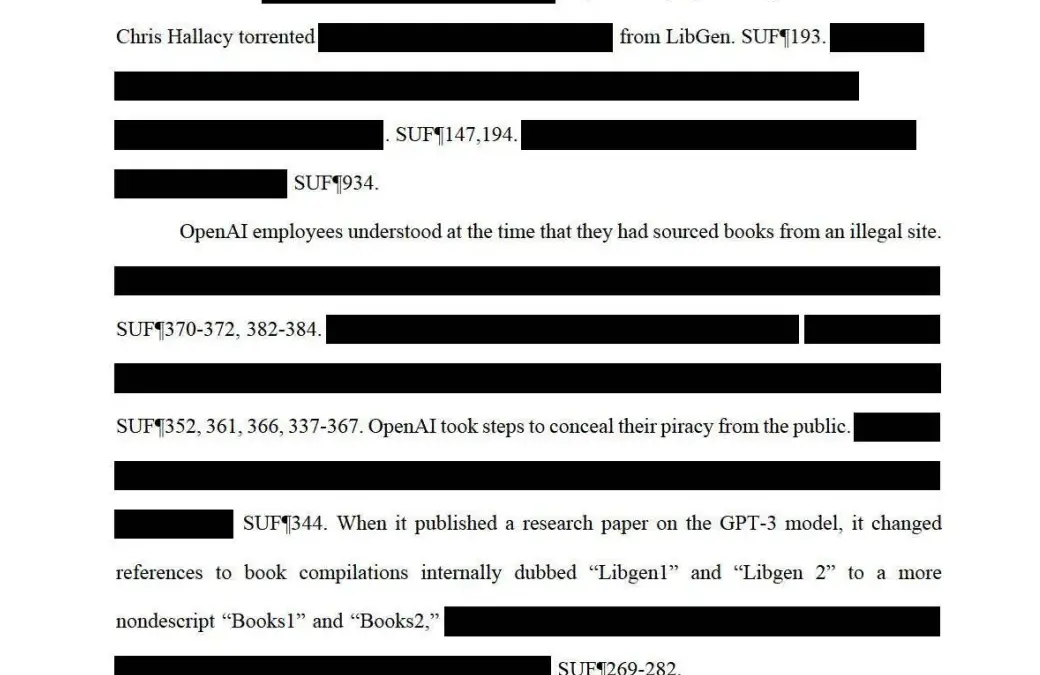
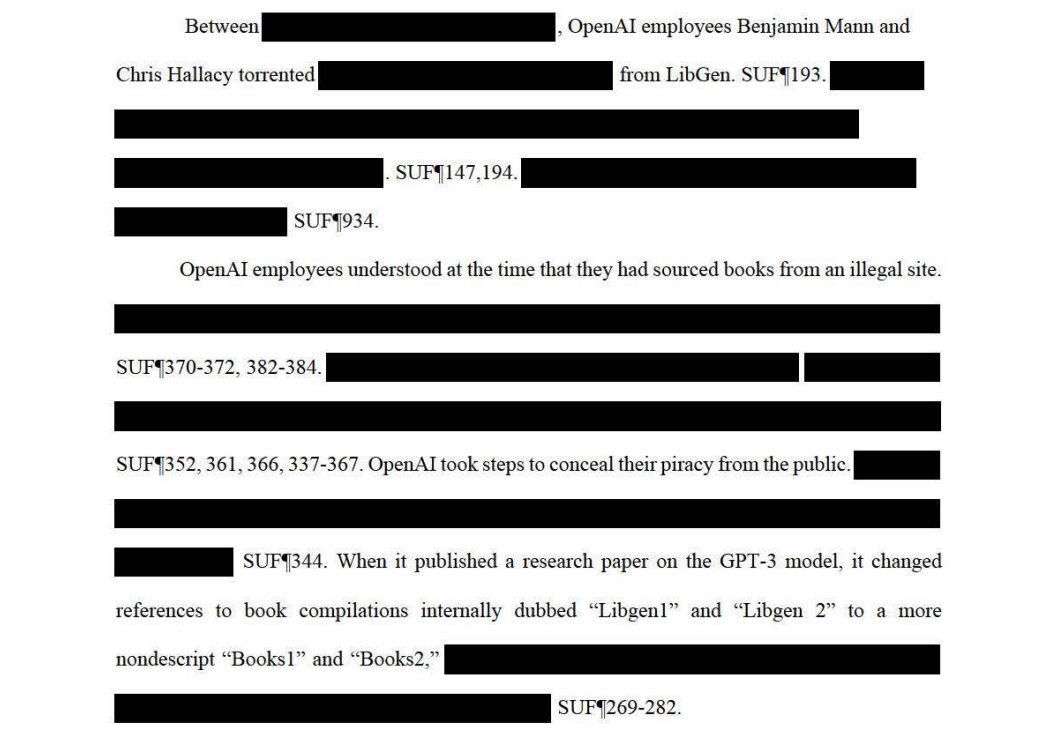
At the core of the plaintiffs’ argument is the accusation that OpenAI obtained its extensive training data through blatantly unauthorized and illicit channels. Although significant portions of the legal filing remain heavily redacted to protect proprietary or confidential materials, the documents explicitly accuse OpenAI of utilizing torrented copies of books downloaded directly from Library Genesis, a notorious and illegal digital shadow library widely known as LibGen.
"OpenAI did not even buy the books it used. Instead, it began by torrenting [REDACTED] books from the notorious and illegal pirate library Library Genesis, also known as LibGen," the motion declares.
At the time OpenAI allegedly harvested these materials, LibGen had already been formally identified and targeted by the Office of the United States Trade Representative, appearing prominently on its annual list of notorious piracy markets. According to the plaintiffs, leadership and engineering teams at OpenAI were fully aware of the highly controversial and illegal nature of the platform when they elected to pull data from it.
Furthermore, the motion alleges that the artificial intelligence developer actively "took steps to conceal their piracy from the public." To support this assertion, the authors point to the original academic research paper published by OpenAI to introduce the GPT-3 model. In that documentation, OpenAI allegedly relabeled internal book datasets that had previously been designated within their own systems as "Libgen1" and "Libgen 2," changing the nomenclature to the far more nondescript and obscure labels of "Books1" and "Books2."
"OpenAI employees understood at the time that they had sourced books from an illegal site," the filing notes, highlighting an internal awareness of the questionable provenance of the training materials.
The attempts at obfuscation did not stop with mere renaming conventions. According to the motion, OpenAI ultimately "deleted its LibGen files in the summer of 2022 due to legal concerns," marking these specific repositories as "the only two training corpuses OpenAI has ever deleted" in the history of the company’s data collection efforts. Before purging the files, however, OpenAI allegedly relied on them heavily to construct the foundational architectures of its early generative pre-trained transformer models. In the blunt assessment of the authors, the company essentially "built the foundations of its business on mass piracy."

Replacing George R.R. Martin
While the allegations concerning torrenting and illicit downloading form a crucial pillar of the legal challenge, the motion also tackles the broader corporate philosophy and long-term economic goals driving the company. The plaintiffs argue that OpenAI deliberately engineered its models with the express intention of displacing the human authors whose works were ingested to train them. To substantiate this claim, the filing highlights controversial and publicly visible statements made by a key member of OpenAI’s technical staff.
In 2022, OpenAI brought Tarun Gogineni on board to lead specialized development work aimed at dramatically improving the creative writing capabilities of its models. According to the summary judgment motion, Gogineni was fully aware that the systems he was actively training would inevitably undermine and replace professional authors, yet he viewed that displacement as merely "acceptable economic disruption."
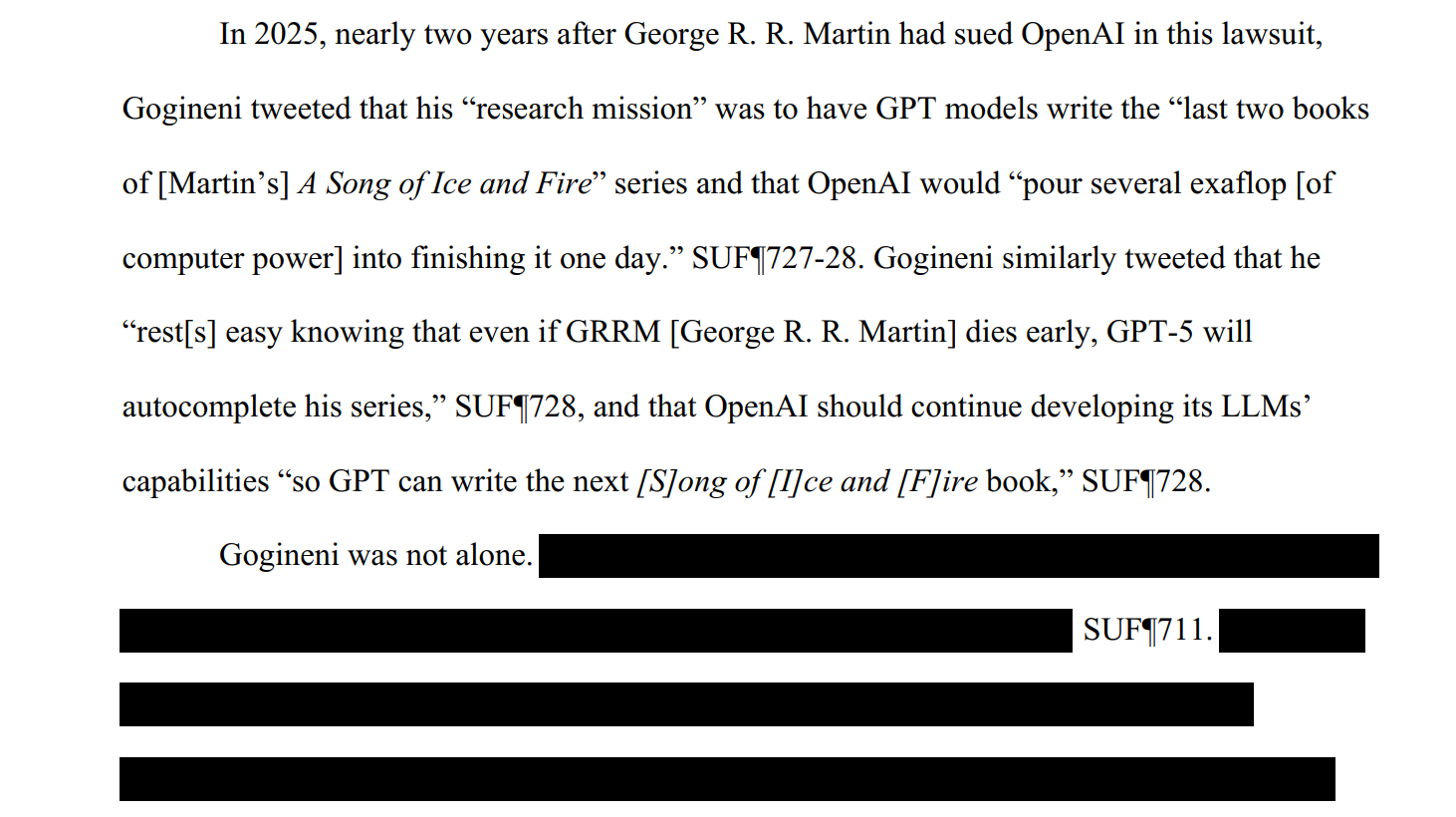
This aspect of the filing carries particular weight because Gogineni specifically singled out one of the named plaintiffs in the litigation: renowned author George R.R. Martin, celebrated globally for writing A Song of Ice and Fire, the epic fantasy book series that inspired the blockbuster HBO television adaptation Game of Thrones. Nearly two years after Martin formally joined the copyright infringement lawsuit, Gogineni took to social media platform X, formerly known as Twitter, in 2025 to outline what he described as his ultimate "research mission."
Gogineni publicly stated that his goal was to develop and train GPT models capable of independently writing the "last two books of [Martin’s] A Song of Ice and Fire." Even if Martin were to "die early, GPT-5 will autocomplete his series," he added in the same post, explicitly suggesting that artificial intelligence could effectively substitute for human creativity and permanently replace the original creator.
Not Fair Use
The central legal debate in this case, much like parallel litigation across the tech and publishing sectors, revolves around the doctrine of fair use. OpenAI and other major artificial intelligence firms have consistently maintained that training large language models on copyrighted books constitutes transformative fair use permitted under federal copyright law. While federal courts handling similar disputes have shown some sympathy toward the general concept of training AI models on public data, they have also introduced critical caveats that threaten the tech industry’s core defenses.
In their motion, the authors invoke the recent 2025 ruling in Bartz v. Anthropic, a California copyright case that established model training as a potentially fair use activity under specific conditions, while simultaneously drawing a sharp line regarding the sourcing of materials. That court found that downloading copyrighted books from unauthorized pirate repositories when legal purchasing options are readily available is "inherently, irredeemably infringing." Building upon this precedent, the plaintiffs argue that the massive copying undertaken by OpenAI was entirely avoidable for general training purposes, emphasizing that their specific books were never strictly or legally necessary to construct a general-purpose language model.
Broader Claims
The legal scope of the newly filed motion extends beyond OpenAI itself, taking direct aim at its powerful corporate partner. The authors are asking Judge Stein to rule that Microsoft bears vicarious liability for OpenAI’s alleged copyright infringement. The legal theory rests on the premise that Microsoft possessed both the capacity and the legal right to supervise the conduct of OpenAI while simultaneously reaping massive financial rewards from the commercial exploitation of the resulting technology.
To underscore Microsoft’s deep integration and financial stake in the enterprise, the authors point to the massive capital investments made by the tech giant, totaling approximately $13 billion distributed across three major strategic partnership agreements signed in 2019, 2021, and 2023.
While OpenAI has not yet formally responded directly to the plaintiffs’ latest arguments in court filings, the company’s overarching legal stance remains firmly entrenched. In a corresponding cross-motion for summary judgment filed simultaneously, OpenAI contends that its utilization of copyrighted books qualifies as fair use as a matter of law, arguing further that instances of models generating recognizable regurgitations of protected text are vanishingly rare.
The latest flurry of legal activity is part of an increasingly aggressive and coordinated pushback from the media and publishing industries. Over recent days, other high-profile plaintiffs—including The New York Times, the Daily News, and the Center for Investigative Reporting—submitted a combined summary judgment motion of their own against OpenAI and Microsoft, signaling a united front among institutional copyright holders.
With many millions of dollars hanging in the balance, alongside the fundamental future economics of artificial intelligence development and training data acquisition, these complex legal battles are being fiercely contested on every front. As both sides prepare for further arguments before Judge Stein in the U.S. District Court for the Southern District of New York, it is clear that this high-stakes confrontation is far from reaching its conclusion.


Leave a Reply